
Lieferung heute & morgen

Qualitätsgarantie

Willkommens-Angebote freischalten: KOSTENLOSE Lieferung | Bis zu 80 % RABATT | Kostenlose 30-Tage-JoyPlus-Testphase
App herunterladen
Solar garden lights provide garden lighting without a mains connection and can usually be set up without tools. However, not every solar light is right for every location. Unclear information about run time, IP rating or colour temperature can often mean the lighting fails to meet your expectations after a short time.
A stated lighting time of, for example, 8 to 12 hours depends on several factors: sunlight, shade, time of year, battery condition and the brightness setting. In a UK garden, a spot beneath trees or against a north-facing wall may provide significantly less charging power than an open south-facing area.
So, look for:
The level of protection is described by the IP rating. IP44 protects against solid objects above a certain size and splashing water. Even so, the light should not be left standing in puddles or submerged for extended periods. IP65 offers greater protection against dust and water jets, but it is not automatically suitable for submersion either.
For solar path lights, solar stake lights and recessed solar lights, it is also important to check whether the housing can be secured firmly in the ground and whether the solar panel will stay clear of leaves and dirt.
RGB solar lights and colour-changing garden lights are best suited to decorative accents. For steps, narrow paths or entrances, a steady light may be easier to see by. Warm white solar lights at around 2700 Kelvin often create a more understated effect, while cool white light at 6500 Kelvin highlights edges more clearly.
Check that the IP rating is suitable for where you plan to use the light. A covered patio has different requirements from a light standing out in the lawn. When installing stake lights, push them into soft ground only. Hard or stony ground can damage the stake and housing.
RGB lights cycle through different colours and are suitable for flower beds, lawns and decorative displays. Warm white light at 2700 Kelvin works well around seating areas and patios. Cool white light can define paths more clearly. You should also check the luminous flux in lumens and the beam angle. A 100-lumen light will have a different effect from a small marker light with only a few lumens.
Ni-MH batteries are common in compact decorative solar lights. Larger models may use lithium batteries and more powerful solar panels. Smart solar garden lights have some additional factors to consider:
Many models switch on automatically at dusk. However, this does not remove the need to clean the solar panel regularly.
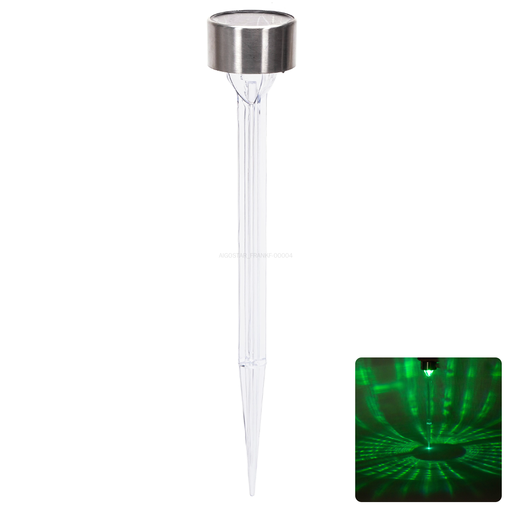
Why this product suits this profile: This compact solar stake light can be placed in soft lawn or flower-bed soil without cables, and provides RGB lighting for decorative accents.
The specifications state a charging time of 4–6 hours, a lighting time of 8–12 hours and an IP44 rating. This makes it easier to assess the charging conditions and where the light can be used.
RGB lighting, an integrated ground stake, automatic dusk sensor and a stated lighting time of 8–12 hours.
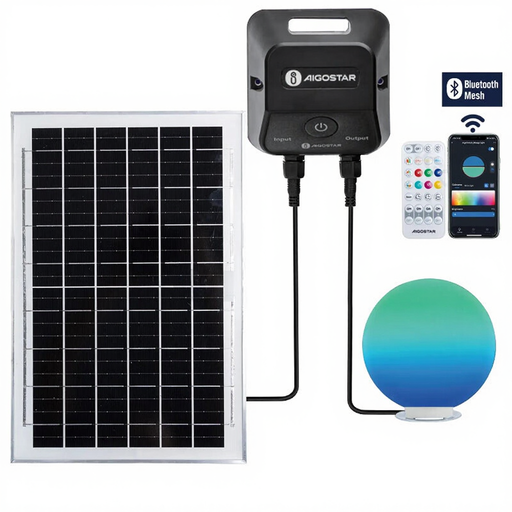
Why this product suits this profile: This floor-standing model combines RGB and white light with Bluetooth Mesh controls, making it suitable for larger patios or garden areas.
The product details specify IP65, an 8 Ah lithium battery and a charging time of 4–6 hours. This gives you a more precise basis for planning the location and run time.
Bluetooth Mesh for up to 200 connected devices, according to the product details; RGB, warm white and daylight modes; and a luminous flux of 350 lumens.
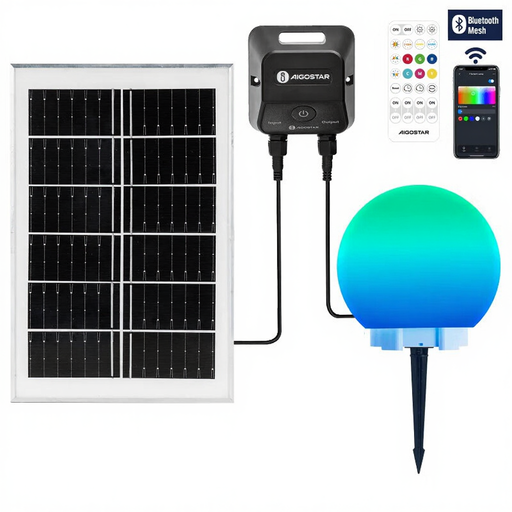
Why this product suits this profile: This smart solar ground light is designed for people who want to group several lights using an app, adjust colour temperatures or set schedules.
The control options are clearly specified: the AigoSmart app, Bluetooth Mesh and optional voice control via a hub. Make sure the IP54/IP44 protection ratings are suitable for the installation location.
RGB+CCT from 2700 to 6500 Kelvin, app control, and group and scheduling functions, according to the product description.
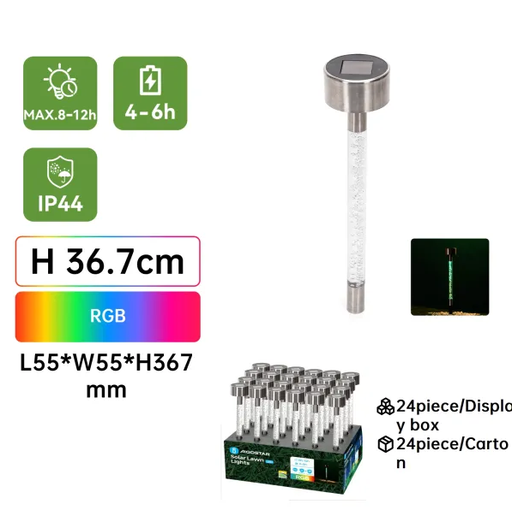
Why this product suits this profile: At 36.7 cm tall, the Bubble light adds colourful accents to flower beds, lawns or the edges of patios.
The product description clearly states the IP44 rating, an operating temperature range of -10 to 50 °C and the need for direct sunlight.
RGB lighting, a light weight of around 80 g, ground-stake installation and a stated lighting time of 8–12 hours.
We’ve put together a complete, regularly updated list of products that meet these strict selection criteria and fully comply with the safety regulations in force in the EU.
Choose a spot that gets as much direct sunlight as possible. The solar panel should face upwards and be clear of obstructions such as trees, buildings or garden furniture. Stake lights should be placed in soft soil or lawn. Before using your light for the first time, we recommend fully charging it in line with the manufacturer’s instructions.
Their lifespan depends on the housing, LED, battery, weather conditions and care. Some of the models mentioned are stated to have an LED lifespan of up to 15,000 or 30,000 hours. The battery is a consumable part and may lose capacity sooner. Clean the solar panel regularly with a soft cloth and avoid using abrasive cleaners.
They do not need a mains connection while in use and charge during the day through the solar panel. This means there are no ongoing mains electricity costs. However, you should still factor in the purchase price, possible replacement batteries and the proper disposal of the battery and electronic components.