
Lieferung heute & morgen

Qualitätsgarantie

Willkommens-Angebote freischalten: KOSTENLOSE Lieferung | Bis zu 80 % RABATT | Kostenlose 30-Tage-JoyPlus-Testphase
App herunterladen
Solar garden lights are a practical way to illuminate paths, flowerbeds or lawns without installing fixed wiring. However, solar lights can vary considerably in brightness, battery, materials and weather resistance. A decorative light with RGB colour-changing effects serves a different purpose from a warm white path light or permanently installed outdoor lighting.
Before you buy, it’s worth checking the technical specifications rather than relying solely on product images and marketing claims.
The IP44 rating means protection against solid objects larger than 1 mm and splashing water. It’s suitable for many sheltered outdoor areas, but it doesn’t mean the light is completely impervious to water or can be placed in puddles. For more exposed locations, solar ground lights with a higher IP rating are a better choice.
An IP65 light is protected against dust and water jets. It should still be used in accordance with the installation instructions. The IP rating doesn’t automatically indicate frost resistance, material quality or battery life.
Solar lights charge during the day using a solar panel. Shade from trees or walls, or an unsuitable orientation, reduces the energy available. Run times of 8 to 12 hours should therefore be understood as product specifications based on suitable conditions.
In winter in the UK, shorter days, cloudy weather and low temperatures can affect run time. An accessible solar panel, a suitable location and a regularly cleaned surface all help keep the light working effectively.
RGB solar lights and decorative bubble lights add splashes of colour, but they won’t necessarily provide bright enough illumination for steps, driveways or entrances. For paths, evenly spaced solar path lights or LED garden lights with suitable brightness are a better option. For a cosy atmosphere, look for warm white solar lights with a colour temperature of around 2700 to 3000 kelvin.
Check the battery type, capacity and stated charging time. The Aigostar models featured here use Ni-MH batteries. Depending on the model, the product specifications state a charging time of around 4 to 6 hours and a run time of 8 to 12 hours under suitable conditions.
The solar panel should face upwards and receive as many hours of direct sunlight as possible. For stake lights, it’s also important that the ground is soft enough. Don’t force the stake into compacted soil, as this could damage the housing or connection.
Solar stake lights can usually be pushed into lawns or loose soil without tools. Even so, check the dimensions and stability of the stake before buying. IP44 lights can be exposed to splashing water, but shouldn’t be left standing in water. A permanently installed, mains-powered light has different installation requirements from a cordless solar light.
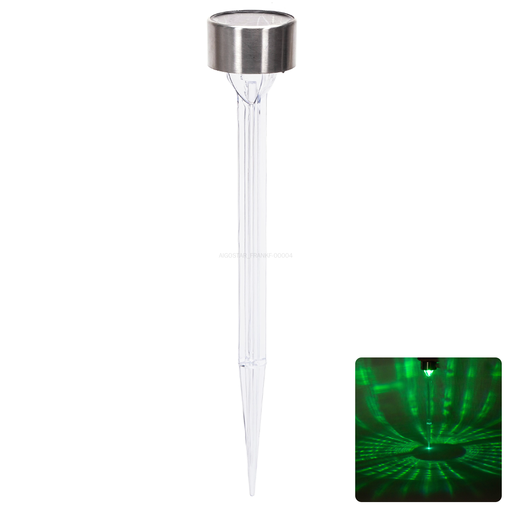
Why it suits this profile: This RGB stake light can be pushed into soft ground without a mains connection, making it a good choice for adding your first decorative touches along paths or in flowerbeds.
The specifications clearly state IP44, a charging time of 4–6 hours and a run time of 8–12 hours. This makes it easier to judge whether the light is suitable than relying on vague terms such as “weatherproof”.
RGB lighting, stainless steel finish, 200 mAh Ni-MH battery and automatic illumination in the dark, according to the product description.
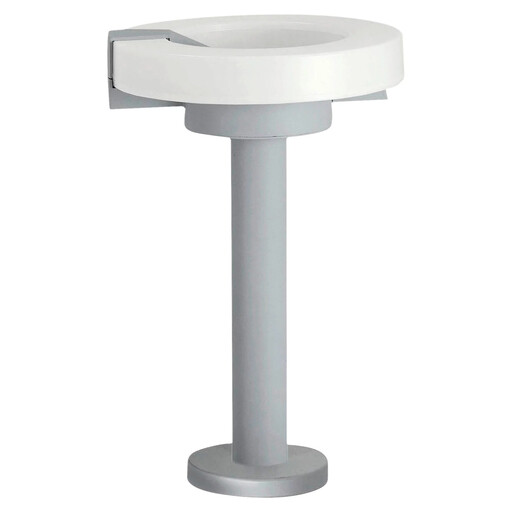
Why it suits this profile: This isn’t a solar light, but a mains-powered alternative for buyers who prefer permanently installed garden lighting with higher light output.
The product details clearly specify a mains connection, an integrated non-dimmable LED module and an E27 socket that needs to be fitted separately. This helps you avoid confusing it with cordless solar garden lights.
IP65 rating, 3000 K warm white light and 470 lumens, according to the product description. It also has an E27 socket rated up to 40 W; bulb not included.

Why it suits this profile: The cool white light at 6500 K is a good option if you want to make paths and flowerbed edges stand out clearly.
The colour temperature is clearly stated as 6500 K. The specifications also list IP44, a charging time of 4–6 hours and a run time of 8–12 hours, so you can choose a light that suits its location.
Ground-spike installation, a stated lifespan of 15,000 hours and a colour rendering index of Ra≥70, according to the product description.
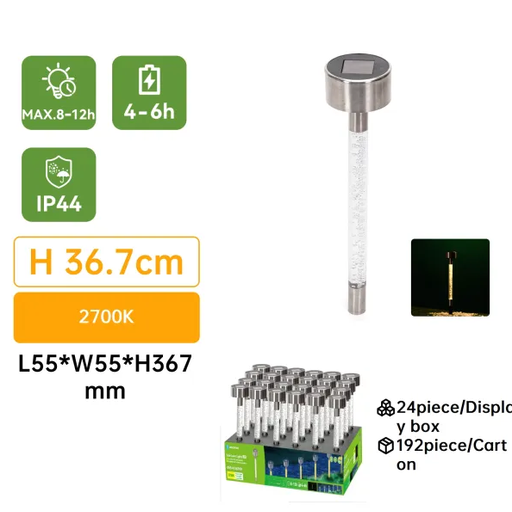
Why it suits this profile: The warm white colour temperature of 2700 K and bubble design work well on patios, in flowerbeds and in areas where decorative rather than functional lighting is what you need.
This light isn’t presented as a high-powered security light. Its stated output of 0,006 W, IP44 rating and 40 mAh capacity show that it’s designed primarily to provide decorative points of light.
2700 K warm white light, 36,7 cm tall, ground-spike design and a stated run time of 8–12 hours under suitable charging conditions.
We’ve put together a comprehensive, regularly updated list of products that meet these strict selection criteria and fully comply with the safety regulations in force in the EU.
Run time depends on the solar panel, battery, sunlight, temperature and light output. Several of the models featured here are stated to run for 8 to 12 hours under suitable charging conditions. In winter or during prolonged cloudy weather, the actual run time may be shorter.
This depends on the product specifications and IP rating. The Aigostar lights mentioned here are rated for an operating temperature range of -10 °C to 50 °C. Even so, they shouldn’t be left standing in water, and you shouldn’t continue using them if they’re damaged. If you’re storing a light for an extended period, keep it somewhere dry and sheltered.
During normal use, they get their energy from the solar panel and use a rechargeable battery. When choosing a light, the main things to consider are the battery type, capacity, charging time and location. A mains-powered light such as the Eglo model, on the other hand, needs a permanent electricity supply.