
Lieferung heute & morgen

Qualitätsgarantie

Willkommens-Angebote freischalten: KOSTENLOSE Lieferung | Bis zu 80 % RABATT | Kostenlose 30-Tage-JoyPlus-Testphase
App herunterladen
Solar garden lights don’t need a mains connection and can usually be installed without tools. However, not every model is right for every outdoor space. Unclear claims about how long lights stay on, an unsuitable installation spot or an IP rating that’s too low can all lead to disappointment.
Claims such as “up to 8–12 hours” assume suitable charging conditions. In the shade, on shorter days or under overcast skies, the actual run time may be shorter. So check:
The IP44 rating means protection against solid objects 1 millimetre or larger, as well as splashing water from different directions. It does not cover prolonged immersion or standing water. IP54 offers additional protection against harmful quantities of dust, but it is not suitable for submersion either.
So, when choosing weather-resistant garden lighting, don’t just look at the IP rating: consider where the light will be installed, too. A solar light under a roof is exposed to different conditions from one on an open lawn.
RGB solar lights produce coloured light for flower beds, lawns or patios. That doesn’t necessarily mean they’ll brightly illuminate paths. If you need practical lighting to help you find your way, also consider the light distribution, installation height and number of lights. For a more subdued atmosphere, warm white solar lights with a colour temperature of around 2700 Kelvin may be a better choice.
A solar panel made from monocrystalline, polycrystalline or amorphous silicon converts daylight into electrical energy. However, the panel type alone doesn’t tell you how long a light will actually stay on. Panel size, battery capacity, positioning and weather conditions all matter, too.
The models featured here use Ni-MH batteries or lithium batteries. A higher battery capacity can mean longer run times, provided the panel can recharge it with enough energy. Claims such as “4–6 hours charging time” and “8–12 hours run time” should be understood as manufacturer figures under suitable conditions.
Solar ground spike lights are suitable for soft ground, lawns and flower beds. Hard or heavily compacted soil can make them difficult to install. Don’t push the ground spike into the soil with excessive force, as this could damage the casing or connecting parts.
Also consider:
Solar ground lights or recessed models, on the other hand, need a suitably sized cut-out and a level surface. They’re less noticeable, but less flexible to install.
RGB lights offer changing colours or fixed shades. Warm white light feels more understated in many outdoor spaces. Depending on the model, RGB+CCT lights can switch between coloured light and different shades of white.
Smart solar lights with Bluetooth can offer app control, schedules and the option to group several lights together. They require a compatible smartphone app and a Bluetooth connection, and may also need a hub. Before you buy, check whether the control features you want are available without extra accessories.
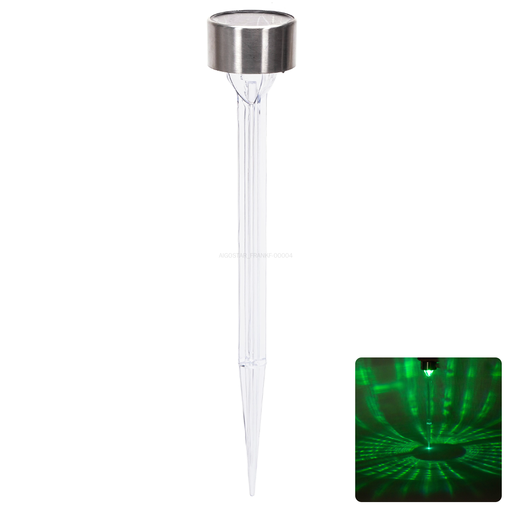
Why this product suits your needs: This compact ground spike light is a good choice if you want to add splashes of colour to paths, lawns or flower beds without any wiring.
The product description gives a charging time of 4–6 hours, a run time of 8–12 hours and an IP44 rating, making it easier to understand the light’s limitations.
RGB light, integrated ground spike, polycrystalline solar panel and automatic switching on at dusk and off at dawn.
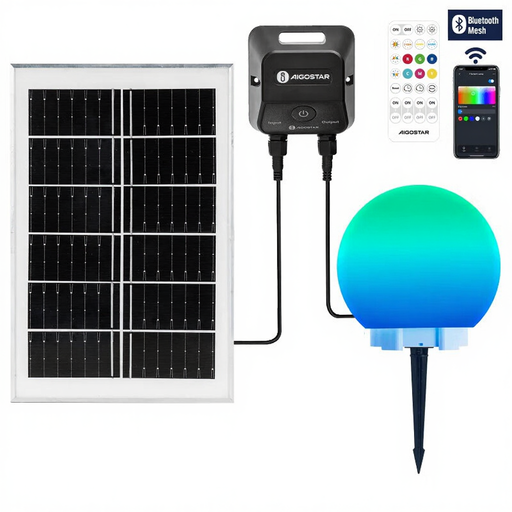
Why this product suits your needs: For larger outdoor spaces or anyone looking for centralised control, this model combines solar power with Bluetooth Mesh and RGB+CCT lighting options.
The product information mentions app control, schedules and grouping. It also lists IP54 and IP44 ratings, so check the specific rating before installation.
RGB+CCT with a stated range of 2700 to 6500 Kelvin, Bluetooth Mesh and control via the AigoSmart app.
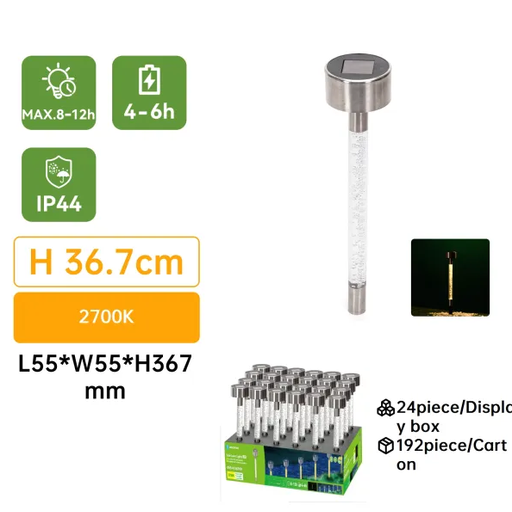
Why this product suits your needs: The warm white light at 2700 Kelvin is well suited to decorative lighting around flower beds, paths and patios if coloured effects aren’t a priority.
The specifications list 2700 Kelvin, IP44, a charging time of around 4–6 hours and a run time of 8–12 hours under suitable conditions.
Warm white light, a height of 36.7 centimetres, an integrated Ni-MH battery and a decorative bubble design.
Where possible, place solar garden lights somewhere that gets several hours of direct daylight. Before first use, charge the battery according to the product instructions. Clean the solar panel regularly with a soft, dry cloth. Remove leaves, dust and pollen without using harsh cleaning products.
If there’s frost, unusually heavy rain or a long period when the lights won’t be used, storing them somewhere sheltered may be a good idea. Don’t open or modify the battery. Electronic components and batteries must be disposed of in line with local requirements.
We’ve put together a comprehensive, regularly updated list of products that meet these strict selection criteria and fully comply with the safety regulations in force in the EU.
It depends on the panel, battery, intensity of the sunlight and positioning. The models mentioned are listed as taking around 4–6 hours to charge. On cloudy days or in a shaded spot, less energy may be available.
An IP rating describes protection against certain external factors, but it doesn’t guarantee unlimited resistance to winter weather. Check the stated operating temperature and protect the light from standing water, ice and very low temperatures. Some of the models mentioned are listed as operating between -10 and 50 °C.
While switched on, they draw energy from the battery, which is charged by the solar panel during the day. They don’t need to be connected to the mains. Ongoing costs are mainly limited to possible replacement parts or replacing the battery later on.