
Lieferung heute & morgen

Qualitätsgarantie

Willkommens-Angebote freischalten: KOSTENLOSE Lieferung | Bis zu 80 % RABATT | Kostenlose 30-Tage-JoyPlus-Testphase
App herunterladen
Solar garden lights don’t need a mains connection and can usually be placed in the ground without tools. However, models vary considerably in light colour, charging performance, design and protection against moisture. If you focus only on decorative design or an especially long run time, you could end up with a light that doesn’t work reliably in your garden.
This guide explains which details really matter when choosing solar lights for your garden, and which features suit different uses.
Claims such as ‘8–12 hours of run time’ assume suitable conditions. A solar panel needs direct sunlight, or at least plenty of bright daylight. Shade from trees, walls or a covered patio can increase charging time or reduce how long the light stays on at night.
Before you buy, check:
IP44 means protection against solid objects above a certain size, as well as splashing water from different directions. This rating is suitable for many outdoor LED solar lights, but it doesn’t mean the product can be left underwater or placed in a pond.
Take extra care if you plan to position a light low in the lawn, in a waterlogged flower bed or somewhere it will regularly be hit by a sprinkler. Always follow the installation instructions and the product’s specific safety guidance.
Solar lights with RGB colour-changing features create decorative effects, but they aren’t necessarily suitable for clearly marking out a path. Warm white light at around 2700 Kelvin tends to feel more subtle and works well around seating areas, flower beds and patios. Cool white light at 6500 Kelvin looks much more neutral to bluish and can create a different effect along paths or by entrances.
It’s also worth keeping the light output in perspective: many solar ground lights are designed to provide guiding and accent lighting, not to fully illuminate large areas.
For a subtle atmosphere, choose solar lights with warm white light. A colour temperature of 2700 K is often perceived as warm. Cool white light at 6500 K can make the edges of paths stand out more, but has a less soft appearance.
Solar lights with RGB colour-changing features are a good choice if you want to add colour to flower beds, lawns or a patio. Before buying, check whether the lights change colour automatically or stay on a fixed colour. The product description should also clearly distinguish between decorative and functional lighting.
A stated charging time of, for example, 4–6 hours assumes a suitable location with enough sunlight. Ni-MH batteries are commonly used in many small solar lights. The following details are useful to check:
Actual run time may vary in cloudy weather or during winter. This isn’t a fault with an individual model, but a result of the limited solar energy available.
Solar stake lights should be sturdy enough for the ground they’re intended for. Hard, compacted soil can put pressure on the ground stake as you push it in. In this case, loosen the soil first rather than forcing the light into the ground.
Also check:
Compact models are often easier to space evenly along paths and in flower beds. Larger lights can make more of a visual statement on lawns or beside patios.
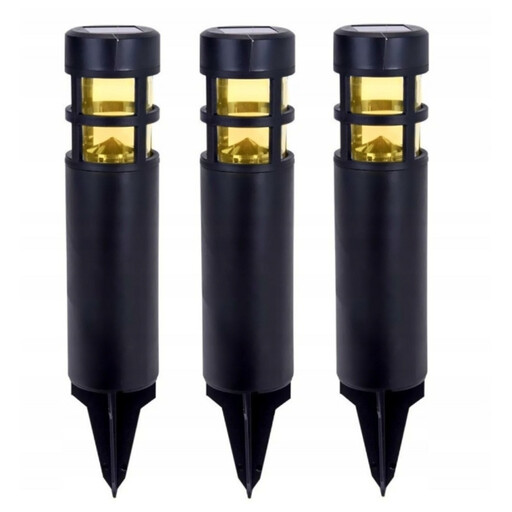
Why this product suits you: The set includes three solar lights, making it a good choice if you want to light several areas, such as a flower bed, path or lawn edge, without buying each light separately. They’re designed to switch on automatically at dusk for straightforward use.
The product description recommends placing the lights in direct sunlight and explains that they switch on and off automatically. This makes the key conditions for use clear.
Three lights per set; no mains connection needed and minimal installation required.
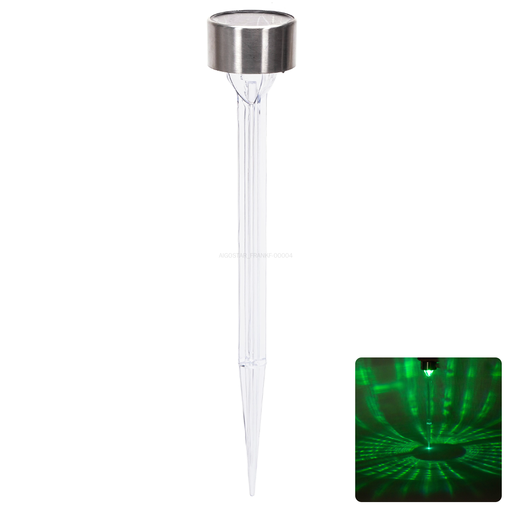
Why this product suits you: Its stainless steel finish, RGB feature and ground installation will appeal if you value clearly specified product details and want to add a decorative touch to your garden paths.
The product details include charging time, run time, battery type, dimensions and an IP44 rating. This makes it easier to check whether the light is suitable than relying on design details alone.
RGB lighting, a stated charging time of 4–6 hours, a run time of 8–12 hours and an IP44 rating.
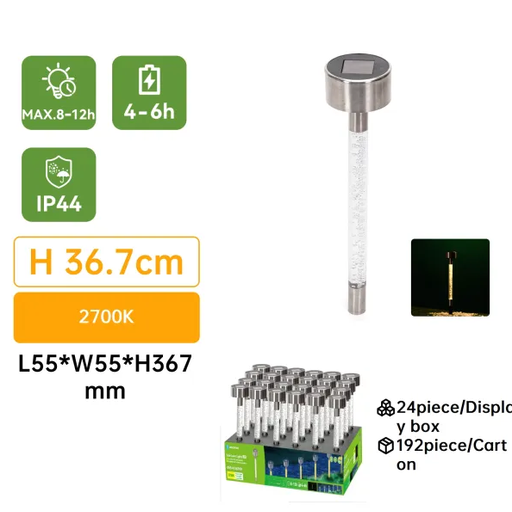
Why this product suits you: The warm white light at 2700 K is well suited to flower beds, paths and seating areas where you want a more subtle lighting effect.
The stated colour temperature sets clear expectations about the light colour. The product details also include charging time, run time, dimensions and an IP44 rating.
Warm white light at 2700 K, IP44 rating, automatic dusk switch and a stated run time of 8–12 hours.
Place solar garden lights somewhere they’ll get as much direct sunlight as possible. Insert the ground stake into soft, reasonably stable soil. If the ground is clayey or dry, loosening it beforehand can make installation easier.
Clean the solar panel regularly with a soft, slightly damp cloth. Dust, pollen and other deposits can reduce the area available for charging. Lights with an IP44 rating should not be left standing in water. Don’t continue using lights with damaged casings or ground stakes, or with damaged cables where applicable. Dispose of batteries and electronic components in accordance with local guidelines.
We’ve put together a complete, regularly updated list of products that meet these strict selection criteria and fully comply with the safety regulations in force across the EU.
Choose a spot that gets several hours of direct sunlight wherever possible. Point the panel upwards and make sure it isn’t shaded by trees, buildings or coverings. After charging for the first time, many models switch on automatically at dusk.
Lifespan depends on the LED, battery, weather, care and seasonal sunlight. A stated LED lifespan of, for example, 15,000 hours doesn’t necessarily indicate the light’s total working life. The battery may lose capacity sooner and should only be replaced if the product description says it can be.
Solar garden lights draw power from the battery charged during the day and don’t need to be connected to the mains. This means there are no ongoing electricity costs from a plug socket during normal use. However, how long they stay lit depends on sunlight, charge level, temperature and battery condition.