
Lieferung heute & morgen

Qualitätsgarantie

Willkommens-Angebote freischalten: KOSTENLOSE Lieferung | Bis zu 80 % RABATT | Kostenlose 30-Tage-JoyPlus-Testphase
App herunterladen
Solar garden lights provide cordless outdoor garden lighting without the need to install an electrical connection. They’re suitable for flowerbeds, lawns, garden paths, driveways and patios. Before you buy, though, it’s worth checking the technical details and limitations of each light. A decorative light may work well along a garden path, but that doesn’t automatically make it suitable as security lighting for a driveway.
Claims such as ‘8–12 hours’ generally assume suitable charging conditions. In the shade, during overcast weather or in winter, less energy will be available. A dirty solar panel can also reduce charging performance. So check whether your chosen spot gets several hours of direct sunlight each day.
The IP44 rating indicates protection against solid objects larger than 1 mm and splashing water. An IP44 light shouldn’t be left standing in water or exposed to heavy rain for prolonged periods. For exposed locations, areas that are frequently splashed or permanent outdoor installations, a higher rating such as IP65 may be more suitable.
Some solar garden stake lights have a stainless-steel look created by applying a silver-coloured finish to plastic. This can make them lighter and easier to handle, but it’s not the same as a casing made entirely from stainless steel. If you’re looking for durable garden lighting, consider the stated material, weight and IP rating together.
Colour temperature is measured in kelvins:
Choose a light colour that suits the intended use. Warm-white LEDs are often more subtle for gentle garden path lighting, while RGB lights can add a splash of colour for special occasions or as an eye-catching feature.
As well as the IP rating, check the operating temperatures stated by the manufacturer. According to the product details, several of the following Aigostar models are designed for temperatures from -10 °C to 50 °C and have an IP44 rating. This indicates that they’re intended for outdoor use, but it doesn’t replace choosing a sheltered location or checking them regularly.
When choosing solar lights for outdoor use, consider the following:
Decorative LED solar lights usually have a low wattage. When choosing one, operating time, panel details, light colour, IP rating and positioning matter more than the wattage alone.
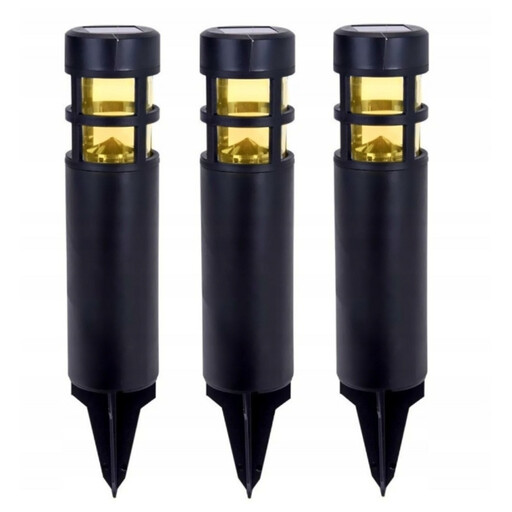
Why this product suits this profile: This set of three lights is a simple way to illuminate paths, flowerbeds or lawn edges. They’re easy to install and don’t require fixed wiring.
The product description clearly states the number of lights and their basic use, making it easier to work out how many you’ll need for a short stretch of path.
Three lights in one set; place them in a sunny spot; according to the product details, they switch on automatically at dusk.

Why this product suits this profile: This model is worth considering if you like to compare details such as light colour, charging time and IP rating before buying.
The product details specify a plastic body with a stainless-steel finish, an IP44 rating and the intended temperature range. This makes it clear that the finish shouldn’t be mistaken for solid stainless steel.
According to Aigostar’s product details: a polycrystalline solar panel, a charging time of around 4–6 hours and 8–12 hours of light in suitable conditions; 6500 K colour temperature.
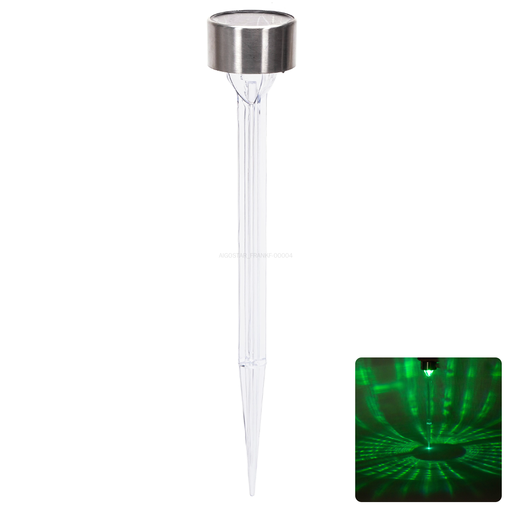
Why this product suits this profile: RGB solar lights are a good choice if you want to add changing splashes of colour to garden paths, flowerbeds or lawns.
The description states that it has an RGB function and gives its dimensions and IP44 rating. This helps you check in advance that its appearance and intended location are a good match.
According to Aigostar’s product details: RGB lighting, a 200-mAh NiMH battery, a charging time of 4–6 hours and 8–12 hours of light in suitable conditions.
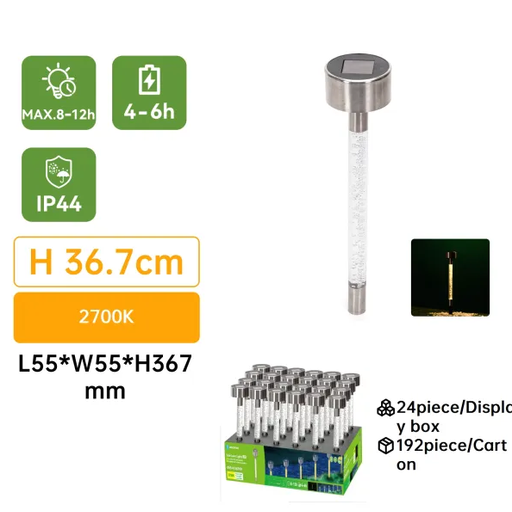
Why this product suits this profile: Its warm-white colour temperature of 2700 K makes it a good fit for decorative areas such as flowerbeds, seating areas and garden boundaries.
The light colour is clearly stated as 2700 K, so you can tell it apart from cool-white models before placing it in your garden.
According to Aigostar’s product details: 2700 K, IP44, compact dimensions of 55 × 55 × 367 mm and a stated operating time of 8–12 hours in suitable charging conditions.
We’ve put together a complete, regularly updated list of products that meet these strict selection criteria and fully comply with the safety regulations applicable in the EU.
Place the solar panel where it can get as much direct sunlight as possible, away from shade cast by buildings, trees or walls. Carefully push the ground spike into soft soil. If the ground is hard, it’s best to make a hole first rather than forcing the light into the ground.
Lifespan depends on the LED module, battery, charging conditions and care. According to the product details, the Aigostar models mentioned here have a stated lifespan of up to 15,000 hours. The battery is a separate wear part and may lose capacity sooner, depending on use and weather conditions.
Solar lights use energy from the sun during the day and don’t need to be connected to the mains. This means they generally have no ongoing electricity costs. You should still factor in the purchase price, possible replacement batteries and proper disposal of the light and battery in line with local requirements.