
Lieferung heute & morgen

Qualitätsgarantie

Willkommens-Angebote freischalten: KOSTENLOSE Lieferung | Bis zu 80 % RABATT | Kostenlose 30-Tage-JoyPlus-Testphase
App herunterladen
Solar garden lights let you illuminate your outdoor space without fixed wiring or electrical work. However, not every light is right for every location. If you focus only on design or a high quoted number of hours, you could overlook important details such as the battery, IP rating and installation.
Claims such as “up to 8–12 hours” usually apply under suitable charging conditions. In autumn, during prolonged cloudy weather or in a shady garden, the battery may store considerably less energy. A solar light under a tree or on the north side of the house often won’t get enough direct sunlight.
So check:
The IP rating describes protection against solid objects and water. IP44 includes protection against splashing water, but not against prolonged immersion. This rating may be suitable for ordinary paths, flowerbeds and lawns, provided water doesn’t collect around the light.
A light with IP67 is also protected against dust and is designed to withstand temporary immersion under the conditions set out in the standard. However, that doesn’t automatically make it resistant to frost, mechanical damage or incorrectly fitted cables.
RGB solar lights and colour-changing garden lights are best suited to decorative accents. For an entrance or a longer path, what matters is whether the light is bright enough and offers a suitable colour temperature. Coloured LEDs can create a lovely atmosphere, but they don’t automatically replace functional solar path lighting.
When choosing LED solar lights, check the actual light output as well as the colour temperature. A wattage figure alone doesn’t tell you exactly how bright a light will appear. If the lumen rating is provided, it makes it easier to compare products.
Check the battery type, capacity and stated charging time. Small Ni-MH batteries are common in compact solar stake lights. A larger lithium battery can store more energy, depending on the product design, but it isn’t the only factor that determines how long a light will stay on.
Always consider these details alongside the solar panel. A high-capacity battery needs enough solar energy to recharge fully on a regular basis.
Solar ground lights and stake lights can usually be pushed into soft soil without tools. If the ground is compacted, prepare the area first rather than forcing the stake into the ground. These models are often better suited to lawns, flowerbeds and loose soil than to hard, paved surfaces.
With plastic housings in a stainless-steel finish, check whether the light has a genuine metal construction or simply a decorative surface. Weight can also matter: lightweight models are easy to move, but may need a more stable footing in soft or windy conditions.
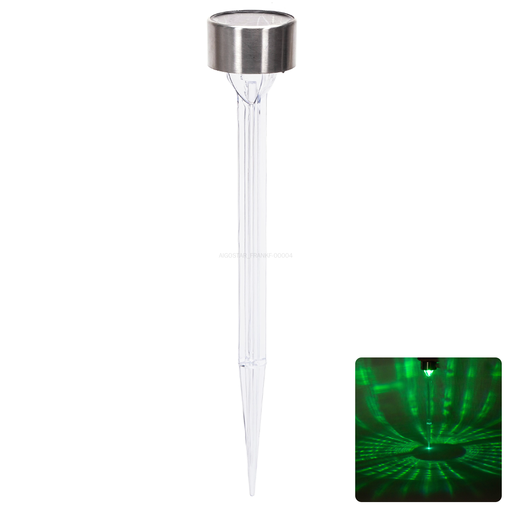
Why this product suits these needs: This compact RGB stake light is designed for anyone looking to add colourful accents to paths, lawns or flowerbeds without fixed wiring.
The product details state a charging time of 4–6 hours, a run time of 8–12 hours and an IP44 rating. This helps you set more realistic expectations based on the location and weather.
RGB lighting, an integrated ground stake, a 200 mAh Ni-MH battery and dimensions of 55 × 55 × 320 mm.
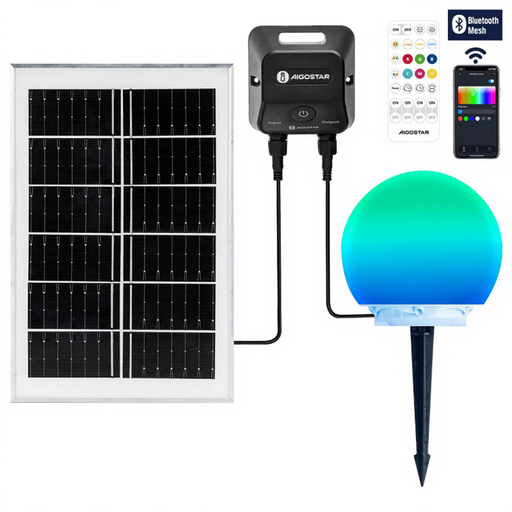
Why this product suits these needs: This model is for anyone looking to incorporate a recessed solar ground light with adjustable colour and app control into their garden design.
The separate panel and light allow you to position the panel more flexibly to catch the sun. The stated IP67 rating is designed for more demanding outdoor settings.
RGBCCT lighting from 2700 K to 6500 K, a 4000-mAh lithium battery, a 5-W solar panel and Bluetooth Mesh control, according to the product details.
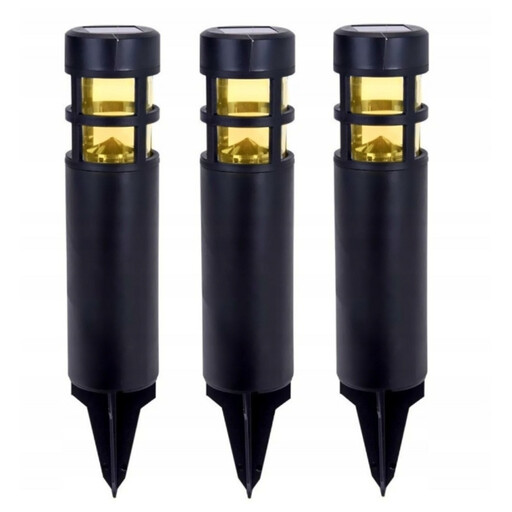
Why this product suits these needs: This three-piece solar light set is a good choice if you want to give several areas, such as stretches of path, flowerbed edges or garden borders, a coordinated look.
The pack size is clearly stated before you buy. This means you don’t need to select several individual items when you’re planning an even spread of lights around your outdoor space.
Three solar lights, automatic activation at dusk and installation without a fixed power connection, according to the product description.
We’ve put together a complete, regularly updated list of products that meet these strict selection criteria and fully comply with the safety regulations in force in the EU.
It depends on the panel size, battery capacity, time of year and location. Many compact models quote a charging time of around 4–6 hours in suitable conditions. Before using a light for the first time, leave the panel in direct sunlight for as long as possible. Dirt, shade and short winter days all reduce the amount of energy available for charging.
You’ll need to check the details for each product. The IP rating, stated temperature range and manufacturer’s guidance are all important. With IP44 models, avoid places where water can collect. Don’t continue using lights that are damaged or have swollen housings.
During normal use, solar garden lights get their energy from the integrated panel, so there are no electricity costs for a fixed mains connection. However, you may need to factor in replacement batteries, wear parts and the proper disposal of batteries and electronic components.