
Lieferung heute & morgen

Qualitätsgarantie

Willkommens-Angebote freischalten: KOSTENLOSE Lieferung | Bis zu 80 % RABATT | Kostenlose 30-Tage-JoyPlus-Testphase
App herunterladen
Solar garden lights don’t need a fixed mains connection and can usually be set up without tools. However, garden solar lights vary considerably in colour temperature, battery capacity, materials and weather resistance. If you focus only on the design or how long they stay lit, you could overlook important details.
Three things are particularly likely to lead to a disappointing purchase:
Many of the models in this selection list a charging time of around 4 to 6 hours and a lighting time of 8 to 12 hours. These figures depend on direct sunlight, the time of year, the panel’s position and the battery’s charge level.
For solar path lighting, position the lights so that the solar panel faces upwards and remains unshaded for as many hours as possible. In winter, or after several overcast days in a row, the lighting time may be shorter. Before first use, it’s a good idea to charge the light fully, following the manufacturer’s instructions.
For outdoor LED solar lights, the IP rating is a key consideration. IP44 is suitable for many sheltered outdoor areas, such as lawns, flower beds, patio edges and garden paths. However, the lights shouldn’t be placed in puddles or exposed to heavy water for extended periods.
The specified temperature range is also relevant. According to the product details, several Aigostar models in this selection are designed for -10 °C to 50 °C. If the casing, solar panel or ground stake is damaged, stop using the light.
Also check the actual material stated in the product details. A silver finish with a stainless steel look may be made of plastic. That isn’t necessarily a drawback, but it should be clear before you buy.
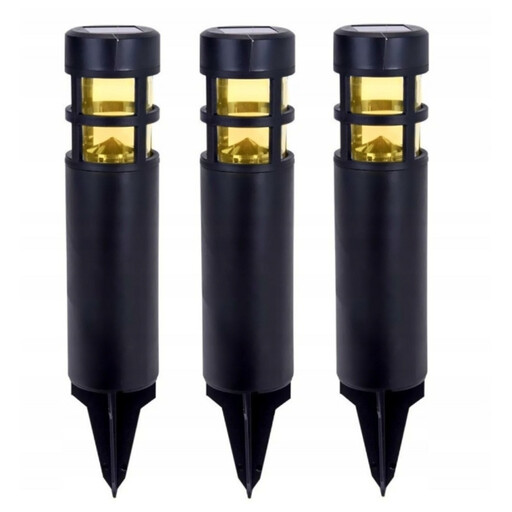
Why this product suits this profile: The set includes three lights for small flower beds, lawn edges or a short garden path, and is designed for straightforward installation.
The product details mention automatic switching on at dusk and recommend a sunny location. This helps you avoid the most common charging mistake before installation.
Three lights in one set, solar charging and automatic switching on at dusk.
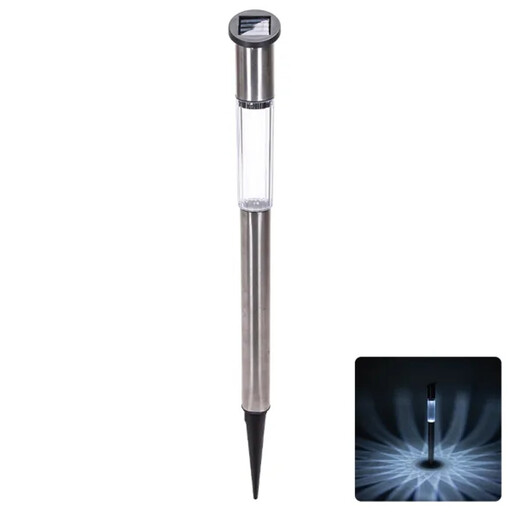
Why this product suits this profile: Its stated colour temperature of 6500 K and stake-light design make it a good fit for clearly marking paths and property boundaries.
The product details distinguish between the plastic construction and the stainless steel look, so you can get a realistic idea of its appearance.
6500 K light, IP44 rating, NiMH battery and a stated lighting time of 8 to 12 hours.
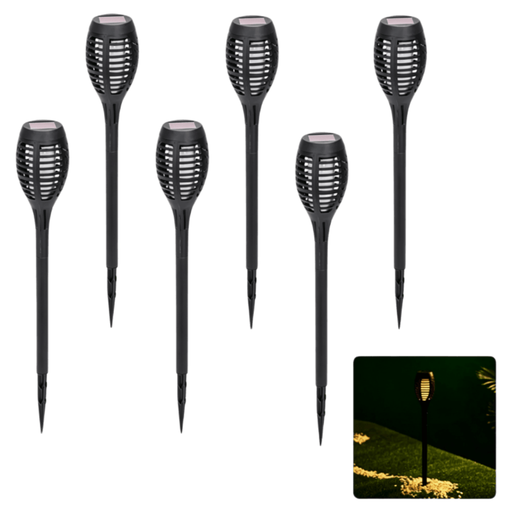
Why this product suits this profile: The set of six is designed for larger lawns, paths, patio edges or regular decorative use.
The flame effect is presented as decorative lighting, not as a full solution for illuminating paths. The IP44 rating is also clearly stated.
Set of six, warm white 2700 K lighting, a charging time of 4 to 6 hours and a stated lighting time of 8 to 12 hours.
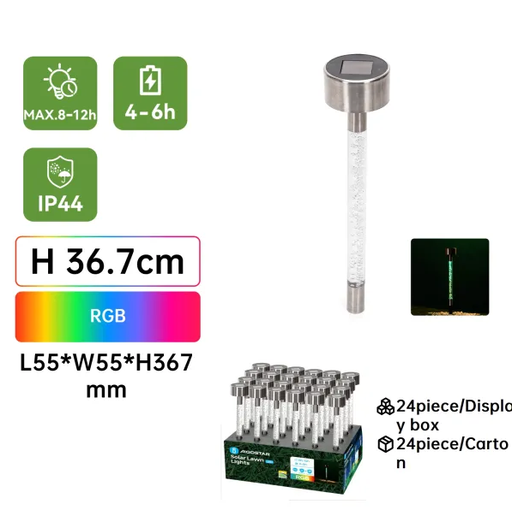
Why this product suits this profile: Its RGB function and bubble design make it well suited to flower beds, lawns and patios where colourful styling takes centre stage.
The product details list a compact height of 36.7 cm and an output of 0.006 W. This makes it clear that the light is a decorative accent, rather than a powerful way to illuminate a large area.
RGB lighting, ground stake installation, IP44 rating and a stated lighting time of 8 to 12 hours when charged in suitable conditions.
We’ve put together a comprehensive, regularly updated list of products that meet these strict selection criteria and fully comply with the safety regulations in force in the EU.
Several of the models mentioned have a stated LED lifespan of up to 15,000 hours. The battery is a separate part that wears out, and its capacity may decrease over time depending on charging cycles, temperature and use. That’s why it isn’t possible to give a single lifespan that applies to every light.
They don’t need to be connected to the mains during normal use, as the battery charges via the solar panel during the day. This means there are no ongoing mains electricity costs. However, you may incur additional costs if you need to replace the battery or the light later on.
Choose open, preferably sunny spots along paths, by flower beds and lawns, or around the edges of patios. Avoid areas that stay in the shade and places where water collects. For practical path lighting, you should also plan an even distance between each light.