
Lieferung heute & morgen

Qualitätsgarantie

Willkommens-Angebote freischalten: KOSTENLOSE Lieferung | Bis zu 80 % RABATT | Kostenlose 30-Tage-JoyPlus-Testphase
App herunterladen
Solar garden lights are a practical option for beds, paths, lawns and patios without a permanent mains connection. Installation is usually cable-free, and a dusk sensor switches the light on automatically. Even so, solar garden lights differ significantly in brightness, battery, weather resistance and the way they light an area.
If you focus only on a decorative housing or a long claimed run time, you can easily end up with a product that doesn’t work reliably in the intended spot. The following points will help you compare solar outdoor lights objectively and avoid common mistakes.
Statements such as “8–12 hours” or “up to 24 hours” refer to suitable charging conditions. In shade, during short days, when it’s cloudy or if the solar panels are dirty, the actual lighting time can be lower. A small battery also stores less energy than a larger, higher-capacity one.
So pay attention to the combination of battery capacity, charging time, solar panel type and the location. A solar light with a ground spike should not be placed directly under a tree, next to a tall hedge or against a house wall that is permanently in shade.
The rating IP44 means protection against solid foreign objects from 1 millimetre and against splashing water from various directions. That’s suitable for many sheltered outdoor areas, but it does not replace protection against continuous immersion or standing water.
For in-ground solar lights in a dip, or areas with frequent splashing, IP67 may be the better choice. This rating also indicates dust tightness and protection against temporary submersion. The specific installation instructions and the manufacturer’s information still apply.
RGB solar lights switch between several colours depending on the model and are particularly suitable for decorative garden lighting. For steps, front doors or longer paths, however, even, clearly recognisable lighting is more important. Warm white solar lights at around 2,700 Kelvin feel more subtle and atmospheric, while cool white light at around 6,500 Kelvin creates a distinctly cooler impression.
Before you buy, decide whether the light is primarily decorative, for wayfinding, or for both purposes.
The IP rating should match the intended area of use:
LED solar lights require comparatively little energy and are available in different light colours. Warm white light is often around 2,700 to 3,000 Kelvin. Cool white light can be more noticeable for path guidance. RGB models offer colour changes, but aren’t always the right choice for even illumination.
Also consider the form factor: solar path lights with a ground spike suit softer soils, while in-ground solar lights or recessed spots for solid surfaces require an appropriate cut-out and a stable base.
An integrated Ni-MH battery is specified for several products in this selection. Capacity and charging conditions are crucial. For example, some Aigostar models cite 4–6 hours of charging time and 8–12 hours of illumination. According to the product information, these values depend on sunlight exposure.
Models with a separate solar panel can be oriented more flexibly. That’s relevant for patios, courtyards or gardens with partially shaded areas.
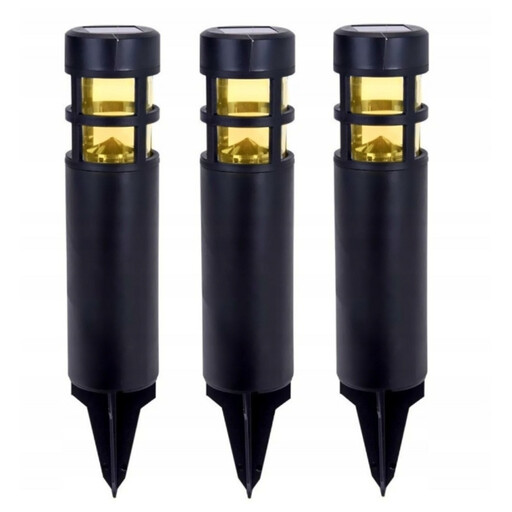
Why this product suits the profile: The set of three solar lights provides a straightforward starter kit for beds, lawn edges or short paths. Installation is designed for use without a fixed mains supply.
The product details specify automatic dusk activation and placement in direct sunlight. That clearly sets out the basic operating conditions.
Three lights per set; automatic dusk switch; suitable for paths, gardens and borders.
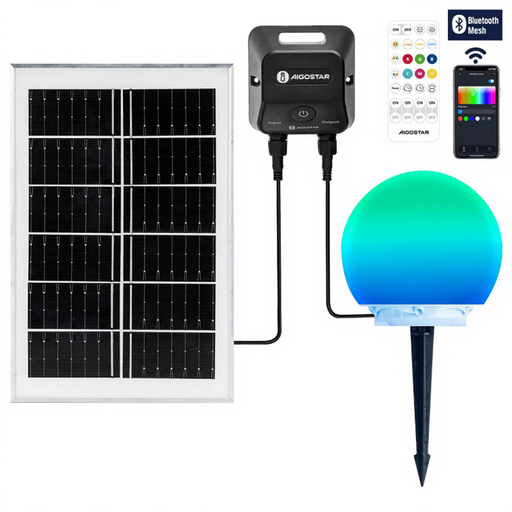
Why this product suits the profile: This recessed spot is aimed at users who want to fine-tune light colour and control. According to the product description, it offers RGB plus adjustable white from 2,700 to 6,500 Kelvin.
The stated IP67 rating is clearly indicated. The separate solar panel can be aligned independently of the light body, which can help where there’s partial shade.
IP67; 4,000 mAh lithium battery according to the product information; Bluetooth Mesh control; RGB and white light options.
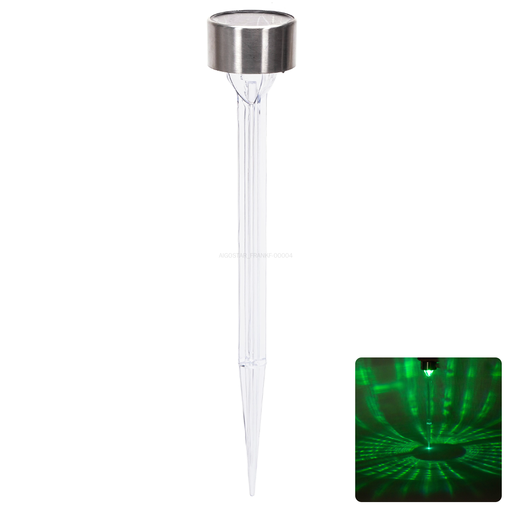
Why this product suits the profile: This solar light with ground spike is intended for lawns, beds and garden paths. The RGB lighting is ideal for changing decorative accents without any cabling.
The product description explicitly states IP44 and notes that the light must not be submerged in water. That prevents it being misinterpreted as a fully waterproof model.
RGB lighting; charging time of around 4–6 hours; stated run time of 8–12 hours; simple ground spike.
Place the solar panel in direct sunlight wherever possible, and keep it free of leaves, dust and persistent shade. With solar path lights, ensure the ground spike is fully inserted and stable in the soil. Loose soil can shift in frost or heavy rain. In-ground solar lights require a level, load-bearing installation point.
Clean the panel surface regularly with a soft, slightly damp cloth. Do not use abrasive cleaners. For models with a Ni-MH battery, the battery must not be opened or modified. Faulty lights and batteries must be disposed of in accordance with the applicable regulations for waste electrical and electronic equipment and batteries.
We’ve compiled a complete, continuously updated list of products that fully meet these strict selection criteria and the safety regulations applicable in the EU.
Many models require around 4–6 hours of charging under suitable conditions, according to the product information. In winter or with heavy cloud cover, the stored energy may be lower. The exact value depends on the solar panel, battery, location and daily sunlight.
IP44 solar lights are protected against splashes, but they’re not designed for continuous submersion. For damp installation sites or areas where water can pool, a light with IP67 may be more suitable. Always follow the installation instructions.
No. Solar lights charge their integrated battery via the solar panel and don’t need a fixed mains connection. There are no ongoing costs as with mains-powered lamps. However, the battery is a wear part and may lose capacity over time depending on the model and usage.