
Lieferung heute & morgen

Qualitätsgarantie

Willkommens-Angebote freischalten: KOSTENLOSE Lieferung | Bis zu 80 % RABATT | Kostenlose 30-Tage-JoyPlus-Testphase
App herunterladen
Solar garden lights promise easy installation without electrical cables. However, it’s often only after buying one that you find out whether it gets enough charge in its intended spot, stays securely in place and gives the effect you want. Vague product descriptions can quickly lead to a poor choice, particularly for garden paths, flower beds, lawns and patios.
Claims such as ‘lights up all night’ usually apply only in suitable charging conditions. In shade, under cloudy skies or in winter, the solar panel receives less energy. How long the light actually stays on also depends on the battery capacity, panel type and ambient temperature.
Look for specific details about charging time, operating time and battery type. A stated operating time of 8 to 12 hours is a guide, not a guarantee in all weather conditions.
An IP44 solar light is protected against solid objects 1 millimetre or larger and splashing water from different directions. However, it is not designed to stand in water for long periods or to be fully submerged. A higher rating may be more suitable for exposed areas.
Also check that the light is approved for the temperature range where you plan to use it. For some models, for example, this is between -10 °C and 50 °C.
A cool white solar garden light at 6500 Kelvin looks noticeably crisper than a warm white solar light at 2700 Kelvin. Warm white is often chosen to create a decorative atmosphere on a patio or in a flower bed. Cool white can give solar garden path lighting a different visual effect.
RGB lighting isn’t automatically suitable for every area, either. An RGB solar light adds splashes of colour, but won’t necessarily provide even lighting to help you find your way.
When choosing garden lights with solar panels, consider these three details together:
For solar lights for flower beds and paths, choose a spot that gets as much direct sunlight as possible. Decorative models can also be used in less sunny areas, but expect them to stay lit for less time.
The IP code tells you the light’s protection rating. The first digit describes protection against solid objects, while the second refers to protection against water. IP44 is suitable for many sheltered outdoor areas and protects against splashing water. For locations that are exposed to the elements, check the manufacturer’s guidance carefully.
Materials such as stainless steel can affect the look, while plastic keeps the weight down. The stability of the ground spike is also important. Hard, compacted soil can make installation more difficult. Push spike lights into soft soil or a lawn, and don’t force them into stony ground.
Colour temperature is measured in Kelvin:
For simply marking a path, a subtle outdoor solar LED light is often enough. A driveway or larger seating area may need a brighter light and a more secure installation. Bear in mind that brightness in lumens is only useful for comparison when the beam angle and light shape are similar.
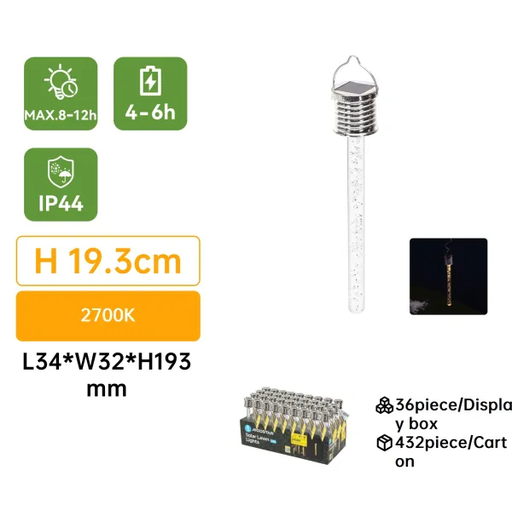
Why it suits this shopper: This compact solar garden light is ideal for small flower beds, lawns or decorative accents. Its warm white 2700 Kelvin light creates a subtle effect.
The product details state a charging time of around 4–6 hours, an operating time of 8–12 hours and an IP44 rating. This makes it easier to match the light to its location and set realistic expectations.
2700 Kelvin light, an integrated 40 mAh Ni-MH battery and a lightweight design at just 40 g. The stated dimensions are 34 × 32 × 193 mm.
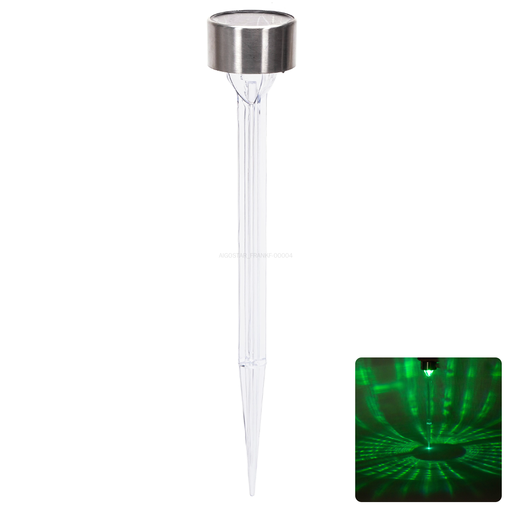
Why it suits this shopper: Its larger housing and ground spike make it a good choice for longer garden paths, lawn edges and decorative lighting you use regularly. The RGB function adds splashes of colour.
The product details clearly state the IP44 rating and specify that the light should be placed in soft soil in direct sunlight. It is therefore not designed to stand in water.
RGB light, a 200 mAh NiMH battery, a polycrystalline solar panel and a stated operating time of 8–12 hours after 4–6 hours of charging.

Why it suits this shopper: The cool white 6500 Kelvin light may be a good choice for clearly marked paths, flower bed edges and driveways when you want a crisp, practical effect.
The technical details give specific charging and operating times, as well as the IP44 rating. They also recommend cleaning the panel regularly with a soft, damp cloth.
6500 Kelvin light, a polycrystalline solar panel, a NiMH battery and ground spike installation with no fixed electrical wiring required.
We’ve put together a complete, regularly updated list of products that meet these strict selection criteria and fully comply with the safety regulations in force in the EU.
Position each solar light so that its panel gets as many hours of direct daylight as possible. Before installing it, check that trees, walls or garden furniture won’t block the sunlight. For models with ground spikes, the soil needs to be soft enough; forcing the spike into the ground can damage it or the housing.
Clean the solar panel regularly with a soft cloth. Don’t use abrasive cleaners. If the light is exposed to frost, damaged or visibly damp inside the housing, stop using it. Dispose of batteries and electronic components in line with local requirements when replacing them.
Many models state a charging time of around 4 to 6 hours. The actual charging performance depends on direct sunlight, shade, the time of year and how clean the panel is. Before using the light for the first time, it’s a good idea to charge it fully as instructed by the manufacturer.
Under suitable conditions, many lights are stated to run for 8 to 12 hours. They may stay on for less time in cloudy weather, with limited sunlight or at low temperatures. So check not only the operating time, but also the panel type and battery capacity.
Not all weather-resistant outdoor lights are fully waterproof. A light with an IP44 rating is protected against splashing water, but shouldn’t be left in a puddle or submerged. For particularly exposed areas, check the specific protection rating given for the model.