
Lieferung heute & morgen

Qualitätsgarantie

Willkommens-Angebote freischalten: KOSTENLOSE Lieferung | Bis zu 80 % RABATT | Kostenlose 30-Tage-JoyPlus-Testphase
App herunterladen
Solar garden lights are ideal for paths, flower beds, lawns, patios and driveways without a mains connection. Installation seems straightforward: push the light into the ground, switch it on and wait for dusk. However, unclear product specifications and unsuitable locations often lead to disappointing purchases.
As a Joybuy Product Recommendation Officer, I’ve picked out the most important things to consider and matched specific products to different needs. This should make it easier to decide whether solar garden lights, solar ground lights or colour-changing models are right for you.
An IP rating refers to specific test conditions. IP44 means protection against solid objects larger than 1 mm and water splashes from different directions. It does not mean the light is completely waterproof or protected against being submerged for long periods.
So, avoid placing IP44 lights in dips where rainwater collects. Extra care may also be needed during heavy rain, snowfall or cleaning with a pressure washer. Even so, IP44 is a useful guide for many solar stake lights in flower beds or along paths.
Claims such as “8–12 hours” assume suitable charging conditions. Trees, house walls, balconies and cloudy days all reduce the solar energy available. A dirty panel or an ageing battery can also shorten the running time.
So, if you’re buying warm white solar lights or RGB solar lights, don’t just look at the maximum lighting time. Check:
Warm white light at around 2,700 Kelvin tends to create a subtle effect, making it suitable for seating areas, flower beds and decorative garden lighting. Cool white light at around 6,500 Kelvin looks noticeably crisper and can make the outlines of paths stand out more clearly.
RGB lights switch between different colours. They add decorative touches, but aren’t automatically a substitute for even solar lighting along a garden path. For safe navigation on steps or uneven paths, the actual spread of light matters more than the number of colours available.
Before you buy, check which IP rating is listed in the product details. IP44 lights can be used in sheltered outdoor areas, provided they are not exposed to water for long periods. A model with a higher IP rating may be more suitable for exposed locations, as long as the manufacturer explicitly states that it is designed for outdoor use.
An integrated Ni-MH battery is common in many compact solar lights. However, capacity alone doesn’t tell you the actual brightness or running time, as LED output, controls and panel size also play a part.
For example, one model lists a charging time of around 4–6 hours and a lighting time of 8–12 hours in suitable conditions. Treat these as manufacturer claims, not guaranteed running times for every season.
Solar stake lights need soft, reasonably firm ground. They can be difficult to push into very hard or stony soil. Choose a spot that gets as much direct sunlight as possible during the day. Also check:
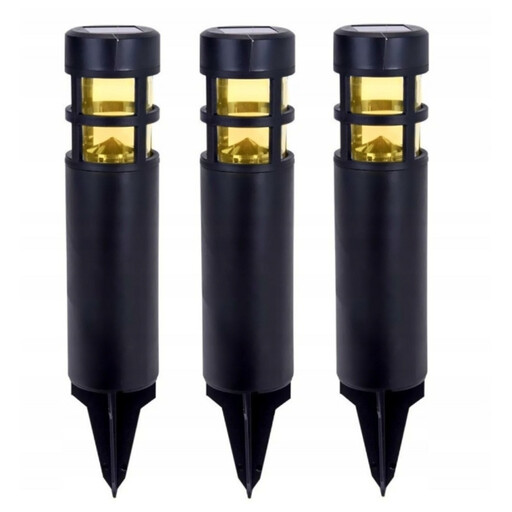
Why this product suits this profile: This set of three solar lights is ideal if you want to illuminate several areas, such as flower bed edges, paths or lawn borders, without much planning. The lights charge in daylight and, according to the product description, switch on automatically at dusk.
The pack size is clearly stated, so you won’t accidentally buy individual lights when you need several points of light.
Three lights per set and automatic activation at dusk; a good choice for a simple starter setup.
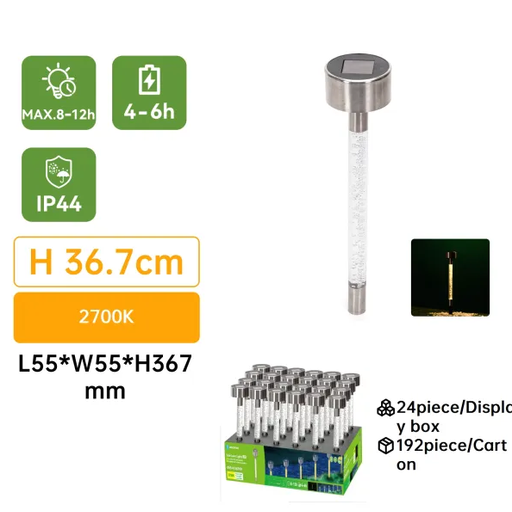
Why this product suits this profile: The warm white colour temperature of 2,700 Kelvin and bubble design make this light a good choice for subtle accent lighting in flower beds, on lawns or along paths.
The product details specify the IP44 rating, charging time, battery type and running time. This gives you a more realistic idea of whether it’s suitable for a sheltered outdoor area than the design alone would.
2,700-Kelvin light, 36.7-centimetre height, 40 mAh Ni-MH battery and a stated lighting time of 8–12 hours in suitable conditions.
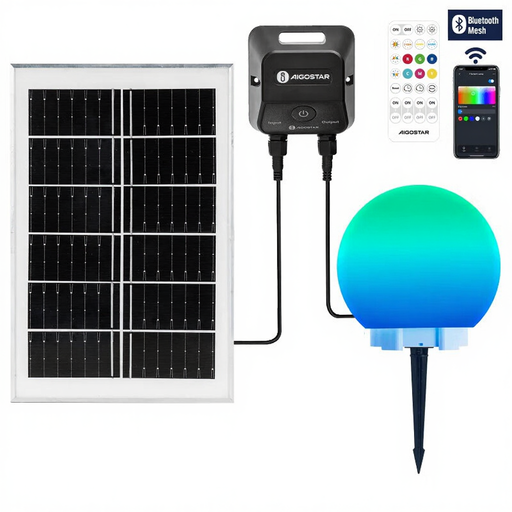
Why this product suits this profile: This model is for anyone looking to combine RGB solar lights, adjustable shades of white and app-based grouping of multiple lights.
The control options are clearly listed: the AigoSmart app, Bluetooth Mesh and optional voice control via a hub. This makes it easy to check what else you’ll need before buying.
RGB+CCT with a range of 2,700 to 6,500 Kelvin, plus app controls for brightness, schedules and group settings; rated IP54/IP44 according to the product details.
We’ve put together a complete, regularly updated list of products that meet these strict selection criteria and fully comply with the safety regulations in force in the EU.
Before first use, switch on the light if it has a switch, then leave the panel in direct sunlight for several hours. Don’t place the light under dense foliage or beside tall walls. With solar ground lights, make sure the top of the panel faces upwards.
Wipe the panel regularly with a soft, slightly damp cloth. Don’t use abrasive cleaning products. If the ground is loose, choose a firmer spot or consider adding extra ground support. Dispose of faulty batteries and lights in line with local recycling and electrical waste regulations.
It depends on sunlight, the panel, battery, temperature and LED output. Some of the models mentioned state 8–12 hours in suitable charging conditions. Running time may be shorter in winter or after several cloudy days.
Not necessarily. A light with an IP44 rating is protected against splashing water, but isn’t designed to be submerged. Avoid installing it where it will stay wet or where water collects. The specific IP rating is listed in the product details.
Not during normal operation. Solar lights charge their integrated battery via the panel and switch on automatically when it gets dark. However, actual performance depends on the sunlight available and the battery’s charge level.