
Lieferung heute & morgen

Qualitätsgarantie

Willkommens-Angebote freischalten: KOSTENLOSE Lieferung | Bis zu 80 % RABATT | Kostenlose 30-Tage-JoyPlus-Testphase
App herunterladen
Solar garden lights are ideal for lawns, flowerbeds, patios, balconies and seasonal decorations. They’re easy to install without power cables, and many models switch themselves on and off automatically when they receive enough sunlight. However, solar lights can vary considerably in their IP rating, battery capacity, light colour and run time.
If you focus only on a high LED count or eye-catching product pictures, you could miss some important details. Three common buying pitfalls are worth looking out for:
The first digit of an IP rating describes protection against solid objects and dust; the second indicates protection against water. An IP65 solar string light is dust-tight and can withstand water jets, including rain and splashes. However, the solar panel or battery compartment must not be submerged.
Models rated IP44 are protected against solid objects above a certain size, as well as splashes from different directions. They’re suitable for sheltered areas, but shouldn’t be installed permanently in an exposed spot where they’ll be subject to heavy rain or splashing.
So, consider whether you need waterproof solar lights for an open area of the garden, or whether a sheltered patio or balcony will do.
Manufacturers’ stated charging and run times are generally based on suitable conditions. A solar panel should receive several hours of direct sunlight. Shade from house walls, trees or railings reduces its charging performance.
Look out for the following details:
Clean the solar panel regularly with a soft, dry cloth. Dust, pollen and dirt can affect how much light it absorbs.
Warm white solar lights at around 2700 Kelvin create a subtle effect and often work well around seating areas, paths or decorative planting. Multicoloured LEDs and RGB solar lights are better suited to parties, seasonal decorations or events.
For a solar string light, check that its total length and the spacing between LEDs suit the area where you plan to use it. A 12-metre string with 120 LEDs distributes its light differently from a 10-metre string with 160 light points. Multiple lighting modes offer more ways to style your space, but don’t automatically make the lights brighter.
The selection below groups specific products by use and provides clear, relevant technical details.
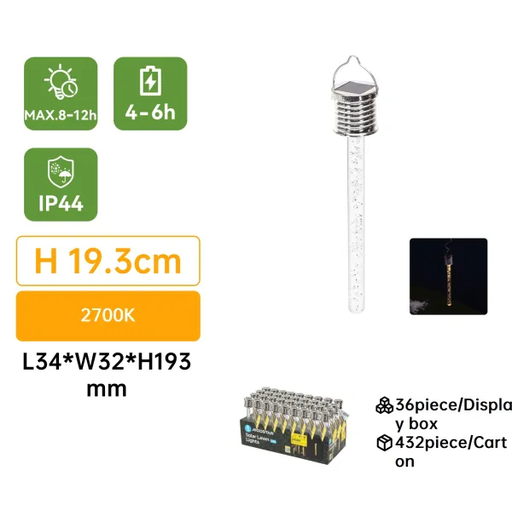
Why it suits this type of buyer: This compact solar light is designed to add a decorative touch to flowerbeds, patios or sheltered outdoor areas. Its warm white light at 2700 Kelvin is ideal for subtle illumination.
The technical details specify an IP44 rating and a charging time of around 4–6 hours. This makes it easier to judge whether the light is suitable for a sheltered spot.
Warm white light at 2700 Kelvin, a built-in 40 mAh Ni-MH battery and a stated run time of 8–12 hours in suitable conditions.
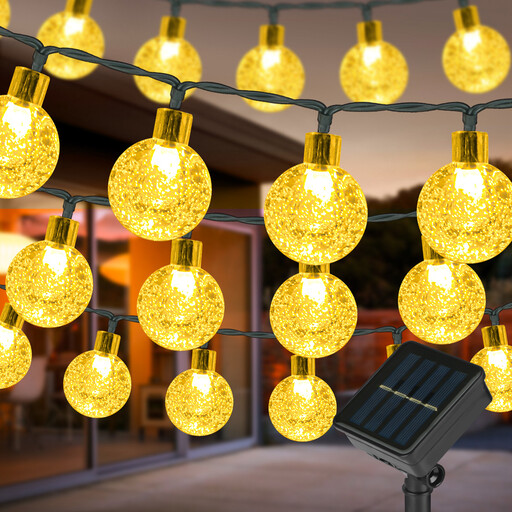
Why it suits this type of buyer: This 7-metre string light, with 50 decorative globes, is designed for gardens, balconies, patios and smaller outdoor spaces where warm white lighting and greater weather protection are important.
The IP65 rating comes with a clear reminder that the solar panel and battery compartment must not be submerged. This makes the difference between rain resistance and protection against immersion clear.
50 LEDs across seven metres, eight lighting modes and a stated run time of 8–14 hours, depending on charging conditions.
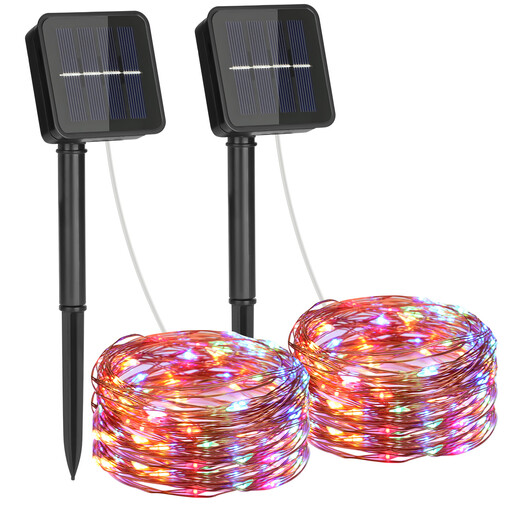
Why it suits this type of buyer: These two 12-metre solar string lights are ideal for larger decorative displays, garden parties, weddings or seasonal outdoor events. The flexible copper wire can be wrapped around railings, branches or decorative features.
The product details specify more than just the LED count: they also include the length, eight lighting modes, a memory function and an IP65 rating. This makes it easier to choose lights for different decorative settings.
Two strings, each with 120 LEDs, multicoloured light, eight modes and a stated run time of 8–14 hours after 6–8 hours of charging in direct sunlight.
We’ve put together a complete, regularly updated list of products that meet these strict selection criteria and fully comply with the safety regulations in force in the EU.
For reliable performance, position the solar panel in an open spot, facing upwards if possible. Avoid placing it directly under trees or next to tall walls. With string lights, route the cable to avoid creating a trip hazard. Flexible copper wire is easy to arrange, but avoid bending it sharply or leaving it under constant tension.
If you’re not going to use the lights for a long time, follow the manufacturer’s advice and switch them off if necessary. At the end of their useful life, batteries and electronic components should be disposed of in accordance with local guidelines.
Run time depends on battery capacity, sunlight, temperature and the lighting mode selected. The models listed are stated to run for around 8–14 hours. These figures aren’t a guaranteed daily run time, as cloudy weather and shade reduce charging performance.
This depends on the individual IP rating and the permitted temperature range. IP65 models are designed to withstand rain and splashes, but not submersion. Check the manufacturer’s operating temperature details too. Protect the solar panel and battery compartment from standing water.
Solar lights don’t need to be connected to your home’s mains electricity to work. However, you may have ongoing costs for replacement batteries, repairs or replacing the light. Its actual lifespan depends on the battery, electronics, weather conditions and care.