
Lieferung heute & morgen

Qualitätsgarantie

Willkommens-Angebote freischalten: KOSTENLOSE Lieferung | Bis zu 80 % RABATT | Kostenlose 30-Tage-JoyPlus-Testphase
App herunterladen
Solar garden lights are a handy way to illuminate lawns, flowerbeds, paths, patios or balconies without fixed cabling. However, not every model suits every location. If you only focus on the design or a long run time, you may overlook important technical details.
The points below help you put marketing claims into context and choose the right solar garden lighting for your own conditions.
A run time of several hours usually assumes suitable charging conditions. Shade from walls, trees or balconies, short winter days and overcast skies can reduce the available energy. Figures such as “8–12 hours” or “8–14 hours” should therefore be seen as reference values, not a guaranteed daily run time.
Also check whether charging time and run time are stated together. Even a model with a four to six hour charging time still needs the sunniest possible spot so the battery can charge sufficiently.
The IP44 rating protects against splashing water from various directions, but is not intended for immersion. IP54 adds extra protection against dust, while IP65 describes protection against dust and water jets. None of these ratings automatically mean a light can sit permanently in a puddle or be submerged.
For free‑standing solar outdoor lights, choose a location where no water collects on the housing or solar panel. In permanently exposed areas, it’s worth looking for a higher rating. A selection of waterproof solar outdoor lights makes it easier to compare by this criterion.
Small solar ground lights or garden stake lights add accents but don’t automatically replace bright path or security lighting. Figures such as 0.006 W indicate very low power consumption in decorative models, and therefore a more atmospheric level of light.
For a flowerbed, hedge or patio, warm or coloured light may be sufficient. For steps and busy paths, also pay attention to lumens, beam angle and a stable position.
For solar string lights, the number of LEDs, total length and available modes also matter. A longer string isn’t necessarily brighter; it simply distributes the light over a greater distance.
Pay attention to the battery type and capacity. Among the models featured here you’ll find Ni‑MH batteries with 40 mAh or 200 mAh, as well as an integrated lithium battery. Capacity is only part of the assessment: the solar panel, LED output, temperature and location also influence the run time.
Amorphous silicon and polycrystalline silicon panels can behave differently depending on design and incident light. In day‑to‑day use, the main thing is that the panel is unobstructed and regularly freed from dust, leaves and pollen.
For outdoor use, IP rating, operating temperature and materials are crucial. Several Aigostar models are specified for a temperature range of -10 °C to 50 °C. Plastic housings with a stainless‑steel look can be lighter than solid metal constructions, which affects stability in windy conditions.
Solar lights with ground spikes are inserted into soft soil or lawn. In compacted ground, don’t force the spike, as you could damage the housing or connection. For balconies and patios, hanging models or string lights are usually more flexible.
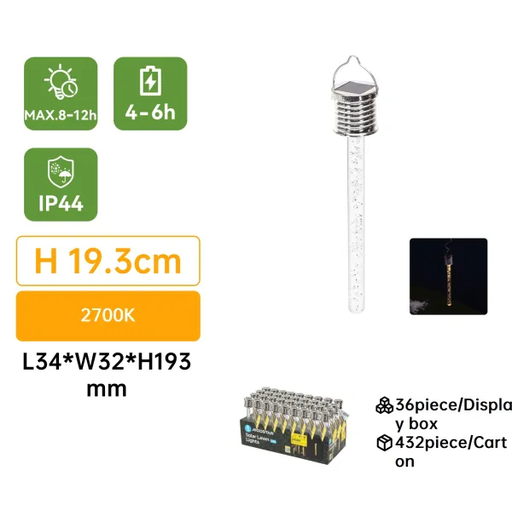
Why this product fits: The compact, 40 g light delivers warm white 2700 K illumination and can be placed outdoors without a mains connection.
The listing explicitly states charging time, run time, colour temperature and IP44, so it’s clear this is a decorative light rather than a strong path light.
2700 K, Ni‑MH battery with 40 mAh, around 4–6 hours’ charging time and a stated operating time of 8–12 hours.
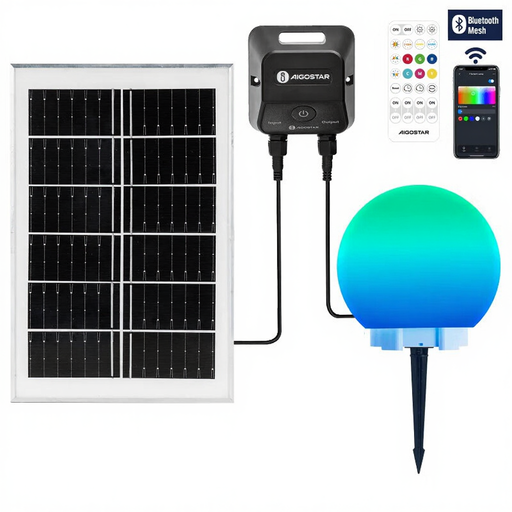
Why this product fits: Bluetooth Mesh and the AigoSmart app let you group multiple lights and choose RGB and white‑light scenes.
The functions are clearly specified: app control, schedules, brightness adjustment and RGB+CCT with 2700–6500 K. The IP54/IP44 ratings should be taken into account when choosing the installation location.
Bluetooth Mesh networking, lithium battery, app control and adjustable colour and white‑light ranges.
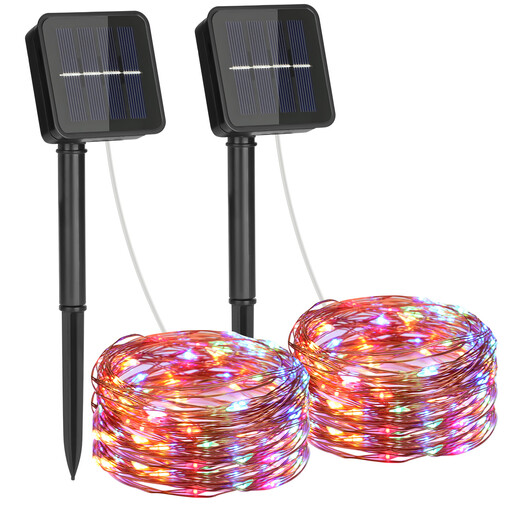
Why this product fits: Two flexible strings, each 12 metres long with 120 LEDs, are suitable for balconies, patios, railings, shrubs or seasonal decoration.
The product details distinguish between a 6–8 hour charging time and a weather‑dependent run time of 8–14 hours. IP65 is specified, but immersion is not recommended.
24 metres total length, 240 LEDs, eight light modes and a memory function for the last selected mode.
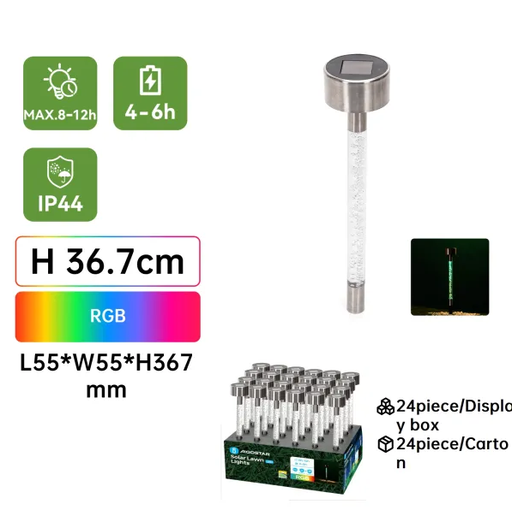
Why this product fits: The RGB function and bubble design add colourful accents to lawns, flowerbeds and along paths.
The colour feature is clearly separate from the protection rating: IP44 means splash protection, not submersion. Choose a spot that stays dry and free of standing water.
RGB light, 36.7 cm height, Ni‑MH battery with 40 mAh, and a stated charging time of 4–6 hours.
We’ve compiled a complete, continuously updated list of products that fully meet these strict selection criteria and the safety regulations applicable in the EU.
Duration depends on the solar panel, battery, light output, season and sunlight. For the models mentioned, around 8–12 hours are stated under suitable conditions, or 8–14 hours for the VIVREAL string lights. In winter or on heavily overcast days, run time may be shorter.
That depends on the specified temperature range and IP rating. Models rated for -10 °C to 50 °C can generally be used outdoors within these limits. Snow, ice, standing water and permanently shaded locations should still be avoided.
No. Solar lights store energy during the day in an integrated battery and use it later to power the LEDs. There are no ongoing mains electricity costs for operation. Actual light duration depends on the stored energy and therefore on charging conditions.