
Lieferung heute & morgen

Qualitätsgarantie

Willkommens-Angebote freischalten: KOSTENLOSE Lieferung | Bis zu 80 % RABATT | Kostenlose 30-Tage-JoyPlus-Testphase
App herunterladen
Solar garden lights don’t need a mains connection and can usually be set up outdoors without any tools. Even so, not every model is right for every garden. A small light may only stay lit for a short time in a shady spot, while a decorative RGB model may not provide enough guidance along a path.
That’s why it’s worth checking the technical details before you buy, rather than relying on product photos and marketing claims alone. Three issues are particularly likely to lead to a disappointing purchase:
Place solar garden lights where their panels will stay unshaded for as long as possible. Charging time and run time depend on the sun’s position, the time of year, orientation, dirt and the condition of the battery. Models with an integrated NiMH or lithium battery store energy collected during the day and switch on automatically when it gets dark.
For even lighting along paths, it’s worth placing several solar path lights at regular intervals. Individual solar stake lights are better suited to flower beds, lawns and decorative accents.
The IP rating is a useful point of comparison when choosing weather-resistant garden lighting. IP44 means protection against solid objects larger than 1 millimetre and splashes of water from different directions. Even so, the light shouldn’t be left standing in a puddle or sprayed directly with a garden hose. For more exposed locations, a higher rating such as IP54 may be more suitable.
The material is worth checking, too. A stainless-steel finish may be made of plastic, so it doesn’t necessarily mean the light has a stainless-steel housing. This affects its weight, stability and resistance to knocks.
Warm white solar lights at around 2700 Kelvin give off a soft, yellowish glow and are often a good fit for patios, seating areas and flower beds. Cool white light at around 6500 Kelvin looks much more neutral and can make edges and paths stand out more clearly.
RGB solar lights switch between different colours and are best suited to decorative areas. For practical path lighting that you’ll use every day, a steady light colour and well-spaced positioning are usually more useful. Solar ground lights can be fitted flush into paths or patios, but they need a suitable surface and careful sealing.
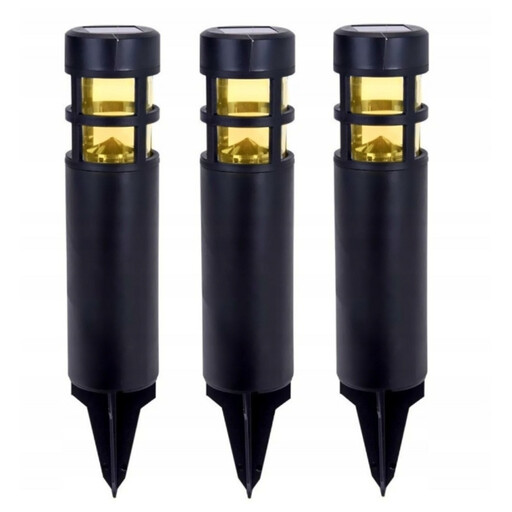
Why this product suits you: The set includes three solar lights, making it suitable for short paths, flower beds or a small lawn. There are no cables to install, and the lights switch on automatically at dusk.
The number of lights in the set is clearly stated. You can spread the lighting across several spots instead of relying on a single light to cover too large an area.
Three lights, automatic switch-on at dusk and easy positioning in soft ground.

Why this product suits you: According to the product details, this model has a polycrystalline solar panel, a NiMH battery, 6500 Kelvin light and an IP44 rating. It’s designed to make paths and borders clearly visible.
The product details state the charging time, expected run time, temperature range and IP rating. This makes it easier to understand where the light can be used than a description without technical details.
Polycrystalline panel, NiMH battery, 6500 K light and IP44 rating; according to the product details, charging takes around 4–6 hours and the light runs for 8–12 hours under suitable conditions.
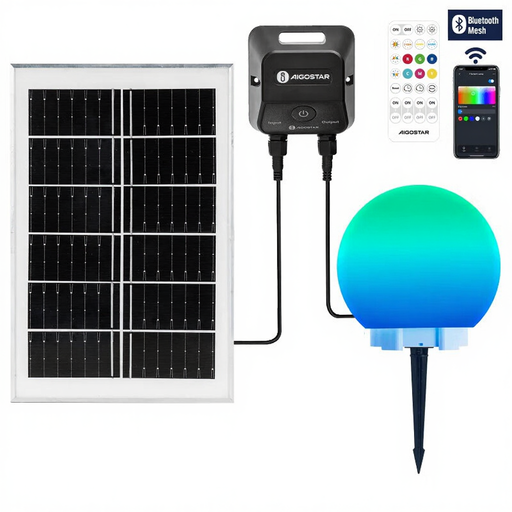
Why this product suits you: If you want to adjust colours, brightness and group controls, this model offers Bluetooth Mesh, RGB+CCT from 2700–6500 Kelvin and control via the AigoSmart app.
The lighting controls are clearly described. Before buying, check that the app, Bluetooth range and stated IP54/IP44 rating are suitable for where you plan to install it.
RGB+CCT lighting, Bluetooth Mesh functionality and solar power with an integrated lithium battery; the manufacturer states an IP54/IP44 rating.
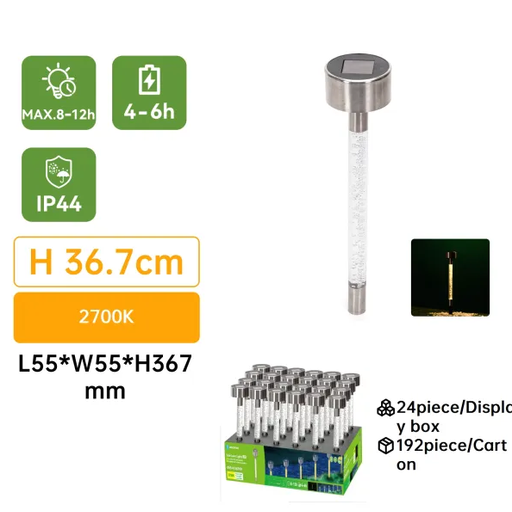
Why this product suits you: The warm white light at 2700 Kelvin is designed for flower beds, lawn edges and patio areas where a decorative glow is more important than the brightest possible illumination.
The product details explicitly state 2700 K, IP44, charging time and run time. This helps you distinguish warm white accent lighting from practical path lighting.
2700-Kelvin light, integrated NiMH battery, automatic dusk sensor and around 8–12 hours of run time under suitable conditions, according to the product details.
We’ve put together a comprehensive, regularly updated list of products that meet these strict selection criteria and fully comply with the safety regulations in force in the EU.
For an even spread of light, avoid placing solar garden lights too close together. When lighting flower beds and paths, arrange the lights along the edges, rather than placing them directly in an area that’s mown regularly. Push the ground spike firmly into the soil, but don’t force it into hard ground.
Clean the solar panel regularly with a soft, damp cloth. Abrasive cleaners can damage the surface. Follow the manufacturer’s instructions before a frost or a long period when the lights won’t be used. Batteries and electronic components should not be put in household waste when replaced; take them to the appropriate collection points instead.
Run time depends on sunlight, charging time, battery capacity, temperature and the age of the battery. Manufacturer claims such as 8–12 hours are generally a guide for suitable conditions. In winter or on heavily overcast days, the lights may not stay on for as long.
Not necessarily. Check the IP rating separately. IP44 protects against splashes, but not immersion in water. So don’t place solar lights in areas that stay wet, in puddles or where they’ll be hit by a direct jet of water.
They don’t need to be connected to the mains while in use. The solar panel charges the battery during the day, so there are no ongoing mains electricity costs. However, after extended use, many models may need a replacement battery, which will incur a cost.