
Lieferung heute & morgen

Qualitätsgarantie

Willkommens-Angebote freischalten: KOSTENLOSE Lieferung | Bis zu 80 % RABATT | Kostenlose 30-Tage-JoyPlus-Testphase
App herunterladen
Solar garden lights provide outdoor illumination without a fixed power cable. They charge during the day via an integrated solar panel and usually switch on automatically when it gets dark. Different designs are available for garden paths, flower beds, lawns, patios and driveways, including solar ground lights, solar path lights, decorative globe lights and smart models with app control.
Choosing the right model may seem straightforward at first glance. In practice, however, unclear runtime specifications, incorrectly assessed IP ratings and an unsuitable installation location often lead to disappointment. The following guide explains which specifications matter before buying solar garden lights and which models are suitable for different applications.
A stated runtime of, for example, 8 to 12 hours depends on several factors: sunlight, season, solar-panel orientation, shading and battery condition. In autumn and winter, the actual charging performance may be lower than on a sunny summer day.
It is therefore worth checking whether the runtime is stated alongside a charging time. Several Aigostar models specify a charging time of approximately 4 to 6 hours and a runtime of 8 to 12 hours under suitable conditions. These figures are not a guarantee for every weather situation.
The IP44 rating means protection against solid foreign objects measuring 1 mm or more, as well as protection against splashing water. Such a product should not be placed in a permanently wet depression or submerged. IP54 provides additional protection against dust deposits, but is likewise designed only for splashing water. IP65 protects against dust and low-pressure water jets, but is not intended for immersion.
The installation location is therefore crucial for solar-powered outdoor lighting. Under a roof overhang or in a well-drained area, an IP44 light may be sufficient. For exposed locations subject to heavier rain, a higher IP rating provides greater protection, but it does not replace correct installation.
RGB solar lights and warm-white solar lights serve different purposes. Colour-changing bubble lights are primarily suitable for accents in flower beds, on patios or as part of decorative arrangements. For clear orientation along a path, evenly spaced neutral-white or warm-white solar path lights are generally more practical.
Also check whether a specific luminous flux is stated in lumens. A wattage specification alone does not reliably indicate how bright a light will appear.
Depending on the model, solar lights use NiMH or lithium batteries. Battery capacity alone does not provide a direct indication of actual runtime, as LED output, control electronics and operating mode also play a role. A larger solar panel and a suitable, unshaded location support the charging process.
Clean the surface of the solar panel regularly with a soft, damp cloth. Aggressive or abrasive cleaning products may damage the surface.
Solar lights with ground stakes are inserted directly into soft soil or lawn. The stake should not be forced into hard or compacted ground. Along paths with heavy foot traffic, ensure that the light is stable and positioned outside the main walking area to prevent tripping hazards.
Plastic housings are lightweight and corrosion-free. A stainless-steel appearance can be decorative, but does not automatically mean that all components are made of stainless steel. Some products are explicitly described as having a plastic construction with a stainless-steel look.
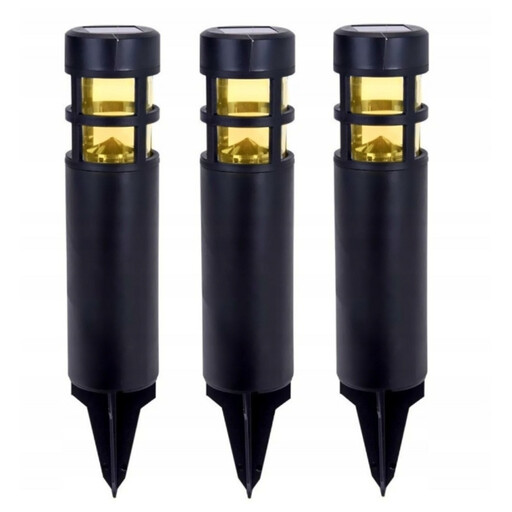
Why this model fits: This three-piece set is designed for small paths, flower-bed edges or first-time solar outdoor lighting. Place the lights in direct sunlight and they will switch on automatically at dusk.
The number of lights is clearly stated, making it easier to plan the desired coverage without having to purchase additional individual lights.
Three lights in one set, cable-free installation and automatic activation in the dark.
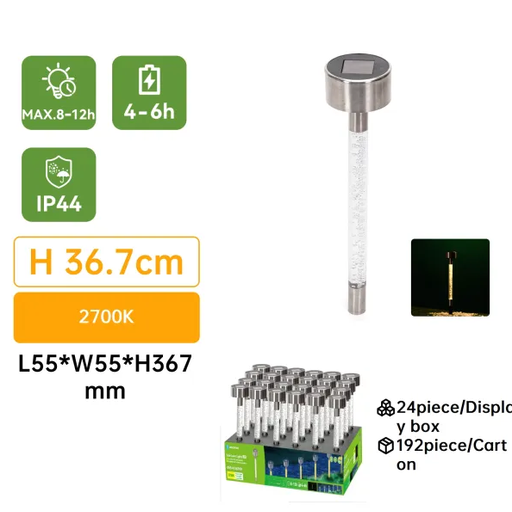
Why this model fits: The decorative bubble design and stated colour temperature of 2700 K make this light suitable for flower beds, lawns and patio areas where a warm ambience is desired.
The light colour is clearly specified, so buyers do not have to judge from product photos alone whether the light appears warm or cool.
2700 K, IP44, ground-stake installation, plus a stated charging time of 4 to 6 hours and runtime of 8 to 12 hours under suitable conditions.
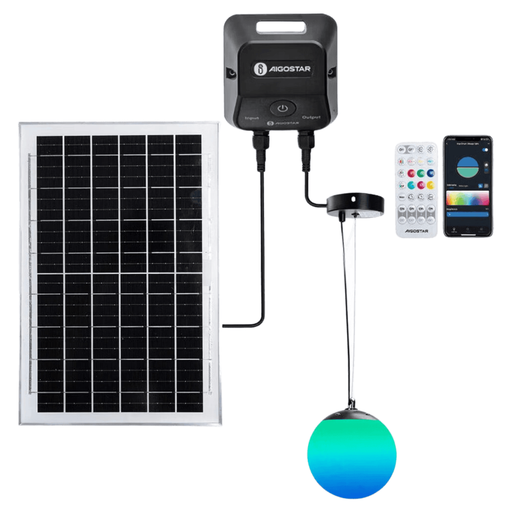
Why this model fits: Bluetooth Mesh, app control and RGBCCT functionality are aimed at users who want to connect multiple lights, create schedules or adjust brightness and light colour digitally.
The control method is clearly specified. Nevertheless, check before buying whether a hub is required for voice control.
According to the product specifications: 350 lm, IP65, a 10 W monocrystalline solar panel and an 8 Ah LiFePO4 battery.
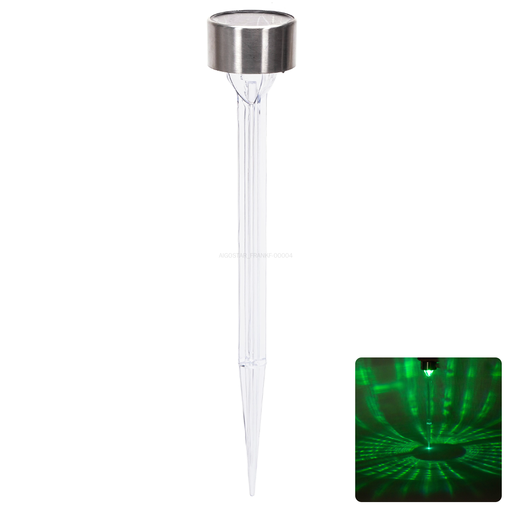
Why this model fits: The RGB function and compact dimensions of 55 × 55 × 320 mm make this light suitable for adding colour accents along garden paths, across lawns or beside plants.
This is positioned as a decorative RGB model rather than the sole source of safety lighting for a driveway or frequently used path.
RGB lighting, ground-stake installation, IP44 and a stated operating time of 8 to 12 hours under suitable charging conditions.
Compare the complete range of outdoor solar garden lights by design, light colour and intended application.
Many models require approximately 4 to 6 hours in suitable sunlight. Actual charging performance depends on the season, weather, orientation and shading. Before first use, charge the battery according to the product instructions.
Service life depends on the LED, battery, housing, weather exposure and maintenance. Some Aigostar models specify an LED lifespan of up to 15,000 hours. However, the battery may lose capacity sooner and is a separate wear component. Regularly cleaning the solar panel helps support the intended operation.
During normal operation, they charge via sunlight and do not require a direct mains connection. Costs may still arise from a later battery replacement or disposal. Smart solar lights may also require an app, a Bluetooth connection or a separately purchased hub.