
Lieferung heute & morgen

Qualitätsgarantie

Willkommens-Angebote freischalten: KOSTENLOSE Lieferung | Bis zu 80 % RABATT | Kostenlose 30-Tage-JoyPlus-Testphase
App herunterladen
Solar lights promise a simple and energy-efficient way to illuminate your garden, patio, or balcony. With no wiring required and no extra electricity costs, they seem like the ideal solution for modern LED outdoor lighting. However, the reality is often different: many buyers are disappointed when the lights fail after the first rain shower, emit only a faint glow, or don't survive the winter.
To avoid making a bad investment, it's crucial to understand the typical weaknesses often hidden behind appealing product images. This guide focuses on the critical technical features to help you make an informed choice.
To separate the wheat from the chaff, you should check three technical parameters before buying. These reveal the true performance and durability of outdoor solar lights.
The IP (Ingress Protection) rating indicates how well an electrical device is protected against the ingress of foreign objects and water. For outdoor lighting, two ratings are particularly relevant:
patio lighting setup.The performance of a solar light depends directly on the battery's capacity (measured in milliampere-hours, mAh) and the solar panel's efficiency. A larger battery stores more energy, enabling a longer runtime. Look for a battery capacity of at least 600 mAh for decorative lights and over 2000 mAh for brighter solar flood lights with motion sensors.
The solar panel is just as important. Models with a separate panel connected by a cable offer more flexibility, as the panel can be optimally positioned towards the sun while the light itself is placed in the shade.
Not every light is suitable for every purpose. Consider what function the lighting should serve:
solar garden torches or lights with warm white, constant light are ideal. Here, brightness is less critical than runtime and design.solar flood lights with motion sensors are the right choice. They only turn on when needed, brightly illuminating the area and thus conserving energy, which ensures longer operational readiness.Based on these objective criteria, we have compiled various models for different usage scenarios.
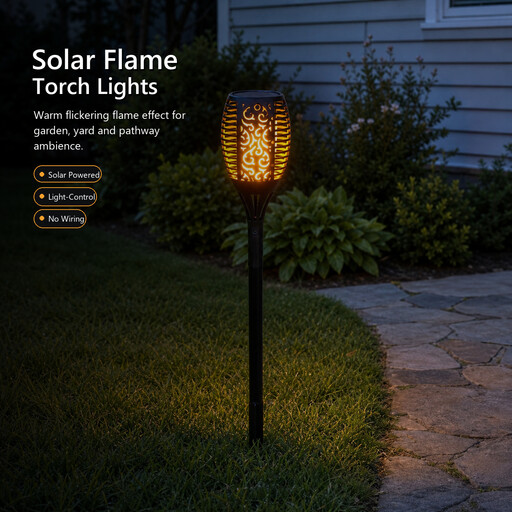
Why This Fits Their Persona: Ideal for users looking for decorative garden lighting to create a warm and inviting atmosphere along paths or on the patio. The dancing flame effect provides an appealing ambiance.
With an IP65 rating, this garden torch is explicitly protected against water jets, making it designed for year-round, unprotected outdoor use, which sets it apart from less robust models.
The 96 LEDs create a realistic flame effect. The automatic on/off function via a dusk-to-dawn sensor ensures convenient operation.
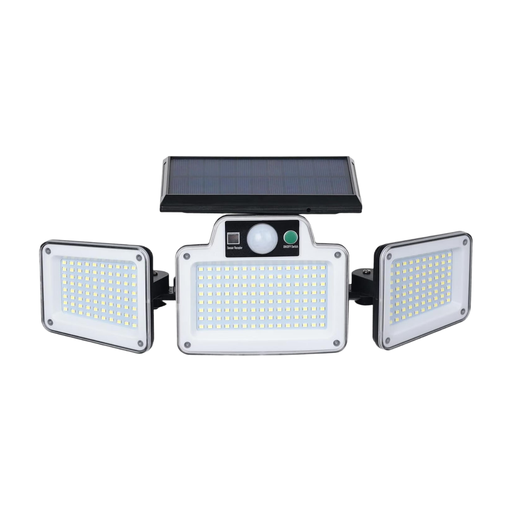
Why This Fits Their Persona: Perfect for homeowners who want to reliably illuminate dark areas like the garage, yard, or driveway to enhance security.
The separate solar panel with a 4.7-meter cable solves the problem of poor charging. The panel can be mounted in direct sunlight, while the floodlight itself is placed on a shaded wall.
Three adjustable light heads allow for targeted illumination. The 2400mAh battery and 3 remote-controlled modes (including a motion sensor) offer flexibility and a long operational life.
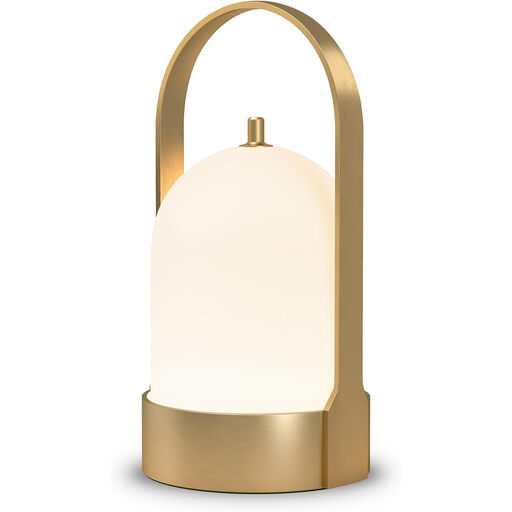
Why This Fits Their Persona: An excellent choice for renters with a balcony or users who need a portable light source for the garden table, camping, or as an emergency light. This lamp is not tied to a fixed location.
As a portable battery lamp, it is independent of daily sunlight. The large 4000mAh battery is charged via USB, thus bypassing the unreliability of solar lights on cloudy days or in winter.
Offers up to 80 hours of runtime at the lowest brightness setting, according to the manufacturer. The 4-level dimming function via touch control and the IP44 certification make it versatile.
We have compiled a complete, up-to-date list of products that fully meet these strict selection criteria and safety regulations.
1. How long do solar garden lights last? The lifespan heavily depends on the quality of the components. High-quality solar garden lights can function for several years. The most critical component is the battery, which may lose capacity after 1 to 3 years depending on charge cycles and quality, and may need to be replaced. The LEDs themselves often have a very long lifespan of over 15,000 hours.
2. Do solar lights work in winter or on cloudy days? Yes, but with reduced performance. The solar panels also charge in diffuse light, but much more slowly than in direct sunlight. This leads to a shorter runtime at night during winter and on heavily overcast days. For reliable lighting in the darker seasons, models with large, efficient solar panels and high battery capacity, or alternatively a USB-rechargeable portable battery lamp, are recommended.
3. Where is the best place to position solar lights for optimal performance? The crucial factor is the orientation of the solar panel. It should be placed in a location where it receives at least 6-8 hours of direct, unobstructed sunlight daily. Avoid locations under trees, eaves, or on the north side of buildings. For models with a separate panel, the light can be flexibly positioned in the shade as long as the panel is in the sun.