
Lieferung heute & morgen

Qualitätsgarantie

Willkommens-Angebote freischalten: KOSTENLOSE Lieferung | Bis zu 80 % RABATT | Kostenlose 30-Tage-JoyPlus-Testphase
App herunterladen
Solar garden lights can be installed without fixed wiring and used to highlight paths, lawns, flower beds or patios after dark. But not every product will be right for your needs. What matters most is not the decorative product photography, but the IP rating, light output, charging conditions and intended location.
RGB solar lights often look particularly vivid in product images. Their actual light output depends on the lumens, beam angle, mounting height and battery condition. A decorative solar garden stake light with a low lumen output can help you find your way around a flower bed, but it won’t replace bright solar path lighting.
So check the stated light output in lumens. For example, a smart solar ground light is listed as producing 350 lumens. That’s a useful, measurable specification, whereas claims such as ‘extra bright’ are difficult to compare without a figure.
IP44 solar lights are protected against solid objects larger than 1 mm and splashing water from any direction. That’s enough for many solar garden stake lights and decorative lights in flower beds, as long as they aren’t left standing in puddles.
IP65 solar lights are dust-tight and protected against water jets, making them a better choice for exposed areas. However, IP65 doesn’t mean a light can be submerged. Also check whether the manufacturer specifies an operating temperature range.
Claims such as ‘8 to 12 hours’ generally apply under suitable conditions. Shade from house walls, trees or hedges, short winter days and dirty solar panels all reduce the energy available for charging. Even a light with a large battery may switch off earlier on a cloudy day if its panel receives very little sunlight.
For reliable operation, the panel should receive as much direct sunlight as possible. Clean the surface regularly with a soft cloth, and avoid placing ground lights where dense foliage will cover them.
First, match the light to the spot where you plan to use it:
Warm white solar lights at around 2700 kelvin create a soft, yellowish glow and are often a good fit for seating areas, patios and decorative flower beds. Cool white light at around 6500 kelvin looks crisper and can help define paths or driveways more clearly.
RGB solar lights offer changing colours, but are mainly suited to decorative use. If you want multiple modes, schedules or consistent colour control, check for app connectivity, Bluetooth Mesh and the range you’ll need.
Check the battery type and capacity. NiMH batteries are common in many small solar garden stake lights, while larger smart solar lights sometimes use lithium batteries. Several of the models listed here have a charging time of around 4 to 6 hours under suitable conditions.
A ground stake is convenient, but requires loose, reasonably firm soil. For hard ground, solar ground lights or models with a suitable base may be a better choice. Before buying, also check the dimensions and cable lengths if you plan to position the solar panel separately from the light.

Why this product suits this profile: This compact solar light is designed for simple use along paths, driveways or in flower beds, and doesn’t need fixed wiring. Two LEDs and an integrated solar panel provide a straightforward set-up.
The product description gives the exact dimensions of 6.5 × 34 cm, specifies two LEDs and lists an AAA battery. This makes it easier to assess what you’re getting than a brightness claim alone.
Ground stake for quick installation; switches on automatically in the dark; black plastic housing weighing 402 g.
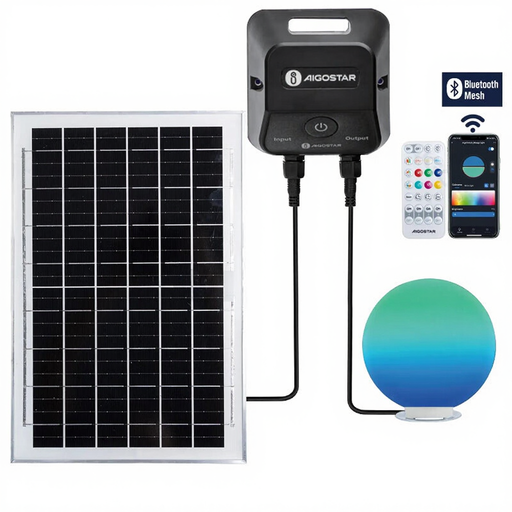
Why this product suits this profile: This light combines a stated IP65 rating with RGB+CCT lighting, Bluetooth Mesh and a separate solar panel. It’s a good option if you want to coordinate several outdoor lights.
The specifications state 350 lumens, a 120-degree beam angle, Bluetooth Mesh for more than 200 devices and an IP65 rating. That gives you clear details on key buying criteria.
RGB+2700K–6500K; 8000 mAh lithium battery according to the product details; 12 W solar panel; stated maximum battery life of up to 24 hours.
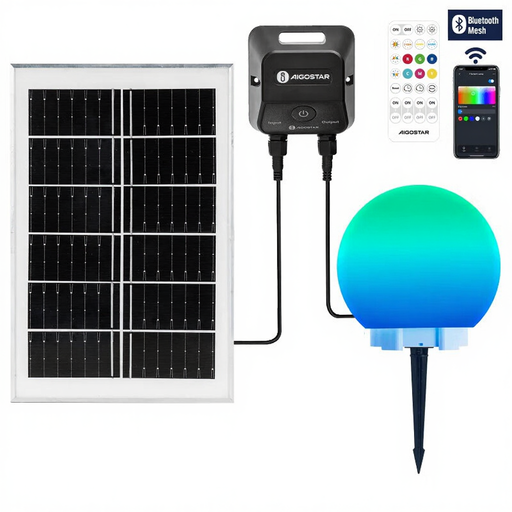
Why this product suits this profile: This smart solar ground light is designed for people who want to control their lighting through the AigoSmart app, group lights together or, with a hub, use voice control.
The description clearly states IP54/IP44 and protection against splashing water. The light shouldn’t be submerged, so you can easily rule out unsuitable locations before installation.
RGB+CCT with 2700K–6500K; app control and grouping; Bluetooth Mesh for multiple lights; solar-powered with an integrated lithium battery.
We’ve put together a complete, regularly updated list of products that meet these strict selection criteria and fully comply with the safety regulations in force in the EU.
Position the solar panel so that it gets as many hours of direct daylight as possible. For solar lights with a separate panel, make sure the supplied cable isn’t under tension and is protected from sharp edges. It’s best to push ground stakes into loose soil first; hammering them in hard can damage the housing or stake.
Before first use, follow the charging time stated in the product description. Regularly remove dust, pollen and leaves from the panel. If the battery is replaceable, use a replacement of the type specified by the manufacturer. Built-in batteries shouldn’t be opened or modified. Dispose of electronic components and batteries in accordance with local regulations.
Run time depends on sunlight, panel size, battery capacity, temperature and light mode. Under suitable charging conditions, some decorative models state a run time of around 8 to 12 hours. Smart solar lights may last for different lengths of time depending on brightness and use.
Many models specify an operating range, such as -10 °C to 50 °C. In winter, the days are shorter and the sun sits lower in the sky, which can reduce charging performance. A suitable IP rating and a spot with as little shade as possible are still important.
They don’t need a mains connection while in use. The solar panel charges the battery during the day, so there are no ongoing electricity costs from the mains. However, you may need to replace the battery or a damaged light over time.