
Lieferung heute & morgen

Qualitätsgarantie

Willkommens-Angebote freischalten: KOSTENLOSE Lieferung | Bis zu 80 % RABATT | Kostenlose 30-Tage-JoyPlus-Testphase
App herunterladen
Solar lights for the garden don’t need a fixed mains connection and can usually be installed without tools. This makes them a practical choice for garden owners, homeowners and people renting a flat with a balcony or patio. However, not every solar garden light is right for every location. Key factors include the amount of sunlight available, the colour of light you want and the level of protection against moisture.
Figures such as ‘8–12 hours’ usually refer to suitable charging conditions. In shade, during short winter days or after several cloudy days, the actual run time may be shorter. Check whether the solar panel will receive direct sunlight or, at the very least, plenty of daylight throughout the day.
An IP44 solar light is protected against solid objects above a certain size and splashing water from different directions. However, it isn’t designed to be submerged in water. For low-lying areas, exposed locations or flush installation at ground level, solar lights with a higher protection rating, such as IP67, are a better choice.
Small solar garden stake lights often create an atmospheric glow, but they won’t necessarily provide bright lighting for a path or entrance. If you want to make trip hazards easier to see, consider the mounting height, light output, beam angle and distance between the lights. For flower beds and lawns, a softer light may be all you need.
Warm-white solar lights at around 2700 kelvin create a subtle effect in seating areas, on patios and along flower beds. Cool-white light at around 6500 kelvin looks noticeably brighter and bluer, so it may be better suited to areas where you need to find your way.
Colour-changing solar lights, also known as RGB solar lights, offer a range of colours for decorative use. They aren’t necessarily brighter than warm-white models. For a coordinated look, choose lights in the same area with the same colour mode or a similar colour temperature.
The combination of battery type, capacity, solar panel and light output affects run time. A larger battery on its own won’t guarantee longer operation if the panel doesn’t supply enough energy. Many compact models quote charging times of around 4–6 hours and run times of 8–12 hours in suitable conditions.
Position solar lights with ground stakes so the panel isn’t shaded by house walls, trees or tall plants. Before using them for the first time, it’s a good idea to charge them fully, following the manufacturer’s instructions.
For freestanding outdoor LED solar lights, it’s important to check the stated IP rating and suitable operating temperature range. Models with an IP44 rating are suitable for many sheltered areas of the garden, but shouldn’t be placed in puddles or exposed to heavy water for extended periods.
Also check the exact material listed. Silver-coloured plastic may look like stainless steel, but it isn’t the same as a light made entirely from stainless steel. When installing a light in the ground, push the stake into soft, firm soil. If the ground is hard, loosen it first to avoid breaking the stake.
The selection below groups different solar garden lights by how you might use them. The technical details are taken from the respective product descriptions.
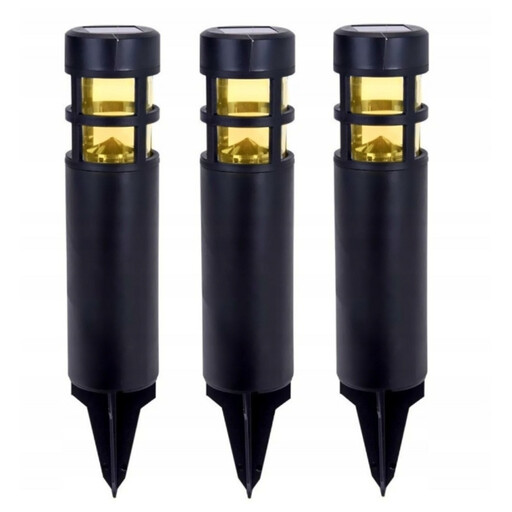
Why this product suits this need: This set of three is a good choice if you want to add several small pools of light along paths, in flower beds or on a patio, without having to plan a complex lighting scheme.
The set clearly states how many lights are included, making it easier to judge how much coverage you’ll get rather than expecting a single decorative light to illuminate a large area.
Three lights in one set; automatic activation at dusk according to the product description.
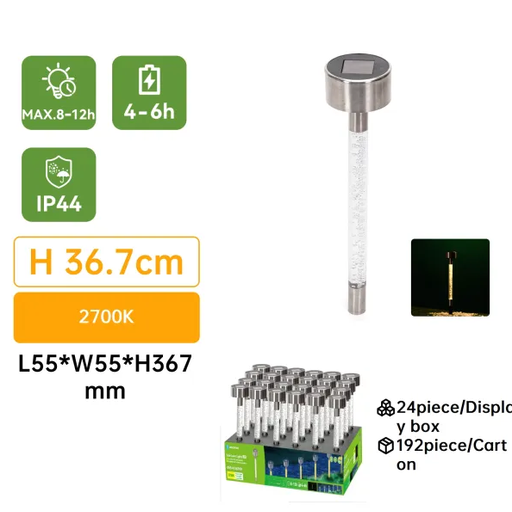
Why this product suits this need: This light gives a clear colour temperature, along with details of its battery type, charging time, IP rating and dimensions. That makes it easier to choose the right option for flower beds, lawns and paths.
The 2700K rating makes it clear that the light is warm white, not cool white. The IP44 rating is also stated explicitly, but it shouldn’t be mistaken for waterproofing.
2700-kelvin light; quoted charging time of 4–6 hours and run time of 8–12 hours in suitable conditions.
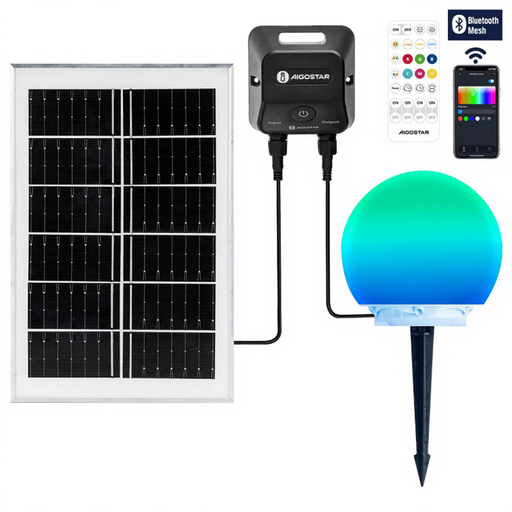
Why this product suits this need: For larger outdoor areas and anyone who wants to manage groups of lights via an app, this model offers Bluetooth Mesh control, RGB+CCT lighting and a separate solar panel for more flexible positioning.
The IP67 rating is clearly stated. Even so, follow the installation instructions: a higher protection rating doesn’t make every type of installation suitable or compensate for damage to the casing.
RGB+CCT from 2700K to 6500K; Bluetooth Mesh connection and 4000-mAh lithium battery according to the product description.
We’ve put together a complete, regularly updated list of products that meet these strict selection criteria and fully comply with the safety regulations in force in the EU.
Place solar lights away from areas of persistent shade wherever possible. The panel should face upwards and be kept clear of leaves, dust and debris. A soft, slightly damp cloth is usually all you need for cleaning; abrasive cleaners can damage surfaces and seals.
For solar ground lights and solar path lights, make sure they’re positioned securely. Avoid placing them where water regularly collects. Don’t open or modify batteries or electronic components yourself. Follow local guidelines when disposing of electrical equipment and batteries.
Their lifespan depends on the battery, LED, weather conditions, charging conditions and care. Some product descriptions, for example, state an LED lifespan of up to 15,000 hours. This figure refers to the light source and doesn’t automatically indicate the lifespan of the whole product or its battery.
Yes, they can generally be used in winter too. However, shorter days and more frequent cloudy weather may reduce the amount of energy stored. A sunny spot without shade is particularly important at this time of year. In freezing conditions, check the manufacturer’s guidance on the permitted temperature range.
While they’re switched on, solar lights run on energy stored in the battery during the day. The solar garden lights mentioned here don’t need an external power supply. In practice, you’ll mainly need to position them correctly, clean them from time to time and replace the battery later on, if the manufacturer allows for this.