
Lieferung heute & morgen

Qualitätsgarantie

Willkommens-Angebote freischalten: KOSTENLOSE Lieferung | Bis zu 80 % RABATT | Kostenlose 30-Tage-JoyPlus-Testphase
App herunterladen
Solar lights for the garden do not require a permanent power connection and can be positioned without complex electrical installation. This makes them appealing to garden owners, homeowners and tenants with a balcony or patio. However, solar garden lights vary considerably in terms of light colour, battery, material, installation and weather protection.
If you only consider the design or stated operating time, it is easy to overlook important details. The following advice will help you choose suitable outdoor LED solar lights and avoid common purchasing mistakes.
The IP44 protection rating is specified for many outdoor lights. It protects against solid foreign objects above a certain size and against splashing water. However, an IP44 solar light is not designed to be submerged or exposed to standing water for prolonged periods.
With solar ground lights and solar lights with ground spikes, the installation site should therefore be chosen so that rainwater cannot collect directly around the housing. Products with IP44 should also not be placed in a pond, water container or permanently wet depression.
Claims such as 8 to 12 hours depend on direct sunlight, the time of year, shade and battery condition. In the German winter or after several cloudy days, the actual operating time may be shorter.
A solar panel beneath trees, on a north-facing wall or behind a tall hedge receives significantly less energy. Before buying, check whether the intended location receives several hours of unobstructed daylight.
Many decorative solar lights create a pleasant ambience, but do not necessarily provide enough brightness for steps, driveways or uneven paths. Information about light colour or the number of LEDs does not automatically describe the actual illumination.
For a safe path, spacing, light height and light distribution are crucial. With solar spotlights and solar path lights, you should also check whether the light source shines downwards, sideways or in a focused beam.
Solar lights with warm white light of around 2700 K create a soft, yellowish glow. They are often well suited to seating areas, flower beds and decorative parts of the garden. Cool white light, such as 6500 K, appears noticeably whiter and can highlight the contours of paths more clearly.
Solar lights with RGB lighting switch between different colours, depending on the product. They are particularly suitable for decorative accents on the patio, lawn or seasonal displays. For consistent orientation along a path, a fixed light colour is generally easier to follow.
Pay attention to the battery type, capacity and charging time. The product specifications provided here use rechargeable Ni-MH batteries. A higher capacity can provide more stored energy under comparable conditions, but does not guarantee the same operating time in every type of weather.
Several models state a charging time of around 4 to 6 hours and an operating time of 8 to 12 hours under suitable charging conditions. Before first use, charge the battery according to the instructions.
Solar lights with ground spikes are practical for lawns, loose soil and flower beds. The spike should sit firmly in the ground without putting strain on the housing. In very hard or stony soil, a ground light may be damaged if it is forced into place.
Also check the height and diameter. A light measuring around 31 to 36.7 cm in height creates a different look from a compact model designed for balcony planters. Plastic with a stainless-steel effect may be lighter than genuine metal. This makes installation easier, but on its own says nothing about long-term durability.
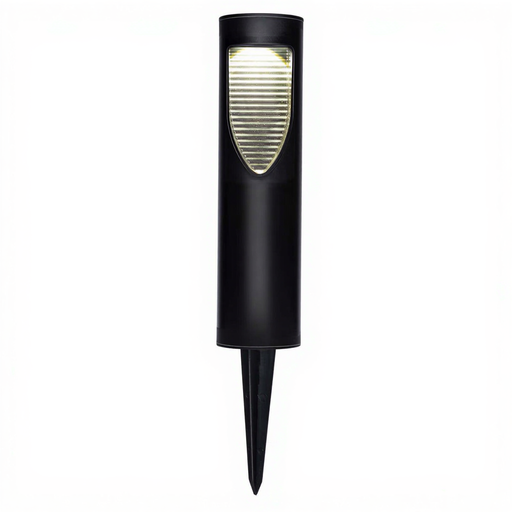
Why this product suits this profile: This freestanding light has a black plastic housing, a diameter of 8 cm and a height of 31 cm. It is designed for simple accent and path lighting without wall mounting.
The specifications clearly state that it has an integrated 600 mAh Ni-MH battery and warm white SMD LED light, rather than relying solely on a general promise of decorative appeal.
Automatic switching on at dusk and off at dawn; solar power and a rechargeable battery.

Why this product suits this profile: This model is appealing to users who look for clearly defined technical details in solar path lights, such as 6500 K, charging time, temperature range and protection rating.
The product specifications explicitly state the IP44 rating and warn that the light must not be immersed in water.
Polycrystalline solar cell; according to the product specifications, 4–6 hours of charging time and 8–12 hours of illumination under suitable conditions.
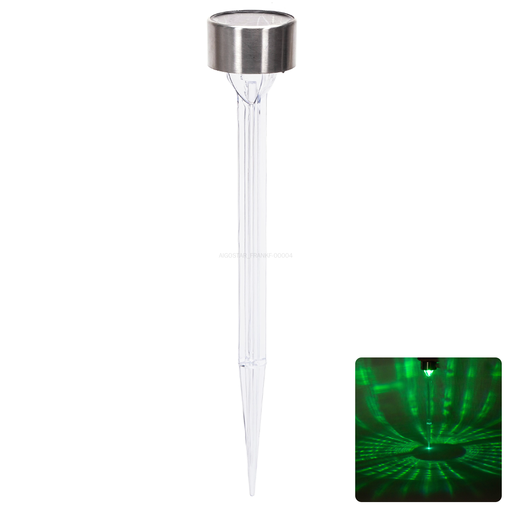
Why this product suits this profile: The RGB version is ideal for garden owners who want to add colourful decoration to paths, lawns or flower beds and combine several lights.
The specifications clarify the IP44 protection rating, state a battery capacity of 200 mAh and specify that the light is intended for outdoor use.
RGB lighting, ground-spike installation, a polycrystalline solar cell and, according to the product specifications, 8–12 hours of operating time under suitable conditions.
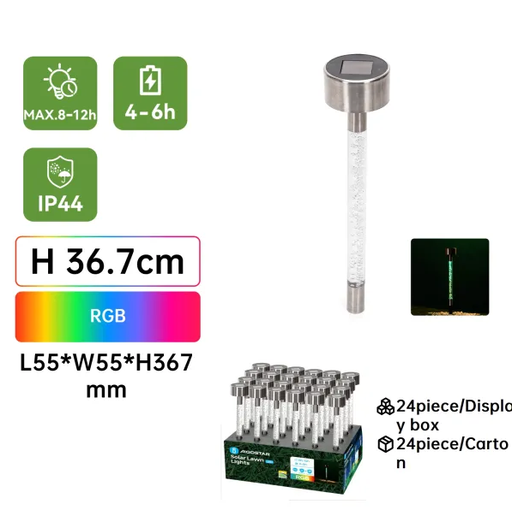
Why this product suits this profile: Standing 36.7 cm tall, the bubble design adds colourful accents to flower beds, lawns or patios without the need for a power cable.
The product description specifies the material, dimensions, IP44 rating, charging time and 40 mAh battery capacity. This makes it easier to assess both the appearance and the technical limitations.
RGB lighting, an integrated Ni-MH battery and automatic switching on in darkness; according to the product specifications, 8–12 hours of illumination under suitable conditions.
We have put together a complete, regularly updated list of products that fully meet these strict selection criteria and the safety regulations applicable in the EU.
Their lifespan depends on the battery, LED, material, frost, moisture and care. The Aigostar models mentioned here are stated to have an LED lifespan of up to 15,000 hours. This is a manufacturer’s specification for the light source and does not automatically represent the service life of the complete light. The battery may lose performance sooner due to charging cycles and exposure to the weather.
In winter, the days are shorter, the sun is lower in the sky and the panel often receives less direct sunlight. Cloud, snow and dirt can also reduce charging. A shorter operating time is therefore possible in these conditions and is not necessarily a sign of a fault.
While operating, solar lights draw their energy from the battery charged during the day and do not require a mains connection. Energy is used in their manufacture, battery production and disposal. For running costs, the key point is that no external power cable needs to be connected.