
Lieferung heute & morgen

Qualitätsgarantie

Willkommens-Angebote freischalten: KOSTENLOSE Lieferung | Bis zu 80 % RABATT | Kostenlose 30-Tage-JoyPlus-Testphase
App herunterladen
Solar garden lights provide cordless illumination for garden paths, lawns, flower beds, driveways and patios. They’re usually easy to install without tools: assemble the light, push the ground spike into suitable soil and position the solar panel so it gets as much sun as possible. It’s still worth checking the technical details carefully before you buy. A decorative design alone tells you little about how long a light will stay on, how well it will cope with the weather or where it’s best used.
Claims such as ‘shines all night’ generally apply only when the light has had suitable conditions for charging. Shade from walls, trees or tall plants reduces the solar energy available. Cloudy days and a dirty panel can also affect how long the light stays on.
Look for specific details about charging time, battery capacity and stated lighting duration. Some models, for example, are listed as taking 4 to 6 hours to charge and providing 8 to 12 hours of light. These figures are manufacturer’s claims under suitable conditions, not a guaranteed result at every location.
The term weatherproof doesn’t automatically mean a light can be left out in heavy rain, standing water or frost for long periods. The IP code gives you a more useful indication of protection. IP44 means the device is protected against solid objects larger than 1 mm and splashing water from different directions. It isn’t designed to be submerged in water.
If you’re choosing solar lights with ground spikes, also check that the temperature range suits the location. Several of the Aigostar models featured here are listed as suitable for temperatures from -10 °C to 50 °C.
RGB solar lights and bubble designs are primarily intended for decorative outdoor lighting. They add colourful accents to flower beds, lawns or the edge of a patio. For even illumination to help you find your way along a dark path, the light colour, mounting height and positioning are more important. A compact solar ground light can create atmosphere, but it won’t do the same job as a garden path light mounted higher up.
Also check whether the LED stays on continuously or switches on automatically only when it gets dark. The models described here switch on at dusk and off in daylight.
Several Aigostar lights are listed with an integrated Ni-MH battery. The Grundig model is listed as using an AAA battery. Check whether the battery is replaceable and what capacity is stated. A higher capacity may mean more stored energy, but it doesn’t tell you on its own how long the light will actually stay on.
Clean the solar panel regularly with a soft, slightly damp cloth. Don’t use abrasive cleaning products. During the day, the light should ideally get several hours of direct sunlight.
The height affects how far the light spreads across the ground. Ground-spike lights around 19 to 37 centimetres tall are suitable for flower beds, lawn edges and paths where a decorative look is the priority. They can be harder to install in hard or compacted soil. Don’t force the spike into dry, stony ground, as this could damage the casing or spike.
When checking the material, distinguish between genuine metal and a metallic finish. Some models have a silver stainless-steel look but are described in the product details as being made mainly from plastic. This helps you set realistic expectations about the design.

Why this product suits this profile: This black solar light is 34 cm tall, has two LEDs and is described as a cordless option for garden paths, driveways and pavements. The ground spike makes installation straightforward.
The product description gives specific dimensions, confirms there are two LEDs and lists an AAA battery, rather than relying on vague claims about brightness.
Subtle black design, automatic lighting and simple ground-spike installation.

Why this product suits this profile: This light combines a stainless-steel look with cool white light at 6500 K. It’s a good option for buyers who take colour temperature, protection rating and operating temperature into account.
The product details distinguish between the stainless-steel look and the predominantly plastic construction. They also specify IP44, a charging time of 4–6 hours and a lighting duration of 8–12 hours.
6500 K light colour, IP44 protection rating and a stated temperature range of -10 °C to 50 °C.
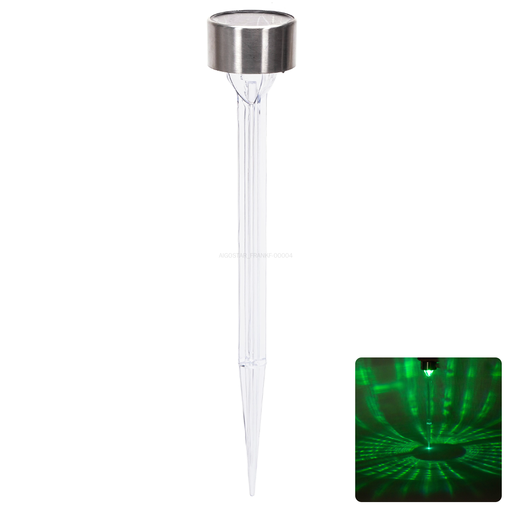
Why this product suits this profile: The RGB function is designed to add colourful accents along garden paths and to lawns and flower beds. The stated lighting duration of 8–12 hours suits automatic evening lighting when the battery has had enough charge.
The product details list RGB as the light colour and IP44 as the protection rating. This makes clear that it’s decorative outdoor lighting, not a floodlight.
RGB colour-changing light, 320 mm height and a Ni-MH battery with a stated capacity of 200 mAh.
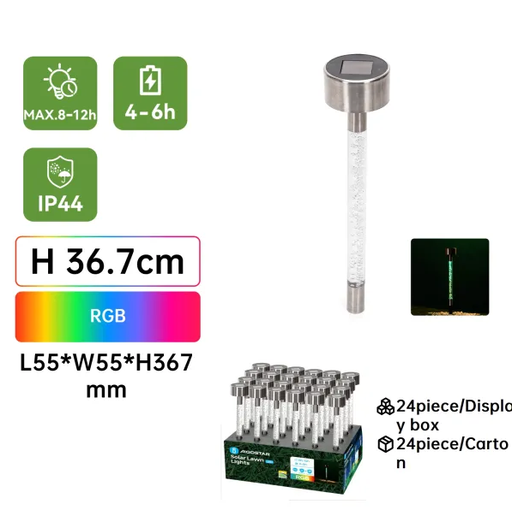
Why this product suits this profile: The bubble design and RGB lighting are ideal if you want to decorate a lawn, flower bed or patio. The light is 36.7 cm tall.
The description specifies a stainless-steel look with a plastic construction and clearly states the IP44 rating. This helps set realistic expectations about the material and water protection.
Bubble design, RGB light, 4–6 hours’ charging time and a stated lighting duration of 8–12 hours.
We’ve put together a complete, regularly updated list of products that meet these strict selection criteria and fully comply with the safety regulations in force in the EU.
For solar garden lights, choose a spot that gets as much direct sunlight as possible. Before installation, check:
Prolonged cloudy weather can reduce how long the light stays on. Solar lights should not be submerged in water or opened. Dispose of batteries and electronic components in accordance with local guidance.
It depends on the model and the light conditions. The Aigostar models mentioned here are listed as needing 4 to 6 hours to charge. In winter, in overcast conditions or in a shady spot, they may store less energy.
Their lifespan depends on the LED, battery, casing, weather and care. The product details for some models state an LED lifespan of up to 15,000 hours. The battery is a separate wear part and may lose capacity sooner.
During normal operation, they run on energy stored in the battery during the day, so they don’t need to be connected to the mains. However, you may incur costs later if you need to replace the battery. Check the stated battery type and look for a design that makes it easy to access.