
Lieferung heute & morgen

Qualitätsgarantie

Willkommens-Angebote freischalten: KOSTENLOSE Lieferung | Bis zu 80 % RABATT | Kostenlose 30-Tage-JoyPlus-Testphase
App herunterladen
Solar lights promise atmospheric garden lighting with no electricity costs or complex wiring. However, the reality is often quite different: lights that fail after the first rain shower, a runtime that barely lasts for a short evening, or materials that become brittle and unsightly after one winter. As your Joybuy Product Recommendation Officer, I'm here to help you sidestep these common traps and make an informed purchasing decision.
Many products on the market entice with appealing images but fail to meet basic quality standards. Pay close attention to these three weaknesses to avoid disappointment.
To avoid a bad purchase, you should be guided not by marketing promises, but by objective technical data. Here are the three most important parameters for durable and functional solar garden lighting.
The IP (Ingress Protection) rating indicates how well an electrical device is protected against the entry of foreign objects and water. For outdoor solar lamps, two values are particularly relevant:
The battery is the heart of every solar light, storing the energy collected during the day. Pay attention to its type and capacity:
The longevity of your solar light depends directly on its materials. Look for weather-resistant materials like ABS plastic, which is more impact-resistant and UV-resistant than standard plastic, or elements made of stainless steel, which resist corrosion. Whether it's a solar stake light in a flowerbed or a solar hanging light on a tree, solid construction is crucial for multi-year use.
Based on these objective criteria, we have selected a few products for different user profiles.
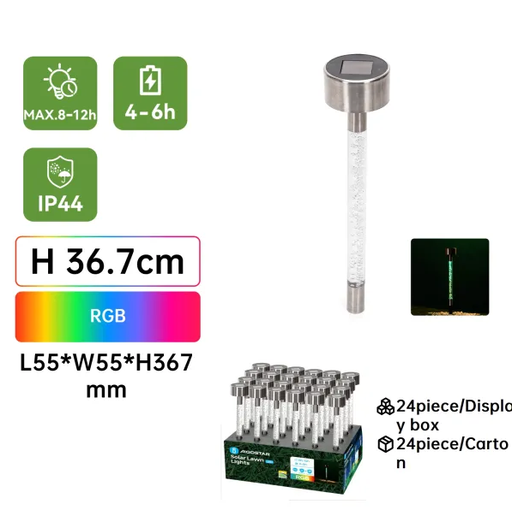
Why this product is a great fit: Perfect for adding colourful accents to flowerbeds, along pathways, or in planters on the balcony. This solar stake light offers a simple and cost-effective way to implement striking solar garden decor.
The IP44 rating is sufficient for use as a ground stake, as the electronics are elevated and not directly exposed to ground moisture. The product description provides a realistic runtime of 8–12 hours under good charging conditions, avoiding exaggerated claims.
Automatic RGB colour-changing for a dynamic lighting effect. Simple, tool-free installation.
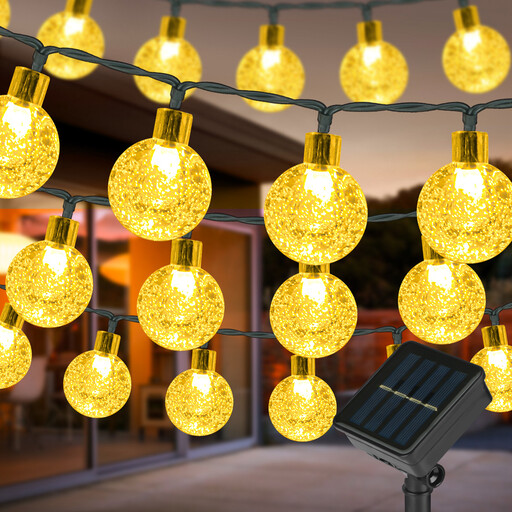
Why this product is a great fit: These outdoor solar string lights are perfect for bathing patios, balconies, or shrubs in a warm, inviting glow. Ideal for garden parties, holidays, or simply for cosy summer evenings.
With an explicitly stated IP65 rating, these string lights are protected against rain and weather, directly addressing the weakness of inadequate weatherproofing. The copper wire and ABS plastic materials are designed for outdoor use.
Eight different lighting modes (from steady on to flashing) allow for flexible customisation of the atmosphere. The specified runtime of 8–14 hours covers the entire night.
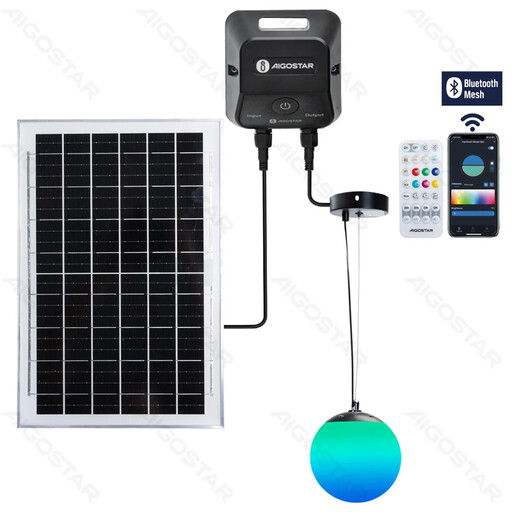
Why this product is a great fit: For users who want more than just simple lighting. This smart hanging light offers full control over brightness, colour, and schedules via an app, serving as a functional and decorative main light source for patios or seating areas.
This model addresses all three core problems: An IP65 housing made of robust ABS & PE protects against weather. A high-performance LiFePO4 battery with 8Ah capacity and an efficient monocrystalline solar panel ensure a long runtime (up to 24 hours according to the manufacturer) and high brightness.
Smart control via Bluetooth Mesh, which allows for networking over 200 devices. Adjustable colour temperature (RGBCCT) and brightness (350lm) for fully customisable lighting.
We have compiled a comprehensive, up-to-date list of products that fully meet these strict selection criteria and UK safety regulations.
The lifespan depends on several components. The LEDs themselves often have a stated lifespan of 15,000 hours or more. The critical factor is the battery, which typically lasts 1 to 3 years depending on quality and usage. On many higher-quality models, the battery can be replaced. The lifespan of the housing is determined by the material; UV-resistant plastic or stainless steel will last significantly longer than simple plastic.
Yes, but with reduced performance. Solar panels also charge in diffuse light, but much more slowly than in direct sunlight. Therefore, in winter or on heavily overcast days, the runtime will be shorter. Monocrystalline solar panels, as found in some premium lights, have a slightly higher efficiency in low light than polycrystalline or amorphous panels.
The most important point is the orientation of the solar panel. It should be placed in a location where it receives as much direct sunlight as possible during the day, without being shaded by trees, buildings, or eaves. Also, avoid placing it near other strong light sources (e.g., streetlights), as their light can trick the dusk sensor and prevent the solar light from turning on automatically.