
Lieferung heute & morgen

Qualitätsgarantie

Willkommens-Angebote freischalten: KOSTENLOSE Lieferung | Bis zu 80 % RABATT | Kostenlose 30-Tage-JoyPlus-Testphase
App herunterladen
By Joybuy Product Recommendation Officer, published on July 29, 2026
Solar lights promise an easy and cost-effective way to enhance your garden. With no wiring required and no extra electricity costs, they provide light for paths, flowerbeds, or patios. However, the selection is vast, and not every product lives up to its promise. Before you make a decision, it's important to understand the typical weaknesses that often only become apparent after the purchase.
Many buyers are disappointed after a short time because the lights don't deliver the expected performance or fail quickly. These problems can often be traced back to three core issues:
To avoid these pitfalls, you should carefully examine three technical specifications. These are the primary determinants of the performance and longevity of your new solar LED garden lighting.
The brightness of a light is measured in lumens (lm), not in watts. For purely accent lighting, values below 50 lm may be sufficient. However, if solar path lights are intended for orientation, values of 100 lm or more per light are recommended.
The colour temperature, specified in Kelvin (K), determines the atmosphere:
The IP rating indicates how well a light is protected against foreign objects and water. For outdoor solar lights, this is a critical quality feature.
The combination of the battery and solar panel is the engine of your light.
Instead of making a one-size-fits-all recommendation, we have put together products for different needs and user profiles.
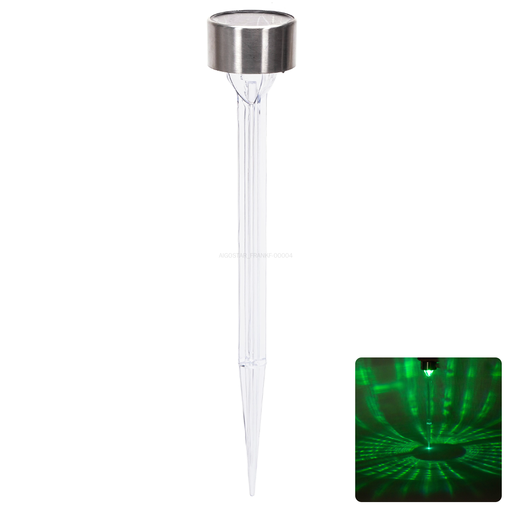
Why This Fits Their Persona: Ideal for users who want to add colourful accents to flowerbeds or along pathways with minimal effort. The ground-stake installation is straightforward and requires no technical expertise.
This light is clearly positioned for accent lighting and doesn't create the false impression of being a bright path light. The IP44 certification ensures the necessary protection against rain, thus preventing premature failure.
Automatic RGB colour-changing for dynamic effects. The stainless steel housing offers a more premium look than all-plastic models.
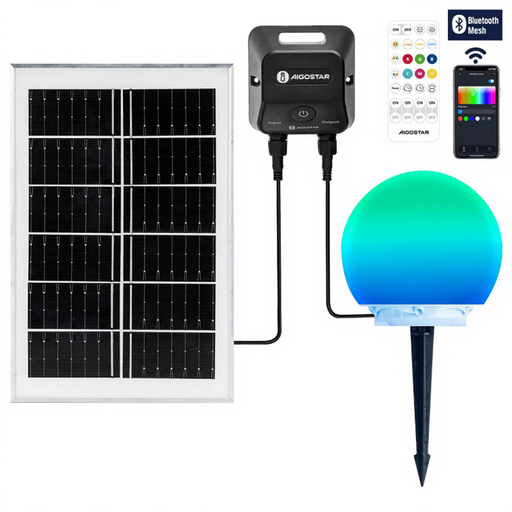
Why This Fits Their Persona: Perfect for users who want full control and connectivity. The app allows you to manage brightness, colour, and schedules for entire groups of lights—ideal for a sophisticated and smart garden design.
Thanks to the powerful 4000 mAh battery and a separate 5W monocrystalline panel, it bypasses the pitfall of short runtimes. The IP65 rating ensures the longevity of the electronics in all weather conditions.
Bluetooth Mesh technology for controlling over 200 lights. Full RGBCCT colour control (colours and white tones).
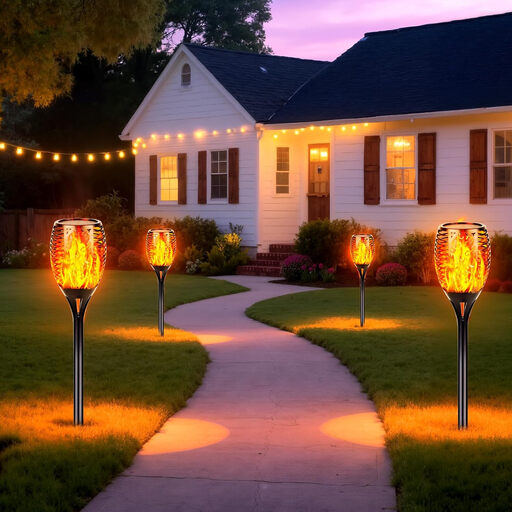
Why This Fits Their Persona: For anyone looking to create a special ambience. These solar torches imitate the flicker of a real flame and are perfect for decorating patios, pool areas, or garden parties.
While cheap torches often display an unnatural blinking, the 96 LEDs in this model create a convincing flame effect. The high IP65 rating ensures the torches will function reliably even after a summer thunderstorm.
Realistic, dancing flame effect. Thanks to its IP65 certification, it is very waterproof and robust.
We have compiled a complete, up-to-date list of products that fully meet these strict selection criteria and UK safety regulations.
The lifespan depends on three components. The LEDs themselves have a very long life, often 15,000 hours or more. The battery is the most common wear-and-tear component and can lose capacity after 2-4 years, depending on its quality and charge cycles. The solar panel is very durable but can lose efficiency due to dirt or debris. Regular cleaning with a soft cloth is therefore recommended.
Yes, but with reduced performance. Monocrystalline solar panels can charge even in diffused light, but much more slowly than in direct sunlight. In winter, the days are shorter and the sunlight is weaker, which leads to a shorter runtime at night. Optimal, south-facing placement without any shadows is crucial.
Installation is usually very simple. The most important factor is the location. Choose a spot where the solar panel will receive direct sunlight for as long as possible during the day. Avoid placing them under trees, eaves, or in the shadow of buildings. Before first use, the battery should ideally be fully charged on a sunny day.