
Lieferung heute & morgen

Qualitätsgarantie

Willkommens-Angebote freischalten: KOSTENLOSE Lieferung | Bis zu 80 % RABATT | Kostenlose 30-Tage-JoyPlus-Testphase
App herunterladen
Solar garden lights promise a simple and cost-effective way to beautify your outdoor space. With no wiring and no extra electricity costs, they transform balconies, patios, and gardens into atmospheric oases. However, the market is flooded with products whose real-world performance often fails to match the promises on the packaging. Many buyers are quickly disappointed when the lights only last for a few hours or when the first heavy rain causes a complete failure.
As your Joybuy Product Recommendation Officer, I'm here to help you identify the typical pitfalls. Instead of falling for exaggerated marketing claims, you should focus on verifiable technical specifications. Here are the three most common problems and how to avoid them.
To make an informed decision that fits your specific needs, you should check three core technical parameters. These give you an objective basis for evaluating the quality of solar garden lighting.
The IP (Ingress Protection) rating indicates how well an electrical device is protected against the ingress of solid particles (first digit) and water (second digit).
The runtime depends directly on the stored energy. Pay attention to the battery capacity, given in milliampere-hours (mAh). A 1200 mAh battery can theoretically supply power for twice as long as a 600 mAh model with the same consumption. The efficiency of the solar panel is just as important. Monocrystalline and polycrystalline panels are common technologies here, which can still generate a certain amount of charge even in diffuse light.
The ambience is largely determined by the light colour, which is measured in Kelvin (K).
Some models, such as a solar floodlight with a motion sensor, combine functionality with efficiency by activating full brightness only when needed, thus conserving the battery.
Based on these objective criteria, we have identified some products that are suitable for different needs and outdoor areas.

Why This Fits Their Persona: Ideal for anyone looking for flexible and atmospheric outdoor solar string lights for the balcony, patio, or for decorating plants. The flexible copper wire can be easily shaped as desired.
With an IP65 rating, these string lights are explicitly protected against water jets, thus avoiding the trap of inadequately weatherproof products. The warm white light provides the desired cosy atmosphere.
Offers 8 different lighting modes with a memory function. The set includes two separate 8-metre string lights for versatile applications.
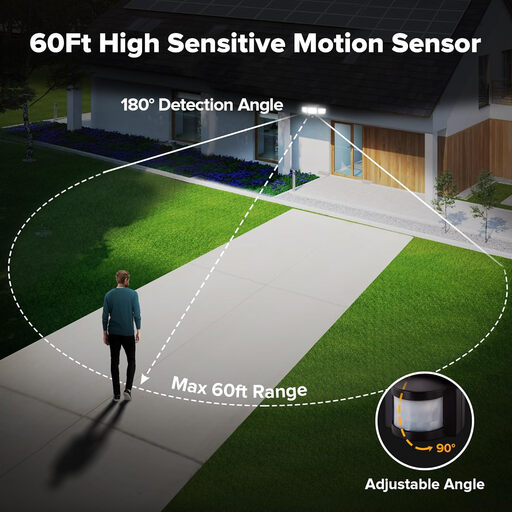
Why This Fits Their Persona: Perfect for illuminating driveways, garages, or dark corners of the garden. This solar floodlight with motion sensor primarily serves security and functionality.
This floodlight solves the problem of inadequate brightness with a powerful 3000 lumens. The motion sensor mode ensures a long battery life by only using full power when needed, bypassing the unrealistic continuous runtime trap.
Three flexibly adjustable light heads provide a wide 270° illumination angle. The IP65 certification ensures high weather resistance.
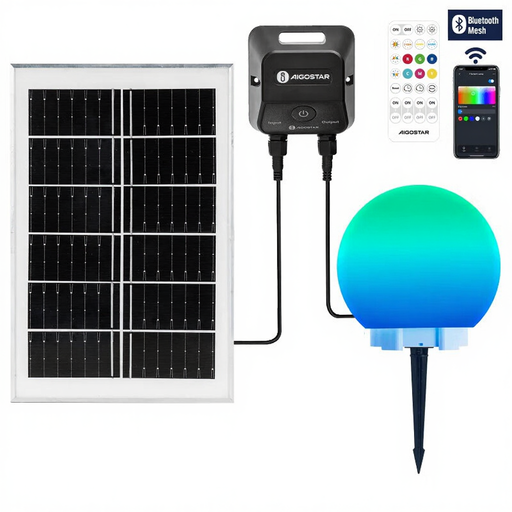
Why This Fits Their Persona: For users who want full control over their garden lighting. Ideal for creating complex lighting scenes in larger gardens by networking multiple lights together.
This model solves the "wrong light colour" problem by offering full control over RGBCCT (colour and white tones from 2700K-6500K) via an app. Schedules and dimmability help to manage battery life intelligently.
Controlled via the AigoSmart app using Bluetooth Mesh technology. Allows for grouping and synchronous control of up to 200 devices without an additional hub.
We have compiled a complete, up-to-date list of products that fully meet these strict selection criteria and UK safety regulations.
Yes, but with limitations. The charging performance of solar lights is reduced in winter due to shorter days and a lower sun angle. Models with high-efficiency solar panels and large batteries will still work on cloudy days, but the runtime is typically shorter than in summer. It's important to keep the solar panel free of snow and debris to ensure maximum charging performance.
The lifespan of a solar light is determined by two main components: the LED and the battery. The LEDs themselves are very durable and can have a lifespan of 15,000 hours or more. The rechargeable battery, however, is a wear-and-tear component. Depending on its quality and usage, it typically needs to be replaced after one to three years.
Installation is usually very simple. The most important factor is the placement of the solar panel. It should be positioned in a location that receives as much direct sunlight as possible throughout the day. Avoid locations in the shade of trees, buildings, or overhangs. Also, ensure that the light is not illuminated by other artificial light sources (e.g., streetlights), as this may prevent the dusk-to-dawn sensor from triggering correctly.