
Lieferung heute & morgen

Qualitätsgarantie

Willkommens-Angebote freischalten: KOSTENLOSE Lieferung | Bis zu 80 % RABATT | Kostenlose 30-Tage-JoyPlus-Testphase
App herunterladen
Solar garden lights seem straightforward at first glance: put them in place, wait for the sun, and the light switches on automatically in the evening. In practice, however, the location, protection rating, battery and light colour determine whether your garden lighting is a lasting fit for your outdoor space. If you only look for a particular design or long operating time, you may overlook important details.
Claims such as “up to 8–12 hours” generally refer to suitable charging conditions. In shady locations, during short winter days or after several rainy days, the actual operating time may be shorter. A small solar panel needs as many direct hours of sunshine as possible.
You should therefore look for:
A rating such as IP44 means protection against solid foreign objects measuring 1 millimetre or more, as well as splashing water from various directions. This is sufficient for many solar garden lights, but it does not mean that the product may be immersed in water. On covered patios, open lawns or in flowerbeds, the light should be positioned so that water cannot collect around the housing for prolonged periods.
For more exposed locations, outdoor LED solar lights with a higher protection rating may be a sensible choice. Even then, the manufacturer’s installation instructions remain the key reference.
Warm white solar lights at around 2700 Kelvin create a yellower, more understated lighting effect. They are often suitable for flowerbeds, patio edges and decorative areas. Cool white light at around 6500 Kelvin appears much more neutral to bluish and can highlight the contours of paths more clearly.
RGB solar lights, on the other hand, switch between different colours. They are an attractive choice for decorative accents, but do not automatically replace even path lighting. So consider whether you are looking for a solar garden light mainly for guidance or primarily for decorative purposes.
For paths, lawns and flowerbeds, solar ground lights or solar lights with ground spikes are practical because no power cable needs to be installed. The ground spike should be inserted into soft, stable soil. In very hard or frozen ground, the plastic may be damaged if the light is pushed in with force.
With IP44, the rule is: protection against splashing water is provided, but prolonged immersion is not. You should also check the specified temperature range. Some models, for example, are rated for -10 °C to 50 °C.
Ni-MH batteries are common in many compact solar lights. Capacity is given in milliampere hours, such as 40 mAh, 200 mAh or 600 mAh. A larger capacity alone is not enough to indicate quality, as LED output, panel size and control electronics also play a role.
Many models charge during the day and switch on automatically when it gets dark. Before first use, the light should be exposed to several hours of direct sunlight in accordance with the instructions. Clean the solar panel regularly with a soft cloth, as dust and pollen can reduce charging performance.
A stainless-steel look may be made from genuine stainless steel or from plastic with a corresponding finish. This distinction should be checked in the product description. For windy locations, weight, spike length and soil conditions are all relevant. Lightweight models are easy to move, but need a secure base.
For long paths, a solar light set is often more practical than buying lots of individual products, as several lights create a consistent appearance. With sets, check the number of lights included and whether each light has its own solar panel.
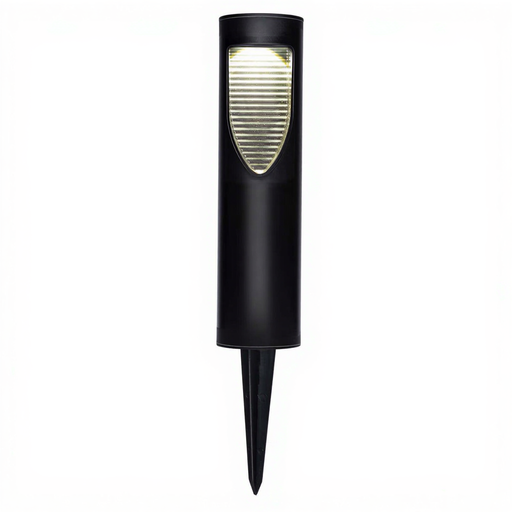
Why this product suits this profile: The warm white SMD LED and automatic switching on and off are ideal for shoppers looking for straightforward, subtle lighting for flowerbeds or paths.
The product details specify the battery type and capacity: an integrated 600 mAh Ni-MH battery. They also explicitly state that direct sunlight is required and that prolonged immersion must be avoided.
Warm white light, 600 mAh Ni-MH battery, 8 cm diameter and 31 cm height according to the product description.
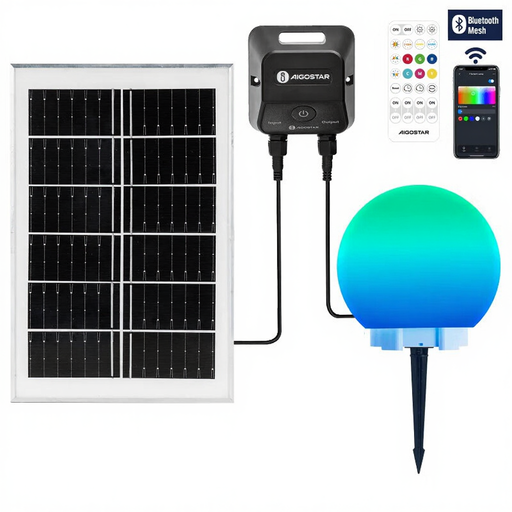
Why this product suits this profile: The combination of RGB+CCT, app control and Bluetooth Mesh is designed for users who want to group several lights and adjust light colours precisely.
The product description states the IP54/IP44 protection ratings and explicitly notes that the light must not be immersed. This makes it easier to plan where to install it.
RGB+CCT from 2700–6500 K, Bluetooth Mesh connection, AigoSmart app and integrated lithium battery according to the product details.
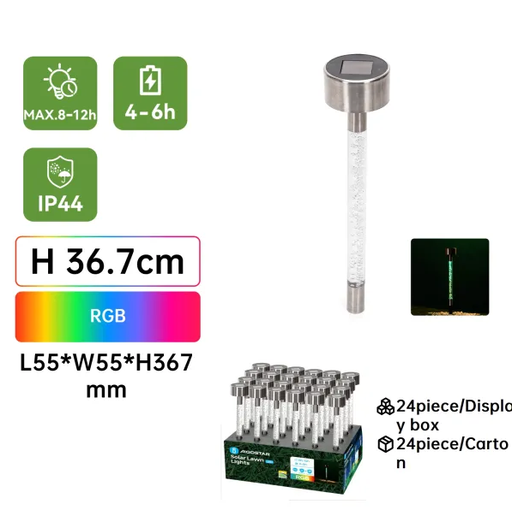
Why this product suits this profile: The decorative bubble design and colour-changing function are ideal for flowerbeds, lawn edges and patios where visual appeal is more important than directed illumination.
The product details specify the charging time, expected operating time and IP44 protection rating. This makes it easier to assess the light objectively for a sheltered location.
RGB light, 36.7 cm height, charging time of around 4–6 hours and a stated lighting duration of 8–12 hours under suitable conditions.
We have compiled a complete, regularly updated list of products that fully meet these strict selection criteria and the safety regulations applicable in the EU.
Place the solar panel in a location that is as sunny and unobstructed as possible. Insert the ground spike into soft, stable soil or lawn. Before first use, the light should charge for several hours in accordance with the instructions. Also check that the automatic dusk sensor and on/off switch are activated.
Their lifespan depends on the battery, LED, materials, weather conditions and care. For some products, for example, 15,000 operating hours are stated as the LED’s rated lifespan. This does not mean that the entire light will have the same overall lifespan. The battery may lose capacity sooner. Regularly cleaning the panel and choosing a suitable location will help support the intended operation.
During normal operation, solar lights draw their energy from the integrated panel and do not need to be connected to the mains. This means they do not add to your daily electricity consumption from a socket. However, you should still take into account any costs for replacement batteries and the proper disposal of batteries and electronic components.