
Lieferung heute & morgen

Qualitätsgarantie

Willkommens-Angebote freischalten: KOSTENLOSE Lieferung | Bis zu 80 % RABATT | Kostenlose 30-Tage-JoyPlus-Testphase
App herunterladen
Solar garden lights promise hassle-free garden lighting without a mains connection: charge during the day and switch on automatically at dusk. In practice, however, the result depends heavily on the location, battery capacity and IP rating. Anyone choosing based solely on design or a low price may end up with lights that barely charge in the shade, become dimmer after a few hours or are unsuitable for areas that remain permanently wet.
This buying guide explains which details really matter when choosing solar lights for the garden and which models suit different situations.
The term waterproof garden lighting is sometimes used rather loosely by retailers. The specific IP rating is what really matters. IP44 means protection against solid foreign objects measuring 1 mm or more, as well as splashing water from different directions. A light with this rating is suitable for normal outdoor use, but should not be left standing in a puddle or fully submerged in water.
IP44 may be sufficient for covered patios, flower beds and paths. For locations that are permanently exposed to the elements, buyers should check the product specifications more carefully and position the light at a raised level, with sufficient distance from standing water.
Figures such as “8–12 hours” refer to suitable charging conditions. In autumn and winter in the UK, cloudy skies, shorter days, low sun levels and shade can reduce charging time. A solar light with a long stated operating time is therefore not automatically suitable for every location.
The solar panel should receive several hours of direct daylight. Trees, house walls, balcony railings and garden lights positioned beneath dense foliage can reduce performance.
RGB solar lights create colourful accents, but do not necessarily provide enough illumination for steps or driveways. For paths, evenly distributed solar ground lights or lights with ground spikes are a sensible choice. For stairs, entrances and dark passageways, buyers should also consider light distribution, mounting height and brightness specifications.
A stated charging time of, for example, 4–6 hours, describes the time required under suitable conditions. For actual use, the battery type and capacity are also important. NiMH batteries are often used; smart models may feature integrated lithium batteries.
Capacity alone does not tell you everything about operating time, however. LED output, lighting mode and ambient temperature also affect how long a solar-powered outdoor light remains active at night. An automatic dusk sensor is practical for paths and flower beds, as no additional switch is required.
The colour rendering index may also be a factor when choosing a light. For example, the Aigostar model with 6500 K has a stated rating of Ra ≥ 70. This is an objective technical specification relating to colour rendering, but does not indicate a particular level of lighting quality in every environment.
A stainless-steel look does not automatically mean that the entire light is made from stainless steel. Several models have housings made mainly from plastic with a silver or stainless-steel-effect finish. This can reduce the weight, but should be taken into account when choosing where to position the light.
Lights with ground spikes require soft, stable soil. In very hard or stony ground, the spike may be damaged. Solar lights with ground spikes are generally easy to position on lawns and in flower beds. On solid patios, freestanding models or solar ground lights with a suitable base may be more practical.
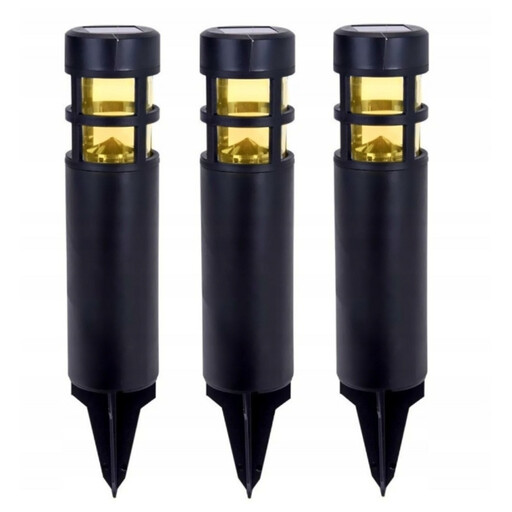
Why this product suits this profile: This set of three lights is ideal for buyers who want to illuminate paths, flower-bed edges or small lawns with several points of light, without having to buy a larger quantity individually.
The product description clearly states the quantity and mentions automatic activation at dusk. Before buying, check that the location receives direct sunlight.
Three lights in one pack; designed for simple, decentralised garden lighting without a fixed mains connection.

Why this product suits this profile: This light is aimed at buyers who want to compare a clearly defined light colour with technical details such as charging time, operating time, colour rendering and IP rating.
The specifications state a charging time of 4–6 hours, a lighting duration of 8–12 hours and IP44 protection. This makes it easier to assess whether the light is suitable for a sheltered outdoor area.
6500 K light, polycrystalline solar panel, NiMH battery and a stated lifespan of 15,000 hours.
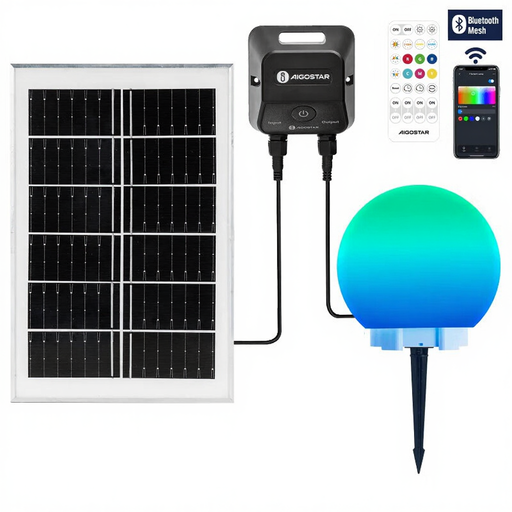
Why this product suits this profile: This model is designed for users who want to group several lights via an app, adjust colours or white tones and control lighting schedules.
The control method is specified as Bluetooth Mesh with the AigoSmart app. The IP54/IP44 ratings are also differentiated; the light must therefore not be submerged.
RGB+CCT with a range of 2700–6500 K; app control, grouping and scheduling are supported.
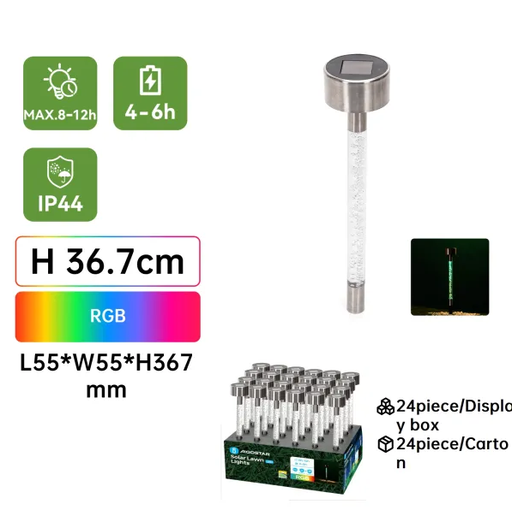
Why this product suits this profile: The 36.7 cm-high Bubble design is suitable for flower beds, lawns and paths where colourful accents matter more than bright functional lighting.
The IP44 rating makes it clear that the light can withstand splashing water, but is not designed to be submerged. It should be positioned in soft ground with the panel unobstructed.
RGB light, 36.7 cm height, NiMH battery and a stated charging time of 4–6 hours.
We have put together a complete, regularly updated list of products that fully meet these strict selection criteria and the safety regulations applicable in the EU.
For even solar path lighting, choose a location that is as sunny as possible, with sufficient space between the individual lights. The ground spike should be positioned vertically and should not be pushed into the ground with excessive force. Before first use, charge the integrated battery according to the product instructions.
Clean the panel regularly with a soft, damp cloth. Dust, pollen and leaves can reduce the amount of light it receives. Abrasive cleaning products are unsuitable. In frosty conditions, during prolonged wet weather or when light levels are very poor, it may be advisable to store the light somewhere sheltered temporarily, provided this is recommended in the instructions.
Many models state a charging time of around 4–6 hours under suitable conditions. The actual time depends on sunlight, orientation, shade, the time of year and how clean the panel is.
Models with IP44 protection are resistant to splashing water and suitable for many outdoor areas. However, they should not be left permanently in standing water or submerged. Always check the specific IP rating in the relevant product description.
They do not require a mains connection while operating, as the battery charges via the solar panel during the day. Energy yield and nighttime operating time depend on the charging conditions and the lighting mode selected. This makes them particularly suitable for garden lighting without a mains connection along paths, in flower beds, on lawns and on patios.