
Lieferung heute & morgen

Qualitätsgarantie

Willkommens-Angebote freischalten: KOSTENLOSE Lieferung | Bis zu 80 % RABATT | Kostenlose 30-Tage-JoyPlus-Testphase
App herunterladen
Solar garden lights illuminate paths, flower beds and patios without the need for a permanent power connection. For tenants, gardeners and homeowners, easy installation is a major advantage: insert the ground spike, position the solar panel and use the automatic dusk sensor. However, certain marketing claims and unclear technical specifications often lead to disappointing purchases.
Typical problems occur when the light is positioned in a shady spot, the IP rating is unsuitable for the surroundings or the stated lighting duration only applies under ideal conditions. A decorative RGB function cannot replace adequate guidance lighting on a path either. That is why our selection focuses on clear specifications such as IP rating, battery type, charging time, lighting duration and mounting type.
Manufacturers’ operating-time specifications usually refer to suitable charging conditions. In autumn and winter in the UK, short days, overcast skies or an unfavourable orientation can reduce the available energy. A solar light with a stated runtime of 8 to 12 hours will therefore not necessarily shine for the same length of time every night.
A position with as much direct sunlight as possible is important. Trees, house walls and tall shrubs can partially or completely shade the panel.
An IP44 solar light is protected against solid foreign objects measuring 1 millimetre or more, as well as splashing water. It is suitable for many sheltered outdoor areas, but should not stand in water or be installed in a permanently wet hollow.
IP67 solar lights offer a higher level of protection against dust and temporary immersion under the conditions defined by the IP rating. Even so, cable connections, seals and the installation position must comply with the manufacturer’s specifications. The IP rating alone does not guarantee trouble-free use in every installation situation.
RGB solar lights create colourful lighting effects and are suitable for flower beds, lawns, balconies or patios. For steps and heavily used paths, however, light distribution is the key consideration. Decorative pinpoint lighting can mark a path, but may not always illuminate it sufficiently.
If you need safe guidance lighting, pay attention to the light colour, beam angle, mounting height and distance between the lights. RGB models can be used as an additional feature for atmospheric garden lighting.
Solar lights with ground spikes can be inserted into soft soil or lawns and repositioned without tools. They are less suitable for hard, compacted ground, as forcing the spike into the soil can damage the spike or housing.
Solar ground lights sit on the surface or are partially inserted into the ground. They are suitable for edging flower beds and patios, but can become a trip hazard if they are not flush with the surface in walking areas.
Recessed solar lights require a suitable opening and a stable surround. Before buying, check the diameter, installation depth and cable routing. For models with a separate panel, the cable length is also important.
An integrated NiMH battery is found in many compact solar lights. Specifications such as 4 to 6 hours’ charging time and 8 to 12 hours of illumination apply under suitable conditions. Larger smart lights may also use lithium batteries with a higher capacity.
Pay attention to:
Aggressive or abrasive cleaning products can damage the surface of the panel.
Outdoor LED solar lights require little energy and are available in different light colours. Cool white light at around 6500 K appears clear and high-contrast, while RGB models can switch between several colours. Smart solar garden lighting offers additional functions such as app control, schedules, brightness adjustment and grouping of multiple lights.
Bluetooth Mesh can enable several lights to be connected. Before buying, check whether a smartphone, a specific app or an additional hub is required.

Why this product suits the profile: This ground-spike light is designed for simple marking along paths, lawns and flower beds, with no mains connection required.
The product specifications explicitly state a charging time of 4–6 hours, a lighting duration of 8–12 hours and an IP44 rating.
Cool white light at 6500 K, a NiMH battery, a polysilicon panel and a stated temperature range of -10 °C to 50 °C.
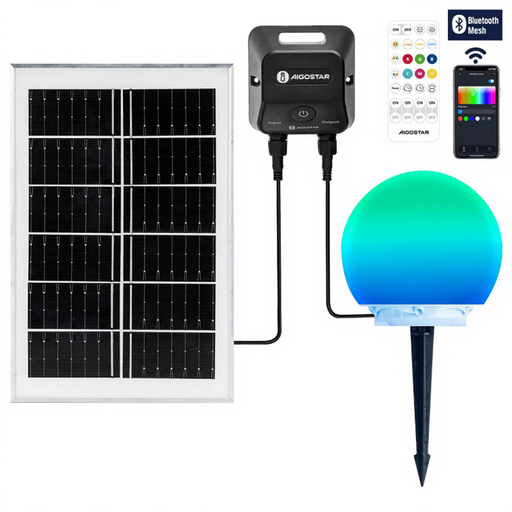
Why this product suits the profile: This model is aimed at users planning to install a recessed light with variable light colour and a higher IP rating.
The specifications state IP67, a separate solar panel with cable and a 4000 mAh lithium battery.
RGB and CCT lighting from 2700 K to 6500 K, Bluetooth Mesh control and a stated lighting duration of up to 24 hours.
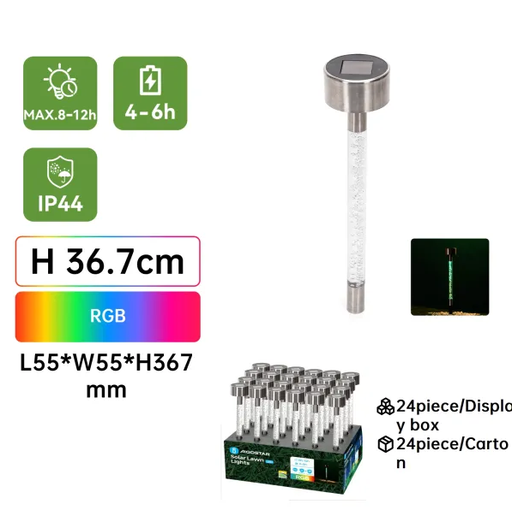
Why this product suits the profile: This compact RGB light is ideal for adding colourful accents to flower beds, lawns, paths or patios.
The product description highlights IP44, a temperature range of -10 °C to 50 °C and the need for direct sunlight.
RGB lighting, a height of 36.7 cm, a 40 mAh NiMH battery and, according to the product specifications, 4–6 hours’ charging time and 8–12 hours of illumination.
We have put together a complete, regularly updated list of products that fully meet these strict selection criteria and the safety regulations applicable in the EU.
The solar panel should receive as much direct sunlight as possible and not be covered by trees, buildings or parasols. For ground-spike models, a firm yet soft surface is ideal. Before first use, charge the light according to the product instructions. The panel will stay cleaner and work more efficiently if dust is regularly removed with a soft cloth.
Service life depends on the LED, battery, housing, weather conditions and maintenance. Several Aigostar models are specified with an LED lifespan of up to 15,000 hours. The battery is a wearing part and may lose capacity earlier depending on charging cycles and temperatures. LED lifespan specifications should therefore not automatically be equated with the service life of the entire light.
Solar lights do not require electricity from the household mains while operating. They charge their integrated battery during the day via the solar panel. Under normal use, their energy consumption from the public electricity grid is therefore zero. However, you should take the purchase, maintenance and, for certain models, a later battery replacement into account.