
Lieferung heute & morgen

Qualitätsgarantie

Willkommens-Angebote freischalten: KOSTENLOSE Lieferung | Bis zu 80 % RABATT | Kostenlose 30-Tage-JoyPlus-Testphase
App herunterladen
Solar garden lights provide outdoor lighting without permanently installed cables or a direct mains connection. The integrated solar panel charges during the day, and the light switches on automatically when it gets dark, depending on the model. It sounds straightforward, but some product claims can create unrealistic expectations when you are buying.
Typical pitfalls include:
For seating areas, flower beds and patios, warm white solar lights with a colour temperature of around 2700 K to 3000 K are often a good choice. The light is subtle and well suited to decorative solar-powered garden lighting.
Cool white light in the region of 6500 K can make the contours of paths stand out more clearly. However, it is more striking and will not suit every outdoor area. A 6500 K light should therefore be used specifically for paths, borders or driveways.
RGB solar lights switch between different colours and are primarily suitable for decorative accents. For consistent guidance along a path, warm white or cool white light is usually easier to see by.
When choosing solar lights for the garden, three specifications are particularly relevant:
For example, several Aigostar models are stated in the product specifications to have a charging time of around 4 to 6 hours and an operating time of 8 to 12 hours. This assumes a suitable location with direct sunlight. Before first use, the battery should be charged according to the instructions.
The IP rating describes how well a product is protected against the ingress of solid foreign objects and water. IP44 provides protection against solid foreign objects measuring 1 mm or more, as well as splashing water from different directions. However, an IP44 light should not be submerged or installed in a hollow that is regularly flooded.
When installing solar spike lights and solar path lights, the type of ground is also important. The ground spike should be pushed into soft but firm soil or grass. In very hard, stony or frozen ground, the spike may be damaged. For patios, freestanding models with a stable base or suitable floor mounting are usually more practical.

Why this product suits the profile: This classic solar spike light is suitable for shoppers who want to mark a path, driveway or lawn area without cables. It is installed using the ground spike.
The description states a specific size of 6.5 × 34 cm, two LEDs and a replaceable AAA battery. This makes the key product details easier to assess.
Cable-free installation, automatic lighting and a weight of 402 g according to the product description.

Why this product suits the profile: This model is aimed at shoppers who value a clearly defined colour temperature and technical specifications for outdoor use.
The product specifications state 6500 K, Ra≥70, IP44 and a temperature range of -10 °C to 50 °C. This makes it easier to choose a suitable location.
Polycrystalline solar panel, NiMH battery and a stated lifespan of 15,000 hours.
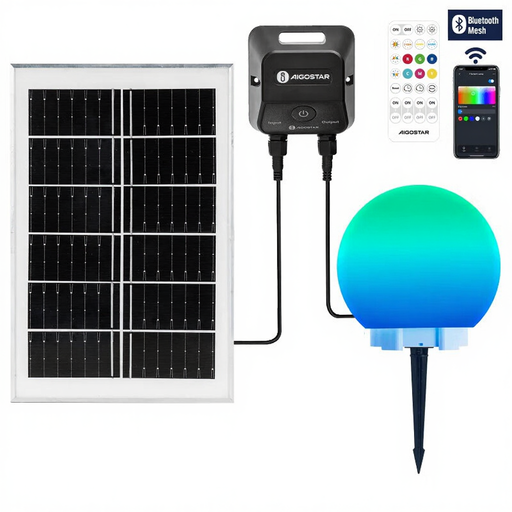
Why this product suits the profile: For larger garden areas or users who want app control, this model offers Bluetooth Mesh and RGB+CCT lighting control.
The IP54/IP44 protection ratings indicate that this model is not designed for submersion. The app functions also require the appropriate set-up.
RGB+CCT from 2700 K to 6500 K, plus group control via the AigoSmart app.
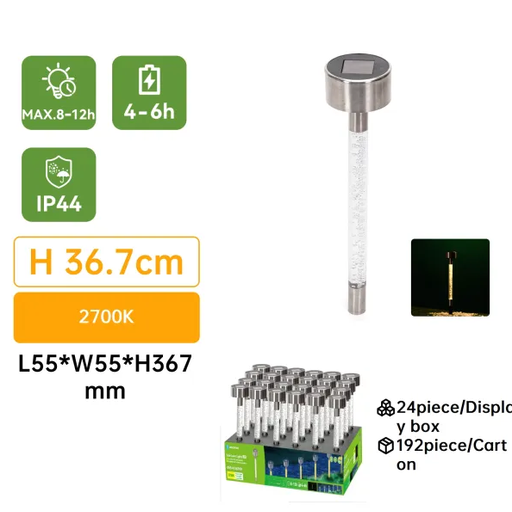
Why this product suits the profile: The bubble effect and warm white light are well suited to flower beds, lawns, paths and patios when the light is intended primarily to add decorative accents.
The product description explicitly states IP44 and advises against leaving the light permanently submerged in water. This clearly defines its suitable garden applications.
Warm white light at 2700 K, a 40 mAh NiMH battery and a stated operating time of 8 to 12 hours under suitable charging conditions.
We have put together a complete, regularly updated list of products that fully meet these strict selection criteria and the safety regulations applicable in the EU.
For solar garden lights, the location is crucial. Keep the following points in mind:
For rented properties, solar spike lights, solar ground lights and freestanding models are practical because they normally require no alterations to the building’s electrical system. Permanently installed wall or mains-powered lights, on the other hand, may require permission and professional installation.
Operating time depends on the solar panel, battery, sunlight, temperature and shade. The Aigostar models mentioned above are stated in the product specifications to provide around 8 to 12 hours of light. On short, cloudy days, the actual operating time may be shorter.
An IP44 rating means protection against splashing water, not complete submersion. Products described as weatherproof solar lights should therefore not be placed in pools of water, drainage channels or areas that are regularly flooded.
They do not need a connection to the mains while operating. The solar panel charges the integrated battery during the day. This means they do not incur ongoing mains electricity costs; however, the battery and solar panel are wear parts, and their service life depends on the conditions of use and maintenance.