
Lieferung heute & morgen

Qualitätsgarantie

Willkommens-Angebote freischalten: KOSTENLOSE Lieferung | Bis zu 80 % RABATT | Kostenlose 30-Tage-JoyPlus-Testphase
App herunterladen
Solar garden lights provide garden lighting without a mains connection. During the day, the solar panel charges the battery, and at dusk the light switches on automatically, depending on the model. This is practical for lawns, flowerbeds, patios, balconies, driveways and paths.
However, product specifications are not always directly comparable. With solar lights, a higher wattage does not automatically mean greater brightness. Terms such as “waterproof” or “suitable for all weather conditions” should also be checked against the IP rating. That is why our selection focuses on clear technical specifications and different usage scenarios.
The IP44 rating protects against solid foreign objects measuring 1 millimetre or more, as well as splashing water from various directions. This may be sufficient for sheltered flowerbeds, lawns and paths. However, a light with this rating should not be placed in puddles or exposed to heavy rain for prolonged periods.
For exposed locations, driveways or wall-mounted installation, higher ratings such as IP65 or IP67 may be more suitable, depending on the design. IP67 additionally means protection against temporary immersion under defined test conditions. The specific installation instructions remain the deciding factor.
Specifications such as “8 to 12 hours” generally assume that the solar panel has been sufficiently charged. In autumn and winter in the UK, shorter days, overcast skies, shade and dirty panels can reduce the available lighting duration.
You should therefore look for:
Small solar stake lights or bubble lights usually create an atmospheric lighting effect. They do not replace powerful lighting for stairs, work areas or a large driveway. For these applications, the lumen output, beam angle and installation height are key.
Solar path lighting with a low light output is suitable for orientation. For larger areas, solar floodlights or powerful outdoor spotlights are generally more appropriate.
Colour temperature is measured in Kelvin:
A colour rendering index of Ra ≥70 describes how naturally colours appear under the light. This value is usually sufficient for basic orientation lighting. For plants, decorations or colourful objects, a higher colour rendering index may be beneficial.
Ni-MH batteries are often used in compact solar lights. Larger solar floodlights sometimes use lithium batteries with a higher capacity. However, battery capacity alone does not indicate how brightly or for how long a light can operate. The key factor is the interaction between LED output, solar panel, charging electronics and operating mode.
If you are using several lights, their solar panels should not remain in permanent shade. Regular cleaning with a soft, damp cloth can help prevent dust from reducing charging performance. Abrasive cleaners are not suitable for solar panels.
Solar stake lights can be inserted into soft soil or lawns without tools. In compacted ground, the stake should not be pushed in with excessive force, as this could damage the plastic parts.
Freestanding models or lights with a stable base are suitable for balconies and patios. Solar ground spotlights and recessed lights, on the other hand, require a suitable surface and careful sealing. Before buying, check the dimensions, cable routing, ground conditions and whether the battery will remain accessible later on.

Why this product suits this profile: This stake light is designed for straightforward solar path lighting on lawns, beside flowerbeds and along smaller paths. According to the product specifications, it takes around 4–6 hours to charge and provides 8–12 hours of light under suitable conditions.
The specifications clearly state the charging time, lighting duration and IP44 rating. This makes it easier to distinguish the light from models with runtime claims that are not explained in detail.
6500 K cool white light, solar operation without a mains connection and a specified operating temperature of -10 °C to 50 °C.
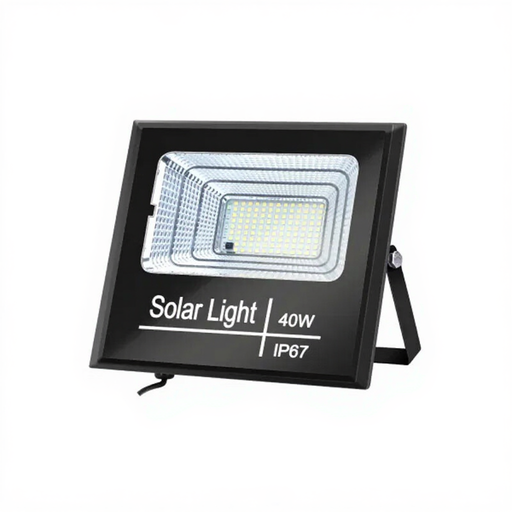
Why this product suits this profile: The separate solar panel allows more flexible positioning if the intended installation site does not receive enough sunlight itself. According to the product description, the model has a 10,000-mAh battery and is designed to provide up to 12 hours of lighting.
The stated IP67 rating and separate-panel design address two common weak points: unsuitable positioning and insufficient weather resistance.
Aluminium and glass construction, separate solar panel and a stated battery capacity of 10,000 mAh.
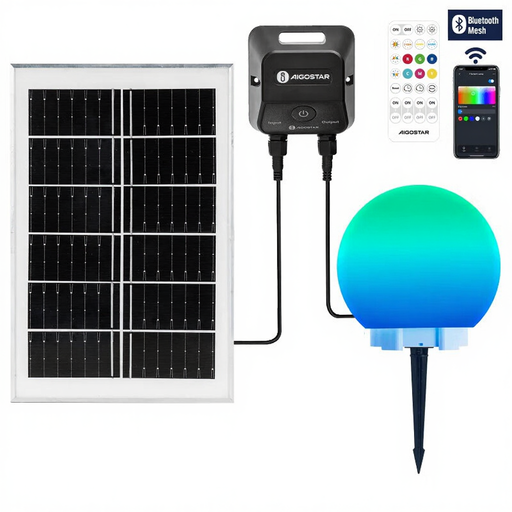
Why this product suits this profile: This model is aimed at users who want to combine RGB and white light and group several lights using an app. According to the product description, it offers 2700–6500 K, Bluetooth Mesh and schedules via the AigoSmart app.
The control method and adjustable white-light range are clearly specified. Before buying, you should still check whether the IP54/IP44 rating is suitable for the intended installation location.
RGB+CCT colour control, app operation and grouping of several lights via Bluetooth Mesh.
RGB solar lights are designed for decorative splashes of colour in flowerbeds, on patios or as part of seasonal displays. For clear orientation along paths, warm white or cool white light is often easier to interpret. Warm white creates a subtle effect, while 6500 K produces a more functional lighting effect.
If you want to illuminate a larger area, compare the technical specifications of a solar floodlight rather than using several small decorative lights. Important factors include luminous flux in lumens, mounting angle, battery capacity, solar panel and IP rating. Non-solar outdoor LED solar lights should not be treated as equivalent to mains-powered LED spotlights, as the available energy depends on daylight.
We have put together a complete, regularly updated list of products that fully meet these strict selection criteria and the safety regulations applicable in the EU.
Some models specify an LED lifespan of up to 15,000 hours. However, the battery is a wear part. Its actual service life depends on factors including charging cycles, temperatures, sunlight exposure and how well the solar panel is maintained.
Choose a location with as much direct sunlight as possible. The panel should not be shaded by plants, walls or garden furniture. Stake lights should be placed in soft, stable ground; on hard surfaces, models with a base or suitable mounting are more appropriate.
They do not require mains electricity while operating. Energy is collected through the solar panel during the day and stored in the battery. This means they do not incur ongoing costs like a mains-powered light. However, the battery may need to be replaced after extended use, provided the product allows for replacement.