
Lieferung heute & morgen

Qualitätsgarantie

Willkommens-Angebote freischalten: KOSTENLOSE Lieferung | Bis zu 80 % RABATT | Kostenlose 30-Tage-JoyPlus-Testphase
App herunterladen
Solar garden lights are a practical solution for many British gardens: they do not require a permanent power connection, can usually be installed without tools and switch on automatically when it gets dark. However, not every solar light is suitable for every location. A small decorative light for a flower bed serves a different purpose from a solar path light for a frequently used entrance.
If you focus only on design, light colour or the stated operating time, you can easily overlook important details. Our selection guide explains which specifications matter before buying solar garden lights and which type of product is best suited to different usage profiles.
Claims such as “up to 8–12 hours” generally refer to suitable charging conditions. In shade, during short winter days, in heavy cloud or when the solar panel is dirty, the available operating time may be shorter. Battery capacity and battery condition also affect how long the light remains illuminated.
You should therefore check:
The level of protection is indicated by the IP rating. With IP44, the product is protected against solid foreign objects above a certain size and against splashing water from various directions. However, a light with this rating should not be left standing in water or submerged for prolonged periods.
The products mentioned here, for example, are rated IP44 or, depending on the area, IP54/IP44. The installation conditions are therefore particularly important for solar ground lights placed in a hollow, on poorly drained ground or in a location regularly exposed to splashing water.
Warm white light at 2700 Kelvin is often suitable for creating a pleasant, understated garden atmosphere. However, a small LED solar light with low power consumption may mark a path without fully illuminating it. RGB solar lights add splashes of colour, but do not automatically replace consistent safety or orientation lighting.
Before buying, consider whether you need decorative garden lighting, a clearly visible marker or genuinely brighter illumination.
Solar lights with warm white light are often around 2700 Kelvin. This light feels subtle outdoors and works well on patios, in flower beds and around seating areas. For a more neutral or colourful look, consider RGB solar lights or models with RGB+CCT.
For smart lights, you should also check:
Solar lights with ground spikes are suitable for lawns, flower beds and soft ground. The spike should sit securely in the ground, but it should not be forced into very hard or stony soil. For firm paths, solar ground lights or models with a suitable freestanding or recessed design may be more appropriate, depending on the product.
When positioning the lights, it is essential that the panel is not shaded by walls, trees or shrubs. The distance between several lights should suit the desired lighting effect and orientation, rather than simply the space available.
An integrated Ni-MH battery is common in many compact solar lights. Some smart models use lithium batteries. The exact capacity should be listed in the datasheet, as this makes it easier to estimate practical operating time together with the panel and light output.
Plastic housings can be lightweight and easy to position. An “stainless steel look”, on the other hand, does not necessarily mean that the product is made from genuine stainless steel. Read the material specification carefully. Similarly, a stated lifespan, such as up to 15,000 hours, is a technical manufacturer specification and not a guarantee of unchanged light output throughout that entire period.
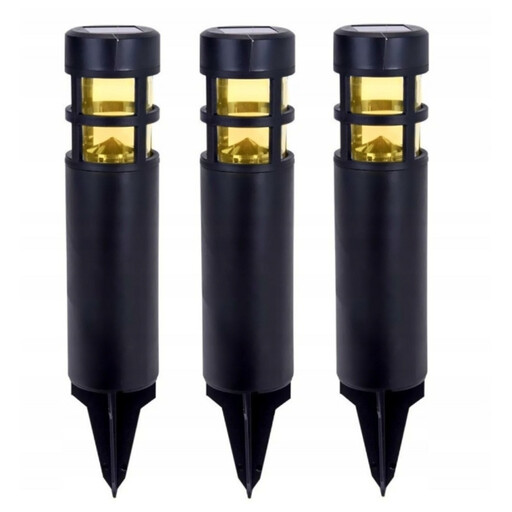
Why this product suits the profile: This set of three solar lights offers an easy way to mark several areas, such as flower-bed edges, paths or lawns, with a consistent look.
The product description specifies the quantity and automatic operation. Before buying, you should still check the IP rating, battery details and exact operating time, where these are listed in the offer.
Three lights in one set; can be installed without a permanent power connection; switches on automatically at dusk.
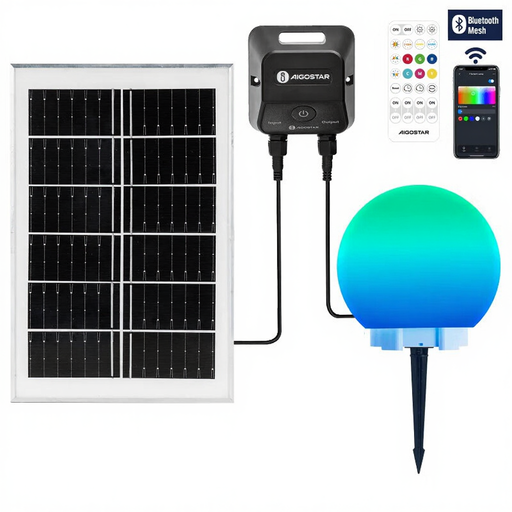
Why this product suits the profile: This light is designed for users who want to manage several light points via the AigoSmart app and switch between RGB and white-light settings.
The specifications state the control method, the colour range from 2700 to 6500 Kelvin and IP54/IP44 protection. Before installation, check which protection level applies to the intended position and whether a hub is required for voice control.
Bluetooth Mesh control; RGB+CCT lighting; adjustable brightness, schedules and grouping according to the product description.
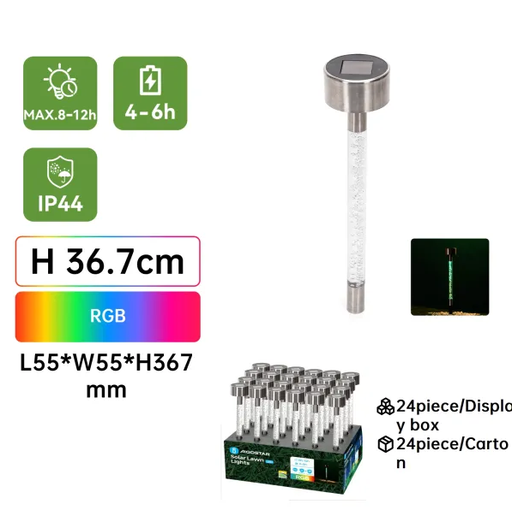
Why this product suits the profile: The 36.7 cm-high Bubble light is designed to add colourful accents to lawns, flower beds, paths or patios.
The product data states IP44, a charging time of 4–6 hours and 8–12 hours of operation under suitable conditions. This makes the impact of location and weather clear when planning your installation.
RGB lighting; integrated 40 mAh Ni-MH battery; low energy consumption of 0.006 W; ground spike for soft ground.
We have put together a complete, regularly updated list of products that fully meet these strict selection criteria and the safety regulations applicable in the EU.
For reliable wireless outdoor lighting, the location is crucial. The panel should receive several hours of direct daylight and should not be positioned beneath a roof overhang. Before first use, follow the charging time specified in the product description.
You should also:
For longer paths, a solar light set can make it easier to create a consistent look. For frequently used entrances, however, you should give greater weight to light output, beam angle and stability than to purely decorative features.
Their lifespan depends on the LED, battery, solar panel, weather conditions and care. Manufacturer claims such as “up to 15,000 hours” typically refer to the light source or a technical rating. The battery may lose performance sooner, and compact lights are not always designed for easy battery replacement.
While operating, solar garden lights draw their energy from the battery charged during the day. An external power supply is not required. You avoid the ongoing costs of a mains connection, although the battery and any replacement parts may still represent future expenses.
The ideal location receives as much direct sunlight as possible, has a stable surface and is sufficiently far from areas where water regularly collects. For paths, clearly visible light points at even intervals work well; for flower beds and patios, warm white or coloured solar lights can be used as decorative accents.