
Lieferung heute & morgen

Qualitätsgarantie

Willkommens-Angebote freischalten: KOSTENLOSE Lieferung | Bis zu 80 % RABATT | Kostenlose 30-Tage-JoyPlus-Testphase
App herunterladen
Solar lights for the garden promise straightforward illumination without power cables. In practice, however, the result depends heavily on the location, ingress protection rating and battery capacity. If you focus only on the design or a high number of LEDs, you may end up with a light that barely charges in the shade, is unsuitable for use in the rain or shines for considerably less time at night than expected.
This guide explains which details matter when choosing solar garden lights and which model is best suited to different requirements.
The level of protection is defined by the IP rating. A light with IP44 is protected against solid foreign objects measuring 1 mm or more and against splashing water from different directions. It is suitable for many sheltered outdoor areas, but should not be placed in water or permanently submerged.
IP54 provides additional protection against dust in harmful quantities. For areas exposed to frequent direct rain or particularly exposed locations, you should follow the specific installation instructions. A general description such as “weatherproof” therefore does not replace checking the IP rating.
An operating time of, for example, 8 to 12 hours depends on sunlight, the time of year, shade, battery condition and temperature. In winter or after several overcast days, the actual lighting time may be shorter.
The solar panel should face upwards with as little shade as possible. Trees, house walls, canopies and heavy dirt reduce charging performance. With outdoor LED solar lights, the location is therefore just as important as the technical specifications.
Warm white solar lights create a calm lighting effect around flowerbeds, seating areas and patios. Colour-changing RGB solar lights are better suited to decorative accents. For steps, narrow paths or driveways, light distribution, mounting height and sufficient brightness are more important than colour effects.
Before buying, check whether the light is designed for lawns, flowerbeds, paths, patios or driveways. Solar in-ground lights and models with ground spikes are subject to different demands: a ground spike must sit securely in the soil, while recessed lights require a suitable, level installation surface.
Most of the products presented here have an IP44 rating. They should not be installed in hollows where water can collect. Depending on the component, the Aigostar smart model is rated IP54 or IP44; here too, you should follow the specific product instructions.
Look out for:
Several products specify a charging time of around 4 to 6 hours and an operating time of 8 to 12 hours. These figures are provided by the manufacturers and depend on the actual amount of sunlight. Integrated batteries should not be opened or modified independently.
Warm white at around 2700 K has a yellowish, understated appearance. 6500 K looks noticeably cooler and whiter. For a consistent look, use the same light colour wherever possible along a path.
RGB lights can add colourful accents. According to the product description, the Aigostar smart solar model offers RGB+CCT from 2700 K to 6500 K and can be controlled via the AigoSmart app. An app-compatible smartphone and, where applicable, a hub may be required for the app function. Not every garden light with an RGB function can automatically be controlled via an app.
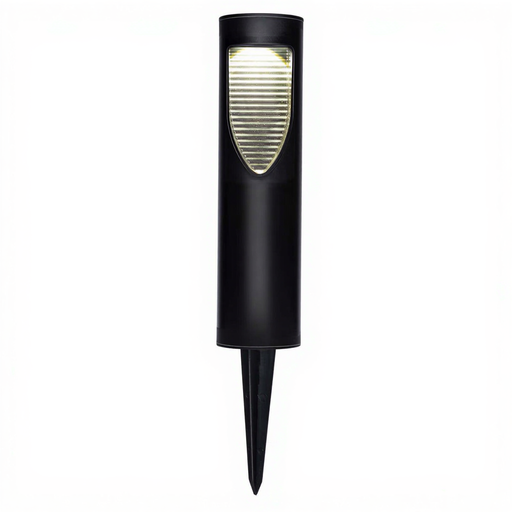
Why this product matches the profile: This freestanding solar garden light, with a black plastic housing and warm white SMD LED, is suitable for simple accent lighting along paths, in flowerbeds or on small patios.
The product description clearly states the battery, light colour and automatic switch-on function. This makes key details easy to verify before buying.
Warm white SMD light, integrated solar panel, 600 mAh Ni-MH battery and automatic dusk control.
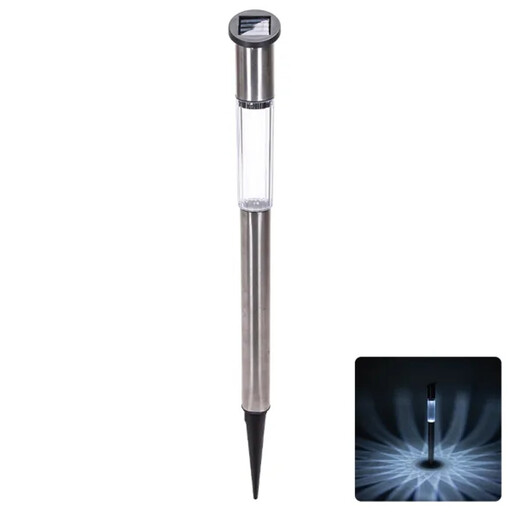
Why this product matches the profile: This ground-spike light is appealing to buyers who want to compare technical details such as charging time, temperature range and protection rating before buying.
The IP44 rating makes it clear that the light is designed for splashing water, but not for submersion. The location must be chosen accordingly.
6500 K, NiMH battery, stated charging time of 4–6 hours, operating time of 8–12 hours and operating temperature from -10 °C to 50 °C.
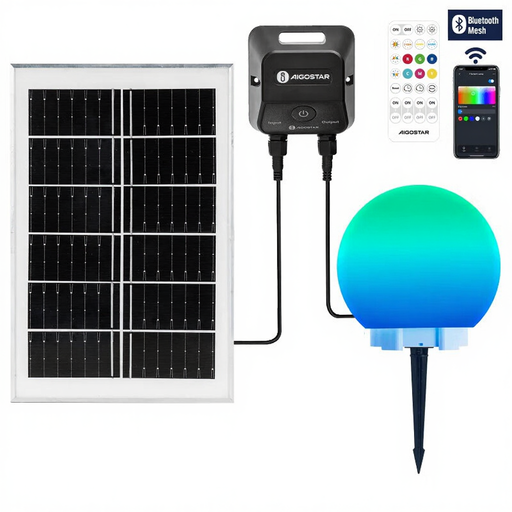
Why this product matches the profile: For larger garden areas or changing lighting moods, this model offers app control, grouping and RGB+CCT light colours.
The app function is described specifically, including Bluetooth Mesh, brightness adjustment and scheduling. Check compatibility and whether a hub is required before use.
RGB+CCT from 2700 K to 6500 K, Bluetooth Mesh control, lithium battery and cable-free installation with a ground spike.
We have put together a complete, regularly updated list of products that fully meet these strict selection criteria and the safety regulations applicable in the EU.
Place solar lights with ground spikes in firm soil that is not permanently wet. If the ground is particularly hard, do not drive the spike in with excessive force, as this could damage the housing or connections. Point the panel upwards and avoid shade from plants or walls.
Clean the surface of the solar panel regularly with a soft, slightly damp cloth. Do not use abrasive cleaning products. Before first use, fully charge the light according to the manufacturer’s instructions. In the event of frost, unusually heavy rain or an extended period of non-use, follow the relevant safety instructions.
This depends on sunlight, the battery, the panel, the temperature and the lighting mode. Under suitable conditions, several of the listed models specify around 8 to 12 hours. Coloured or particularly bright modes can affect the operating time.
Models with IP44 are protected against splashing water, but are not designed to be submerged. Do not install them in areas where rainwater collects. For more exposed locations, check the stated protection rating and installation instructions.
Solar lights charge their integrated battery using daylight and do not require a mains connection. They therefore normally incur no electricity costs through the household mains during operation. However, the battery is a wearing part and, depending on the design, may not be replaceable or may only be replaceable using suitable spare parts.