
Lieferung heute & morgen

Qualitätsgarantie

Willkommens-Angebote freischalten: KOSTENLOSE Lieferung | Bis zu 80 % RABATT | Kostenlose 30-Tage-JoyPlus-Testphase
App herunterladen
Solar lights for the garden provide illumination without the need for permanently installed electrical wiring. However, to avoid disappointment after only a short time, buyers should consider more than light colour and design. Key factors include the right IP rating, available sunlight and realistic operating time.
The IP44 rating describes protection against solid foreign objects measuring 1 millimetre or more and against splashing water. This may be sufficient for a sheltered patio or flowerbed. A wall light mounted in an exposed position, however, is subject to heavier rain. An IP65 outdoor light offers additional protection against dust and water jets.
Important: even an IP65 product should not be submerged. For example, the Aigostar Smart Solar Wall Light specifically distinguishes between weather-suitable use and avoiding standing water.
Figures such as “up to 8–12 hours” or “up to 24 hours” refer to defined charging conditions. In the German winter, when shaded by trees or when the solar panel is dirty, the operating time may be shorter. A solar garden light should therefore receive several hours of direct daylight wherever possible.
Before buying, it is worth checking:
An RGB solar light is ideal for decorative accents and colour-changing garden illumination. For steps, driveways or uneven paths, however, brightness, beam angle and consistent positioning are more important. Coloured lighting effects can create an atmospheric setting, but they do not automatically provide better orientation.
For outdoor areas, the IP rating should match the installation location. IP44 is intended for applications protected against splashing water, while IP65 also provides a higher level of protection against dust and water jets. Stainless steel, ABS and PC offer different advantages: stainless steel looks sturdy and is corrosion-resistant, while ABS and PC are lightweight and can be shaped flexibly.
The IP rating does not replace proper installation. Cable connections, the solar panel and the housing should be positioned in accordance with the manufacturer's instructions.
Warm white light between around 2700 and 3000 Kelvin is often chosen for patios, entrance areas and subtle warm white night lighting. Cool white light of around 6500 Kelvin highlights contours more strongly and can be useful for paths or points of orientation. The Aigostar Solar Path Light Stainless Steel is specified as having a light colour of 6500 Kelvin and a colour rendering index of Ra≥70.
For decorative lights, colour specifications such as RGB+CCT 2700–6500 Kelvin are interesting. They allow you to switch between coloured light and warmer or cooler shades of white. For practical illumination, you should also consider the luminous flux in lumens.
A solar light with a ground spike can be installed in soft ground without permanent fitting. For hard surfaces, solar ground lights or permanently mountable models are more suitable. A solar path light should be positioned so that it does not cause glare and the spacing between individual lights suits the path.
If you want to operate several lights in sync, you can choose a smart solar light with Bluetooth and app control. Buyers should check whether a hub is required, what range applies and whether the lights can also be controlled without an active internet connection.

Why this product suits the profile: The ground-spike design is intended for flowerbeds, lawns and simple path marking. A charging time of 4–6 hours and an illumination time of 8–12 hours are specified.
The IP44 rating, charging time and operating time make the product's limits clear. This model is not described as a waterproof light suitable for submersion.
No power cable required; NiMH battery, polycrystalline solar panel and stainless-steel elements.
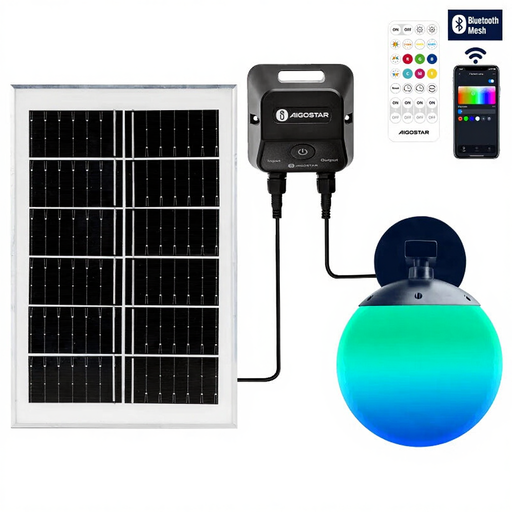
Why this product suits the profile: Designed for façades, entrances and patios, this model combines IP65 protection, RGBCCT lighting, Bluetooth Mesh and a separate solar panel with a 5-metre cable.
The separate panel can be positioned to reduce shading. The IP rating, luminous flux of 200 lm and temperature range of -10 °C to 50 °C are clearly specified.
RGB plus 2700–6500 Kelvin, app control and a stated lifespan of 30,000 hours.
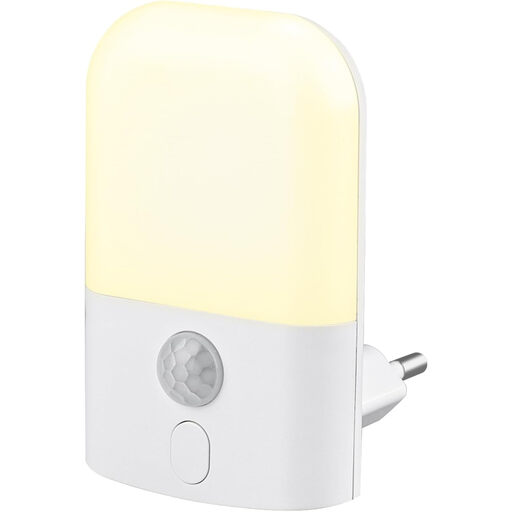
Why this product suits the profile: As an LED night light with a sensor, it is intended for children's bedrooms, hallways, staircases and indoor spaces. According to the product information, the motion sensor detects movement up to 3 metres away within a 120° range.
Its use is clearly limited to indoor spaces. This avoids confusing it with a weatherproof outdoor light, while five brightness levels allow for customised adjustment.
2700-K warm white light, 0.5 W power consumption, dusk and motion sensor, plus automatic switch-off after 60 seconds.
For a child's bedroom or hallway, a plug-in model with a dusk sensor may be a suitable alternative. According to the product information, the Aigostar LED Sensor Night Light switches on below 20 lux, requires no battery and operates at 1 W and 6500 Kelvin. With an IP20 rating, it is intended exclusively for indoor use.
For colourful flowerbeds or decorative areas, an RGB ground light with a ground spike is worth considering. According to the data sheet, the Aigostar Solar Ground Spike Light provides 8–12 hours of illumination after 4–6 hours of charging and has an IP44 rating. For regular use, the solar panel should be kept free of leaves and dust.
We have put together a complete, regularly updated list of products that fully meet these strict selection criteria and the safety regulations applicable in the EU.
The panel should receive as much direct daylight as possible and should not be permanently covered by roof overhangs, trees or buildings. With a light featuring a separate panel, the lamp can be positioned in the shade while the panel is installed in a brighter location.
Lifespan depends on the LEDs, housing, battery, charging cycles and weather conditions. Product information may state, for example, 15,000 or 30,000 hours for the LED. The integrated battery is a separate wearing part and may lose capacity sooner depending on usage and temperature.
While operating, solar lights draw their energy from the charged battery and do not need to be connected to the mains. Costs may include the initial purchase, possible battery replacements and spare parts. Plug-in night lights, such as a 0.5-W model or a 1-W light, do require mains electricity, but have low power consumption when used for short periods.