
Lieferung heute & morgen

Qualitätsgarantie

Willkommens-Angebote freischalten: KOSTENLOSE Lieferung | Bis zu 80 % RABATT | Kostenlose 30-Tage-JoyPlus-Testphase
App herunterladen
Solar garden lights provide illumination without permanently installed cables and can enhance paths, lawns, flowerbeds, patios or gazebos. However, not every budget-friendly offer will be the right solution. It is not just the design and light colour that matter, but also the installation location, IP rating, battery capacity and available sunlight.
Claims such as “up to 12 or 24 hours” refer to suitable charging conditions. In shaded locations, during short winter days, when the panel is dirty or throughout longer periods of rain, the actual operating time may be shorter. Check whether the solar panel will receive several hours of direct sunlight and whether the desired operating time matches the battery capacity.
An IP44 solar light is protected against splashing water, but is not designed for permanently standing water or complete immersion. For more exposed locations, such as open patios, unprotected walls or ground surfaces, higher IP ratings are advisable. An IP65 solar light is protected against dust and water jets. IP67 solar lights can withstand temporary immersion under the conditions specified for the product. However, the IP rating does not replace correct installation.
RGB solar lights are primarily suitable for decorative, colour-changing garden lighting. If you want to illuminate a path, staircase or seating area clearly, you should also look for a white light option. Solar lights with warm white light create a subtle atmosphere and are often suitable for entrances, flowerbeds and seating areas. With RGBCCT models, for example, you can adjust the colour temperature between warm and cooler white.
Match the light to its actual location:
An IP rating applies to the complete, enclosed product. Cable connections, plug connections and the solar panel must also be positioned correctly.
Polycrystalline and monocrystalline solar panels differ in their construction and performance characteristics. More important than the terminology is whether the panel, battery and light output are properly matched. Pay attention to:
A separate panel can be practical for solar garden lights if the light is suspended beneath a gazebo while the panel is installed in a sunny location.
Solar ground lights are installed flush or almost flush with ground surfaces and require a stable, suitable recess. Solar garden stake lights can be pushed into soft soil or lawns. They are not readily suitable for hard surfaces. Freestanding lanterns and sets containing several lights, on the other hand, are ideal for flexible arrangements along paths and flowerbed edges.
For technically minded buyers, smart solar lights with app control, schedules and grouping may be appealing. Bluetooth Mesh garden lighting is particularly useful when several lights need to respond in sync. Before buying, check whether a hub is required and what connection range the manufacturer specifies.
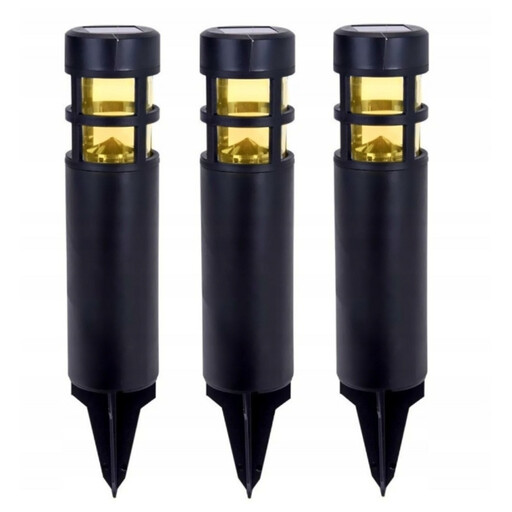
Why this product suits this profile: This set of three solar lights is designed for simple markers along paths, in flowerbeds or beside lawns. Installation requires no professional electrical work, and the lights switch on automatically at dusk.
The number of lights is clearly stated. This makes it easier to estimate the requirements for short sections of path or flowerbed areas, without accidentally ordering just one light.
Three lights, automatic dusk activation and cable-free installation for simple outdoor areas.
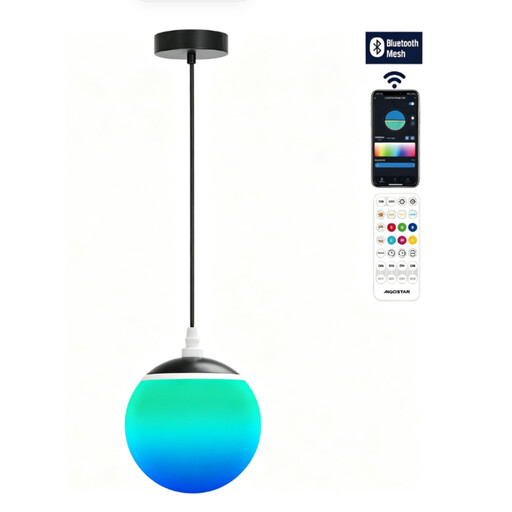
Why this product suits this profile: This pendant light is designed for gazebos, covered patios and similar areas. The separate solar panel can be positioned in sunlight while the light hangs in a shadier location.
Positioning the panel separately from the light helps overcome the problem of a decorative light barely charging in the shade. However, the IP65 rating should not be confused with suitability for underwater use.
RGBCCT from 2700 to 6500 K, Bluetooth Mesh, app control, 200 lm and a stated maximum operating time of up to 24 hours.
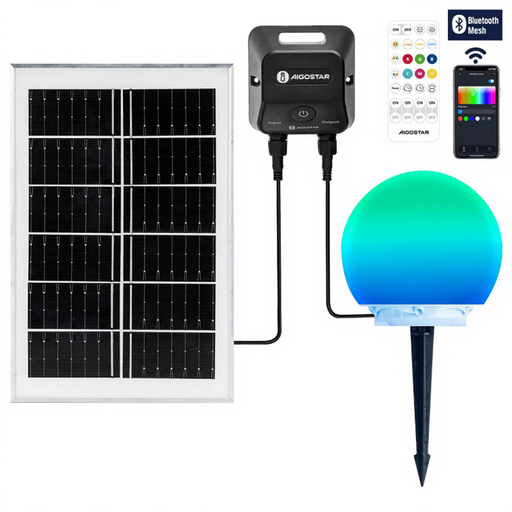
Why this product suits this profile: This recessed light is aimed at users who want to enhance ground surfaces, patios or paths with synchronisable colour and white-light settings.
The separate panel position helps at shaded installation sites. With an IP67 rating, the light is designed for more demanding ground-level areas; the installation instructions and water drainage conditions remain decisive.
4000-mAh lithium battery, 5-W monocrystalline solar panel, RGBCCT light and Bluetooth Mesh for synchronising multiple lights.
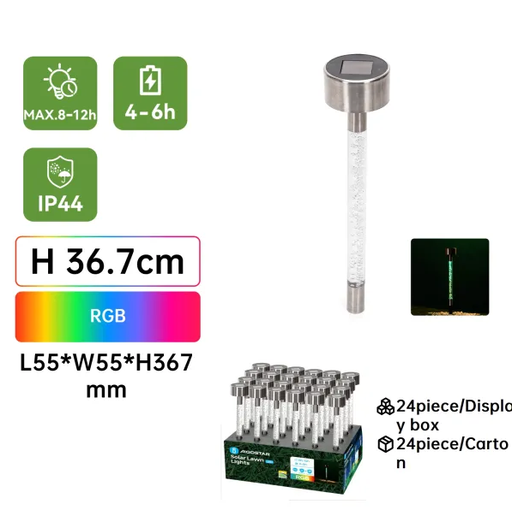
Why this product suits this profile: Standing 36.7 cm high and featuring a bubble effect, this solar light adds colourful accents to lawns, flowerbeds and paths without requiring a power cable.
The technical specifications state the charging time, battery type, operating time and IP44 rating. This makes it easier to distinguish its decorative purpose from bright path lighting.
RGB light, automatic dusk activation, a stated charging time of 4 to 6 hours and a stated operating time of 8 to 12 hours under suitable conditions.
We have put together a complete, regularly updated list of products that fully meet these strict selection criteria and the safety regulations applicable in the EU.
According to the product information, many simple models require around 4 to 6 hours in suitable direct sunlight. The actual charging time depends on the season, orientation, cloud cover, shade and dirt on the panel. Before first use, the light should be fully charged in accordance with the instructions.
The lifespan depends, among other things, on the LED, battery, housing, frost, moisture and maintenance. Manufacturers’ LED lifespan figures do not automatically indicate how long the battery will last. Clean the solar panel regularly with a soft cloth and do not replace the battery with an unapproved battery type.
While operating, they draw energy from the charged battery and do not require a direct mains connection. However, the purchase price, potential battery replacement and disposal costs should still be taken into account. Smart models may also involve additional requirements, such as an app, Bluetooth connection or compatible hub.