
Lieferung heute & morgen

Qualitätsgarantie

Willkommens-Angebote freischalten: KOSTENLOSE Lieferung | Bis zu 80 % RABATT | Kostenlose 30-Tage-JoyPlus-Testphase
App herunterladen
Solar garden lights with ground spikes are ideal for outdoor areas without a permanent power connection. They can be pushed into soft soil or lawns, charge during the day via a solar panel and switch on automatically when it gets dark enough. However, it is worth taking a close look at the technical details before buying: not every decorative light is suitable for the same location.
Claims such as “up to 8–12 hours” generally refer to suitable charging conditions. Shade from trees, house walls or dense hedges, short winter days and dirty solar panels can reduce the amount of stored energy. The light should therefore receive as many hours of direct daylight as possible.
IP44 means protection against solid foreign objects from 1 mm in size, as well as splashing water from various directions. This makes the light suitable for many covered or sheltered outdoor areas, but it should not be placed in a permanently wet hollow or fully submerged in water. The exact position is therefore particularly important for solar lights used in borders and along paths.
RGB solar lights and colour-changing solar lights create decorative accents. However, for evenly illuminating a long drive or frequently used path, light distribution, light colour and the number of lights are more important than colour-changing functions. Cool white light can show contours differently from coloured light.
Pay attention to the panel type, stated charging time and battery capacity. The Aigostar models featured here are specified as having a charging time of around 4–6 hours and an operating time of 8–12 hours. According to the product descriptions, these figures apply under suitable conditions.
A Ni-MH battery is integrated into several models. The battery should not be opened independently or replaced with an unsuitable type. If the operating time drops significantly after prolonged use, replacement may be necessary in accordance with the manufacturer’s instructions.
For outdoor LED solar lights, the protection rating is a key specification. The Aigostar products in this selection have an IP44 rating. Several models have a stated operating range between -10 °C and 50 °C. This is not a guarantee for every weather condition, but a technical guide to the intended use.
Check that the height suits the intended location and that the ground spike can be inserted into the soil without bending it. Hard, stony or frozen soil can make installation more difficult. In soft soil, the light should be inserted straight. A stainless-steel look may be made from plastic, as is the case with some decorative Aigostar models. The actual material specification is therefore more important than the product name.

Why this product suits this profile: This classic black light is suitable for shoppers looking for simple, cordless basic lighting for a path, lawn or driveway. It has two LEDs, an integrated solar panel and an AAA battery.
The product description gives specific dimensions of 6.5 × 34 cm and identifies a separate AAA battery. This makes it easier to assess the space required and power source before buying.
Two LEDs, ground-spike installation and automatic switching on in darkness, according to the product description.
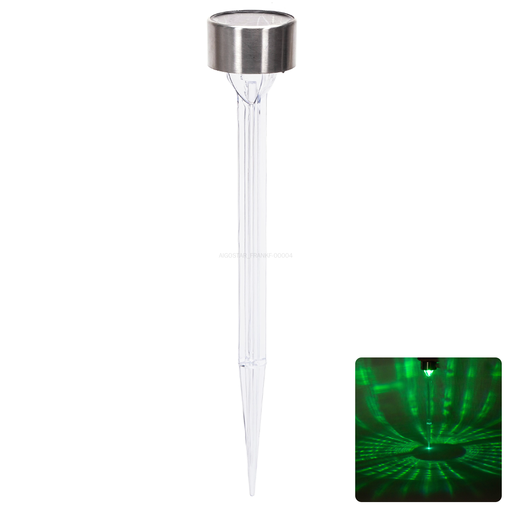
Why this product suits this profile: This model combines RGB lighting with a silver-coloured stainless-steel look. It is suitable for paths, lawns or borders when you want a decorative light colour.
The specifications list the charging time, operating time, battery, panel type and IP44 protection rating. This highlights the difference between decorative colour effects and genuine weather suitability.
RGB lighting, a 200 mAh Ni-MH battery, IP44 protection and dimensions of 55 × 55 × 320 mm, according to the product data.

Why this product suits this profile: This light is designed for users who prefer a fixed, cool light colour of 6500 K and want to position cordless solar path lights along paths or borders.
The fixed light colour prevents false expectations about colour-changing functionality. The product also specifies IP44 protection, a charging time of 4–6 hours and an operating time of 8–12 hours.
6500 K light, a colour rendering index of Ra≥70 and a stated lifespan of 15,000 hours.
Only push solar lights with ground spikes into sufficiently soft soil. In compacted earth, making a narrow pilot hole first may be helpful; the ground spike should never be forced into place. The solar panel must face upwards and should, wherever possible, be kept clear of shade from plants or buildings.
Clean the surface regularly with a soft cloth. Do not use abrasive cleaning products. If the lights are stored for a longer period, for example over winter, follow the manufacturer’s instructions for battery care. For permanently very wet locations, consider weatherproof solar lights with a higher protection rating than IP44.
We have put together a complete, regularly updated list of products that fully meet these strict selection criteria and the safety regulations applicable in the EU.
Push the light into soft soil or a lawn. Choose a position with as much direct sunlight as possible, point the panel upwards and remove sources of shade. Before using the light for the first time, charge the battery according to the product instructions.
The actual operating time depends on the battery, panel, weather, dirt and temperature. The Aigostar models mentioned are specified as providing 8–12 hours of light and a stated LED or light lifespan of up to 15,000 hours. These figures should not be confused with a guaranteed battery life.
Solar lights do not need to be connected to the mains while operating. However, ongoing costs may arise later from replacing a battery or replacing the light if it is damaged. Cost-effectiveness therefore also depends on the lifespan, build quality and intended use.