
Lieferung heute & morgen

Qualitätsgarantie

Willkommens-Angebote freischalten: KOSTENLOSE Lieferung | Bis zu 80 % RABATT | Kostenlose 30-Tage-JoyPlus-Testphase
App herunterladen
Solar garden lights promise cable-free illumination without the need for a mains connection. In practice, however, how satisfied you are depends largely on where you place them, their IP rating and how much sunlight they receive. If you choose purely on design or the longest claimed run time, you may overlook important details.
Three common buying misconceptions can easily lead to the wrong choice:
The IP rating describes how well a housing is protected against solid objects and water. Many solar garden lights are rated IP44. The first digit indicates protection against solid objects; the second indicates protection against splashing water from different directions.
IP44 is suitable, for example, for:
Even so, avoid placing the light in a hollow where rainwater can collect. For locations exposed to the elements, it is worth checking the manufacturer’s specific guidance. A higher IP rating is no substitute for regularly checking for cracks, loose covers or damaged cables and housing components.
Solar-powered outdoor lights store the energy they collect during the day in a battery. The key factors are:
Several Aigostar models are listed with a charging time of around 4 to 6 hours and a run time of 8 to 12 hours. These figures should be taken as manufacturer’s claims under suitable conditions. In winter or during prolonged cloudy spells, the amount of energy stored may be lower.
A replaceable or accessible battery may be important if you use the lights frequently. If the battery is built in, the product information should include details of its type and capacity, as well as how to dispose of it. Batteries and electrical appliances should not be put in household waste.
Light colour is measured in kelvins:
Warm-white solar lights at 2700 K often complement wood, plants and patio furniture. Cool-white solar path lights can create more contrast, but may look more functional depending on their surroundings. RGB solar lights are an option for seasonal displays or splashes of colour, but do not automatically replace practical path lighting.
Also consider how the light is mounted. Solar lights with ground spikes can be placed in soft soil. For hard surfaces or balconies, freestanding models with a base or a suitable surface to rest on are a better choice. Do not force a ground spike into compacted or stony ground.
The selection below groups specific solar garden lights by typical needs. The details are based on the information provided for each product and do not replace checking that it is suitable for your intended location.

Why this product suits this profile: At 34 cm tall, this black solar light has two LEDs and a ground spike. It’s a straightforward way to get started with cable-free lighting for paths or flower beds.
The product description specifies a built-in battery, automatic lighting and exact dimensions. This makes it easier to work out how much space you’ll need before buying.
Ground spike for easy positioning; two LEDs and automatic activation in the dark, according to the product information.
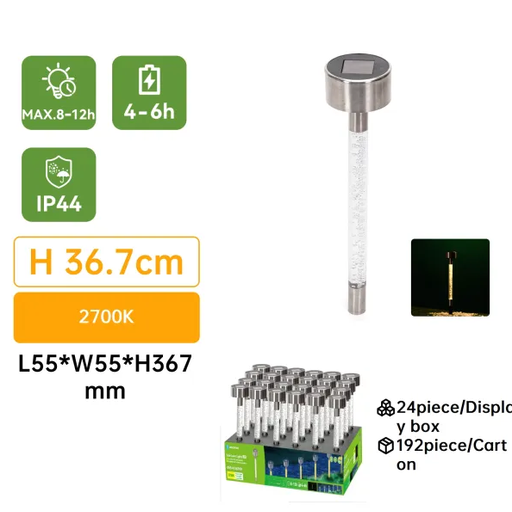
Why this product suits this profile: This light combines a specified colour temperature of 2700 K with details of its IP44 rating, Ni-MH battery, charging time and dimensions. That makes it easier to choose with confidence for flower beds, lawns and paths.
The product details make clear that IP44 means protection against splashing water, and that the light must not be immersed. They also explain that run time depends on charging conditions.
Warm white at 2700 K; stated charging time of 4–6 hours and run time of 8–12 hours under suitable conditions.
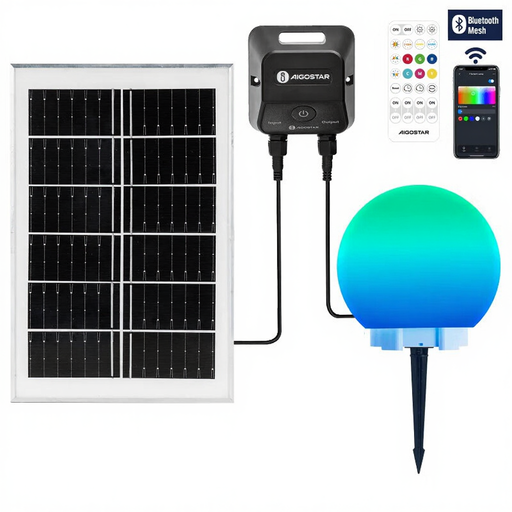
Why this product suits this profile: For anyone with several lights or who likes to change the lighting to suit the occasion, the product description lists Bluetooth Mesh control, app connectivity and RGB and CCT lighting from 2700 to 6500 K.
The information distinguishes between IP54 and IP44, and warns that the light must not be immersed. This is particularly important when planning where to place it in the ground or along an edge.
RGB+CCT lighting control; Bluetooth Mesh and app control according to the product description.
We’ve put together a complete, regularly updated list of products that meet these strict selection criteria and fully comply with the safety regulations in force in the EU.
Where possible, choose a spot that gets several hours of direct sunlight. A light beneath a dense tree, against a north-facing wall or behind a tall balcony railing will usually charge less reliably. If your solar light has a ground spike, the soil should be soft enough to take it without leaving the housing unstable.
For reliable performance:
Run time depends on the battery, charge level, lighting programme and sunlight. Manufacturer claims of 8 to 12 hours generally apply under suitable charging conditions. In winter or in heavy shade, the lights may stay on for less time.
There’s no one-size-fits-all answer. It depends on the stated IP rating, operating temperature range and installation instructions. An IP44 light is protected against splashing water, but is not suitable for immersion. In frosty conditions, do not push the ground spike into frozen soil.
While they are running, they draw power from the battery charged during the day. They do not need to be connected to the mains. However, the amount of energy they generate depends on the panel size, sunlight, orientation and weather conditions. LED solar lights usually use little power, but choose one for what it can actually do, rather than relying on marketing claims alone.