
Lieferung heute & morgen

Qualitätsgarantie

Willkommens-Angebote freischalten: KOSTENLOSE Lieferung | Bis zu 80 % RABATT | Kostenlose 30-Tage-JoyPlus-Testphase
App herunterladen
By Joybuy Product Recommendation Officer, August 29, 2026
Solar garden lights promise simple, atmospheric lighting with no electricity costs or complex installation. But the reality is often different: lights that fail after a rain shower, or a runtime that barely lasts past dusk. Before you invest, it's crucial to understand the typical weaknesses often hidden behind attractive product photos.
This guide will help you cut through the noise. We focus on the three most common pitfalls and show you which technical features truly matter for finding durable and functional decorative garden lighting.
To avoid the problems mentioned above, you should check three technical specifications. These give you an objective basis for your purchasing decision, far from marketing promises.
The IP (Ingress Protection) rating indicates how well an electrical device is protected against the intrusion of foreign objects and water. For solar garden lights, the second digit is crucial.
Always check that at least an IP44 rating is specified. If this information is missing, the product is likely not suitable for permanent outdoor use in the UK.
The performance of a solar light depends directly on the efficiency of its energy system.
The light colour significantly determines the mood. It is measured in Kelvin (K).
Here are some product recommendations tailored to different needs and requirement profiles.
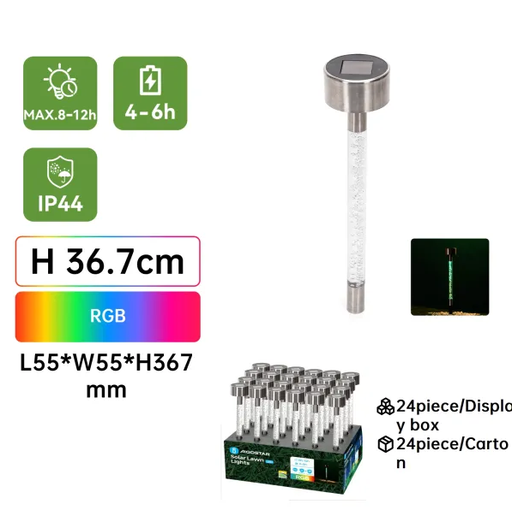
Why This Fits Their Persona: Ideal for anyone wanting to add colourful and dynamic accents to their garden on a budget. The bubble design and RGB colour change make it a striking piece of solar garden decor for flowerbeds and paths.
The product has a clear IP44 certification, making it ready for rainy weather. The runtime is realistically stated as 8–12 hours under suitable charging conditions (4–6 hours), which correctly manages expectations.
Automatic RGB colour change for vibrant effects. Simple installation as a solar garden stake with no tools required.
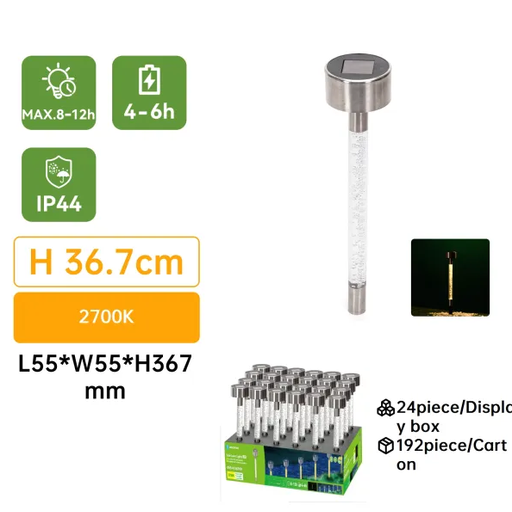
Why This Fits Their Persona: Perfect for users who prefer classic, warm, and inviting lighting. Ideal for creating subtle and elegant solar path lighting or gently illuminating flowerbeds.
Specifying the exact light colour of 2700K (Warm White) prevents buyer's remorse, ensuring you get the desired cosy atmosphere. The IP44 classification guarantees functionality in bad weather.
Creates a pleasant, warm white light for a stylish atmosphere. Uses the same reliable solar and battery technology as the RGB model.

Why This Fits Their Persona: For special occasions like Christmas, you need a decoration that delivers maximum impact. This 3-metre-tall, illuminated archway is a guaranteed showstopper. Note: This product is mains-powered, not solar, making it suitable for occasions where a constant, high light output is required.
By relying on mains power, this product bypasses the pitfall of unreliable runtime. Such a large, bright decoration could not be operated reliably with solar power, especially in winter. The power supply guarantees consistently bright illumination.
Impressive 3-metre size for maximum visual impact. Complete set including a blower, tethers, and ground stakes for easy and stable installation.
We've compiled a full, up-to-date list of products that fully meet these strict selection criteria and safety regulations.
The lifespan of an LED solar garden light depends on two components: the battery and the LED. The Ni-MH battery typically has a lifespan of 1-3 years, depending on charge cycles, and can be replaced in many models. The LED itself is extremely durable; manufacturer specifications like 15,000 hours are common, which translates to many years of nightly operation.
Yes, but with limited performance. On cloudy days or during the shorter winter days in the UK, the battery will not fully charge. This results in a shorter runtime at night. Models with amorphous solar panels have a slight advantage here, as they can generate power even in diffuse light, though less than in direct sun. Expect a significantly reduced runtime in winter.
Location is key. Place the solar garden stake in a spot that receives several hours of direct sunlight daily. Avoid shadows from trees, walls, or overhangs. Also, ensure the light is not placed near other strong light sources (e.g., streetlights or window lighting), as their light can trick the dusk sensor and prevent it from turning on automatically.