
Lieferung heute & morgen

Qualitätsgarantie

Willkommens-Angebote freischalten: KOSTENLOSE Lieferung | Bis zu 80 % RABATT | Kostenlose 30-Tage-JoyPlus-Testphase
App herunterladen
Solar garden lights illuminate paths, flower beds, lawns and patios without the need for a fixed electricity connection. However, not every solar garden light is suited to every location. Decorative solar ground lights serve a different purpose from practical path lights or smart solar lights with app control.
If you focus only on design or a long stated running time when buying, it’s easy to overlook important details. The following criteria will help homeowners, garden owners and tenants in Germany compare solar lights for the garden objectively.
Figures such as ‘up to 8–12 hours’ generally apply in favourable conditions. In the garden, shade from buildings, trees or hedges, short winter days and cloudy skies can all reduce charging performance. So it’s not just battery capacity that matters: the position of the solar panel is important too.
The IP44 rating means protection against solid objects larger than 1 mm and splashing water from various directions. It does not mean the light can be submerged continuously or exposed to a powerful jet of water. So avoid placing IP44 solar lights in dips where rainwater can collect.
RGB solar lights can add colourful accents. For evenly lighting a path or staircase, warm white or neutral white light is often more practical. For decorative settings such as flower beds, lawn edges or patios, RGB lighting can be used as a deliberate design feature.
Look out for information on:
A solar light with a dusk sensor usually switches on when ambient light levels are low and switches off again in daylight. Even so, check that this feature is explicitly mentioned in the product description.
For weatherproof solar lights, the IP rating is an important point of comparison. IP44 is suitable for many sheltered outdoor areas, but the light needs to be positioned carefully. This is particularly important for solar stake lights in lawns and flower beds.
For more exposed locations, a light with a higher IP rating may be a better choice. Check the manufacturer’s specifications against the location where you plan to use it.
Warm white solar lights at 2700 K produce a soft, yellow-toned glow and are often well suited to decorative areas. For paths, several evenly spaced solar path lights may be more effective than one bright light. Solar stake lights are easy to install in soft ground; hard surfaces require recessed models or a different type of fitting.
Also check:
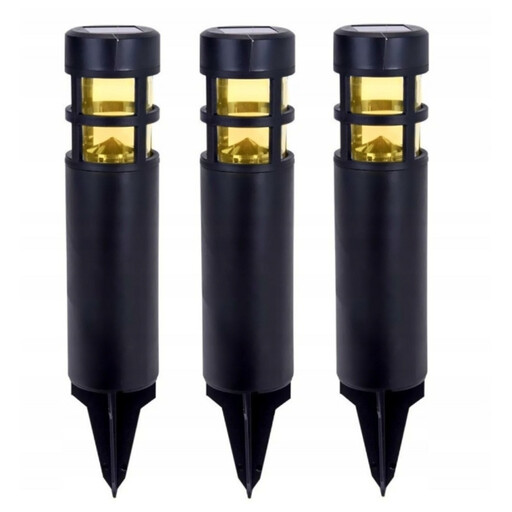
Why this product suits this profile: This set of three solar lights is a good choice for beginners who want to illuminate several areas, such as the edge of a path, a flower bed or a lawn, without installing fixed wiring.
The product description explicitly states that the lights operate automatically at dusk and can be used along paths, in gardens and beside flower beds. This makes it easier to assess how practical they’ll be before you buy.
Three lights for different spots; solar-powered charging and automatic switching on and off at dusk.
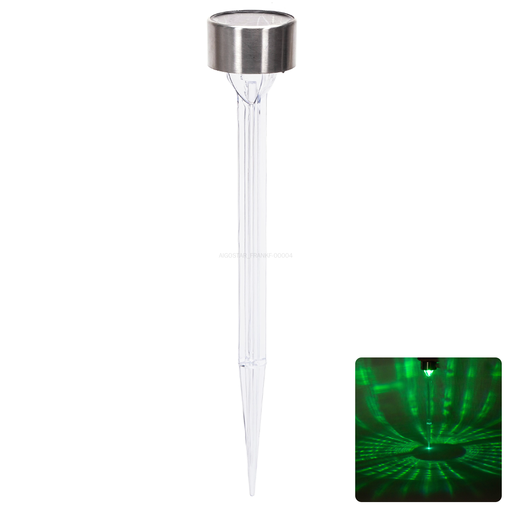
Why this product suits this profile: This light combines a silver-coloured stainless steel finish with RGB lighting and a height of 320 mm. It’s well suited to garden paths and lawn edges where colourful decorative lighting is wanted.
The specifications state a charging time of 4–6 hours, a lighting time of 8–12 hours and an IP44 rating. This makes it possible to compare the claims with specific technical details.
RGB lighting; 200 mAh Ni-MH battery; integrated ground stake; CE and RoHS certified according to the product details.
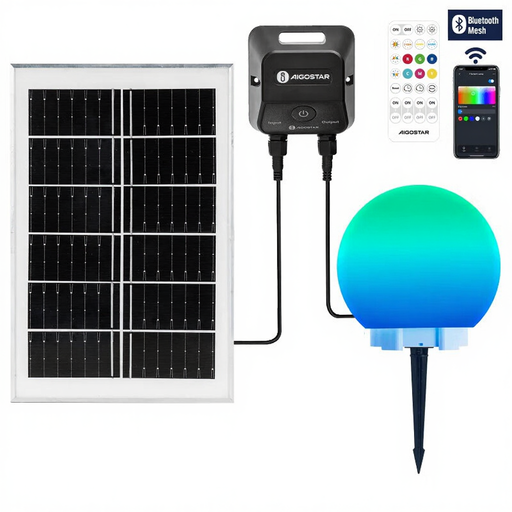
Why this product suits this profile: Bluetooth Mesh, RGB+CCT and control via the AigoSmart app are aimed at users who want to group several lights, choose colours or manage schedules.
The product description specifies the control method, a white-light colour temperature range of 2700–6500 K, and IP54/IP44. This means you can check the app functions and protection ratings before buying.
RGB+CCT lighting; Bluetooth Mesh connection; lithium battery; app control for brightness, grouping and schedules.
We’ve put together a complete, regularly updated list of products that meet these strict selection criteria and fully comply with the safety regulations in force in the EU.
Lifespan depends on the LED, battery, charging cycles, weather and maintenance. Some product details, for example, state an LED lifespan of up to 15,000 hours. This doesn’t guarantee the overall lifespan of the light. Clean the solar panel regularly, and if you won’t be using the light for an extended period, store it according to the manufacturer’s instructions.
Yes, the solar panel can still absorb energy in diffuse light. However, charging performance is usually lower than in direct sunlight. The light may therefore stay on for less time or be dimmer. In winter especially, try to choose a spot that isn’t shaded.
Solar lights charge their batteries using sunlight and don’t need a fixed mains connection. This means they don’t draw electricity through your home’s wiring during normal use. However, you should factor in the purchase price, possible battery replacement and the proper disposal of batteries and electronic components in line with current regulations.