
Lieferung heute & morgen

Qualitätsgarantie

Willkommens-Angebote freischalten: KOSTENLOSE Lieferung | Bis zu 80 % RABATT | Kostenlose 30-Tage-JoyPlus-Testphase
App herunterladen
Solar garden lights don’t need a fixed power supply and can usually be set up without tools. Even so, not every solar light suits every outdoor space. It’s not just about the design or a quoted runtime. The location, light colour, battery type and protection against moisture matter most.
When you’re buying solar lights for the garden, it helps to put typical marketing claims into context. Any quoted runtime usually assumes suitable charging conditions. In shade, on short winter days or with a dirty solar panel, the actual lighting time may be shorter.
Figures like ‘8–12 hours’ usually assume several hours of direct sunlight. A spot under a tree, on a north-facing wall or beside a tall hedge reduces charging performance. Cloudy days and a low sun also affect the outcome.
Practical tip: Before buying, check that the solar panel can be mounted facing upwards with several hours of unshaded exposure.
IP44 describes protection against solid foreign objects from a certain size and against splashing water from various directions. However, it doesn’t mean the light may stand permanently in water or be submerged. IP44 can be suitable for solar path lights in normally sheltered garden areas. If water tends to pool, choose a different location.
Warm white solar lights or RGB solar lights add accents to beds, paths and patios. Their light output is not automatically comparable to a hard-wired path light or security lighting. RGB models are primarily decorative. For clearly visible steps or driveways, assess brightness, beam angle and positioning separately.
Warm white light around 2,700 Kelvin is subtle and suits seating areas, beds and entrances. Cool white light at about 6,500 Kelvin looks crisper and can bring out contours on paths more strongly. RGB solar lights produce changing colours and are best for decorative accents or outdoor parties.
Also look for the lumen figure, if given. For LED solar lights used outdoors, the wattage only describes energy consumption and says little about perceived brightness.
Charging time depends on the panel type, sun angle and weather. Several of the models featured here quote 4–6 hours of charging and 8–12 hours of runtime. Treat these as guide values under suitable conditions.
Ni-MH batteries are integrated in many solar garden lights. Avoid models that don’t state essential information on the battery, replaceability or disposal. For integrated batteries, dispose of the light at the end of its service life in line with local rules for electricals and batteries.
Solar lights with a ground spike need firm but not rock-hard soil. In compacted ground, a pre-loosened hole can protect the plastic spike. For balconies or patios, free-standing solar ground lights with a stable base are more practical.
Check before buying:
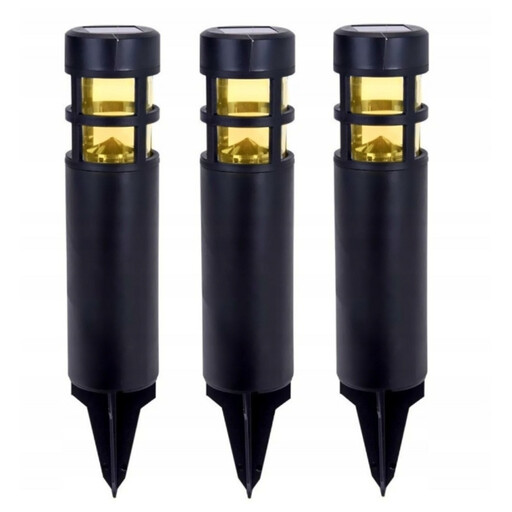
Why this product fits the profile: The set of three offers an easy way to mark paths, beds or lawn edges without a fixed power supply. According to the product description, the lights switch on automatically at dusk.
The manageable pack size makes it easier to plan locations. Before buying, still check whether the product page specifies a concrete protection rating.
3 lights, automatic dusk switching, and installation without cabling or a professional electrical installation.
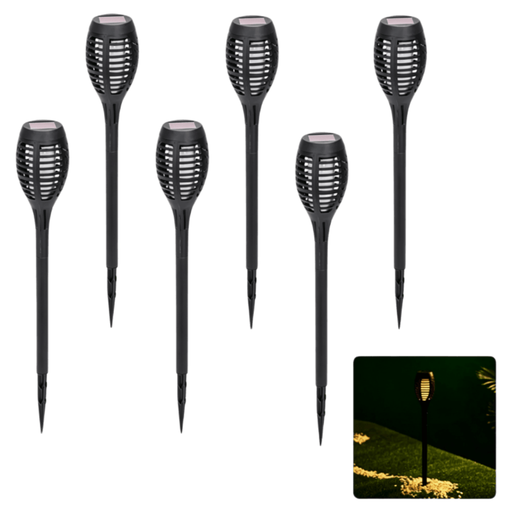
Why this product fits the profile: This 6-pack combines a stated warm white light colour of 2,700 Kelvin with a flame effect. It’s intended for paths, lawns, patios and sociable outdoor spaces.
The product details list charging time, runtime, battery type, temperature range and IP44, making it easier to match the conditions before you buy.
6 pieces, warm white 2,700‑Kelvin lighting, IP44 and, according to the product details, 8–12 hours of runtime with suitable charging.
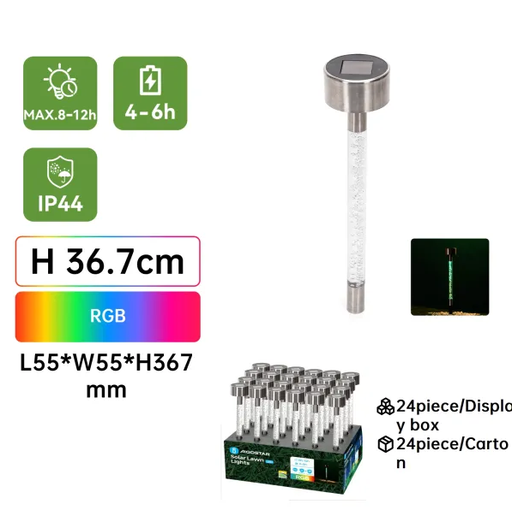
Why this product fits the profile: The RGB colour changes suit seasonal decoration, balconies, patios and garden parties. At 36.7 cm tall, the light can be positioned visibly in beds and lawns.
The IP44 rating isn’t mistaken for submersion protection. Charging time, battery capacity and temperature range are also listed in the product data.
RGB light, ground-spike installation, IP44 and, according to the product details, 8–12 hours’ runtime with 4–6 hours’ charging under suitable conditions.
We’ve compiled a complete, regularly updated list of products that fully meet these strict selection criteria and the safety regulations in force in the EU.
For rented homes, solar ground lights or small solar lights with a ground spike are practical as no drilling or electrical installation is required. On balconies, the light must stand securely and must not obstruct escape routes or walkways.
That depends on the panel, battery, time of year and weather. Several models quote 4–6 hours of charging time. In Germany, charge times may be longer in overcast conditions or when the sun is low.
Service life depends on the LED, battery, housing, care and weathering. Some product details state a rated service life for the LED of up to 15,000 hours. That doesn’t automatically mean the battery and the entire light will last as long. The battery is often the component that loses performance first.
While operating, solar garden lights draw energy from the battery charged during the day. No connection to the mains is needed for ongoing use. Costs can arise from replacement batteries, batteries in certain models, or later replacement of the light.