
Lieferung heute & morgen

Qualitätsgarantie

Willkommens-Angebote freischalten: KOSTENLOSE Lieferung | Bis zu 80 % RABATT | Kostenlose 30-Tage-JoyPlus-Testphase
App herunterladen
Solar garden lights are wireless, require no fixed mains connection and can usually be placed outdoors without tools. However, not every budget-friendly option leads to a lasting, suitable garden lighting setup. What really counts is the intended location, the ingress protection rating, the battery capacity and the desired lighting function.
Claims such as "up to 8–12 hours" refer to sufficient sunlight, a clean solar panel and a fully charged battery. In the British autumn and winter, in shaded spots or after several rainy days, the run time can be significantly shorter. A position under trees or against a north-facing wall is therefore unsuitable for many solar lights.
IP44 solar lights are protected against solid objects larger than 1 mm and against splashing water from any direction. This makes them suitable for many sheltered areas, flower beds and paths, but it does not mean they can be permanently submerged in water. For more exposed positions, a higher rating such as IP65 is often more appropriate. The manufacturer's specific specifications and installation instructions remain the deciding factor.
RGB solar lights and colour-changing solar lights add decorative accents. For a driveway, steps or a frequently used path, brightness, beam angle and even placement matter far more than multiple colour effects. Warm white light tends to feel more subdued in seating areas, whereas neutral or cool white light can make contours more clearly visible.
The IP code consists of two digits. The first describes protection against solid objects and dust, the second against water. An IP65 garden light is dust-tight and protected against water jets. It is therefore designed for areas more exposed to the weather, but should still not be immersed in water.
For a covered patio or a sheltered flower bed, IP44 solar lights may be sufficient. For open lawns, driveways and permanently exposed positions, the IP rating should be matched to the location.
Colour temperature is measured in Kelvin:
The lumen value describes the light output. It is a more meaningful measure for functional lighting than the wattage. With solar garden lights, you should also check whether the stated brightness is achieved continuously or only in the maximum operating mode.
Pay attention to battery type, capacity, charging time and stated run time. In the featured Aigostar lights, Ni-MH or lithium batteries are used depending on the model. Several products state a charging time of around 4–6 hours and a run time of 8–12 hours under suitable conditions.
For installing solar ground spike lights, the soil should be soft enough but firm. On hard ground, pre-drilling can be useful to avoid damaging the spike. The solar panel should be positioned as free from shade as possible. Regular cleaning with a soft cloth helps maintain charging performance.
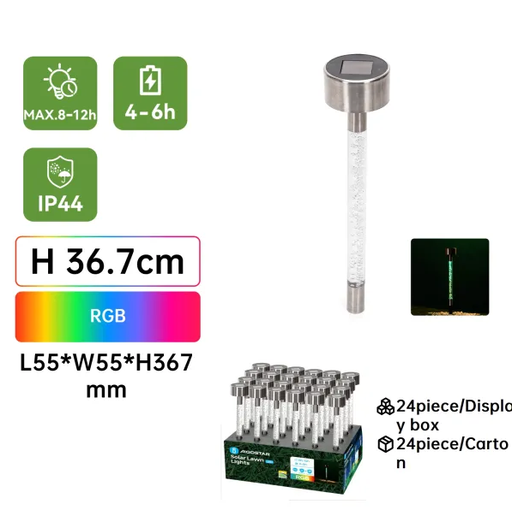
Why this product fits the profile: This compact solar ground light offers RGB colour changing for flower beds, lawns and decorative path sections, with no need to run any cables.
The product specifications state IP44, a charging time of around 4–6 hours and 8–12 hours of run time under suitable conditions. This makes it easier to set realistic expectations for its use.
RGB light, 36.7 cm height, integrated Ni-MH battery with 40 mAh and automatic activation at dusk.
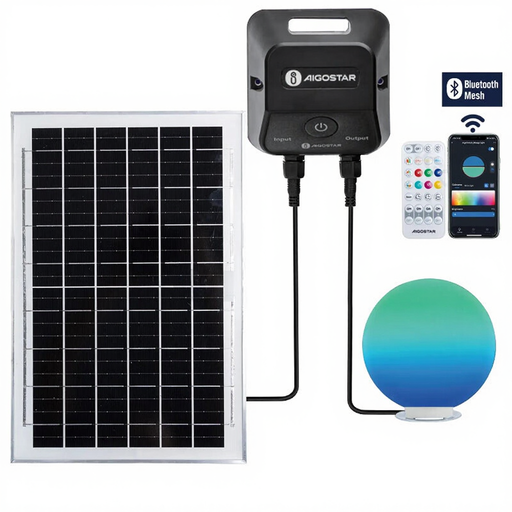
Why this product fits the profile: For large outdoor areas or multiple lights, this model offers RGB+CCT, Bluetooth mesh networking and an IP65 rating.
The IP65 rating is more meaningful for exposed locations than a vague claim of being "weatherproof". A hub may be required for app and voice control.
350 lm light output, 8000 mAh lithium battery, 2700–6500 K and Bluetooth mesh control for up to 200 devices according to the product specification.
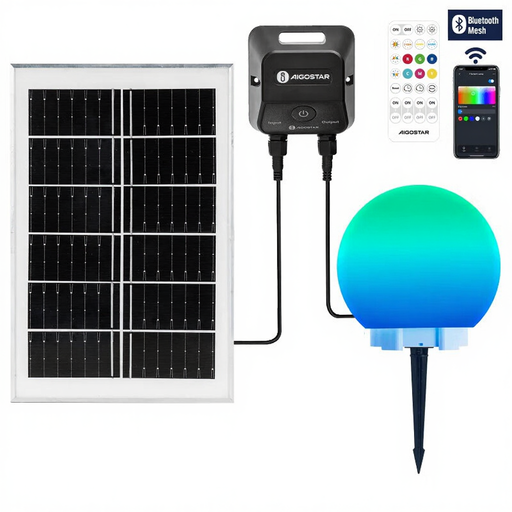
Why this product fits the profile: This model is aimed at buyers looking for smart solar garden lighting with grouped control, schedules and adjustable white tones.
The product description mentions Bluetooth mesh and AigoSmart app control. At the same time, IP54/IP44 are stated; the exact variant should be checked before installation and immersion in water must be avoided.
RGB+CCT from 2700–6500 K, app control, grouping of multiple lights and a solar-powered lithium battery.
We have put together a complete, regularly updated list of products that fully meet these strict selection criteria and the safety regulations in force in the EU.
Before installation, you should determine the lighting needs of the area. For garden path lighting, an even spacing is recommended to avoid creating isolated bright and dark patches. Ground spike lights belong in firm soil and should not be placed where water regularly collects.
During frost, extended periods of bad weather or heavy snowfall, it may be sensible to store the lights temporarily, provided the manufacturer's instructions allow this. Batteries must not be opened, damaged or replaced with unsuitable parts. Electronic components and batteries should be taken to the appropriate recycling point or separate collection scheme at the end of their service life.
The lifespan depends on the LED module, battery, weather conditions, charge cycles and maintenance. In the product specifications of individual models, for example, up to 15,000 or 30,000 operating hours are stated. These figures refer to the respective LED system and are not automatically equivalent to the battery's lifespan.
They can be used in winter if the panel receives enough daylight and the temperature is within the stated operating range. However, shorter days, low sun, snow and cloud cover often reduce the available charging energy. For security lighting that is needed continuously, you should check whether solar power alone meets the requirement.
In operation, they require no mains electricity because the solar panel charges the battery. Possible future costs may arise from replacing a battery or from replacement if damaged. That is why accessible installation, a suitable IP rating and proper maintenance are important for long-term use.