
Lieferung heute & morgen

Qualitätsgarantie

Willkommens-Angebote freischalten: KOSTENLOSE Lieferung | Bis zu 80 % RABATT | Kostenlose 30-Tage-JoyPlus-Testphase
App herunterladen
Solar garden lights are a practical way to illuminate paths, lawns and flower beds where there’s no mains connection. They’re usually easy to install, with no cables or sockets required. However, unclear product details and unrealistic expectations can often lead to the wrong purchase.
Figures such as “8–12 hours” usually assume suitable charging conditions. In the shade, during short winter days or after several cloudy days, the actual run time may be shorter. It depends on the size and type of solar panel, the battery capacity and the location.
The IP rating is an important factor to check for outdoor lights. IP44 means protection against solid objects larger than 1 millimetre and splashing water from any direction. A light with this rating isn’t designed to be submerged or left in standing water. Waterproof solar lights should also be positioned so that water can’t collect around the casing or solar panel.
Many solar garden lights are designed to create atmosphere or help you find your way. A small solar ground light or stake light won’t necessarily provide enough light for a driveway, staircase or large seating area. Check the luminous flux in lumens and the intended use, rather than relying solely on marketing claims or the number of LEDs.
Warm white solar lights at around 2700 Kelvin have a subtle look and work well in flower beds, along patio edges and beside garden paths. RGB solar lights can change colour and are mainly suited to decorative garden lighting. For consistent illumination along a path, a fixed light colour is often easier on the eye than changing colours.
When choosing outdoor LED solar lights, also check:
Solar lights with a rechargeable battery store the energy collected during the day. Nickel-metal hydride batteries, or Ni-MH batteries for short, are common in many decorative models. Larger lights may also use lithium batteries. Compare the battery capacity, charging time and stated run time together.
A suitable location should:
Don’t choose solar garden path lighting based only on the number of lights. Along a long path, evenly spacing the lights is more important than having one particularly eye-catching fitting.
Check that the dimensions suit the surrounding area. A light that’s 19.3 centimetres tall will look different in a low flower bed from a model that’s 36.7 centimetres tall. For solar stake lights, the length of the ground spike also matters, as it may not be as secure in soft soil.
Technical details such as IP44 or IP65 should always be checked against the intended use. IP65 indicates greater protection against dust and water jets than IP44. However, neither rating automatically means that a light can be used under water for extended periods.

Why this product suits these needs: This black solar stake light is 34 cm tall and can be installed along paths, flower beds or a driveway without any cables. With two LEDs and a built-in battery powered by one AAA battery, it’s a straightforward introduction to solar lighting.
The product description gives specific details about its dimensions, number of LEDs and battery power, rather than making only a general promise about brightness.
Cord-free installation, automatic lighting and a weight of 402 g help it stay securely in position in the ground.
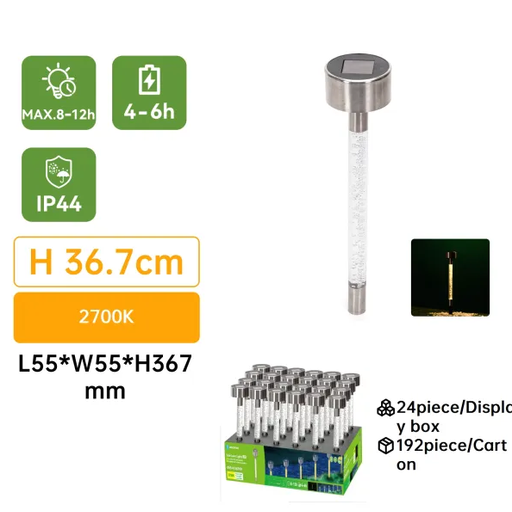
Why this product suits these needs: Its warm white light at 2700 Kelvin and Bubble Stick design are ideal for buyers looking to combine clear technical specifications with a subtle look.
The IP44 rating and recommended operating temperature range of -10 °C to 50 °C are clearly stated, making it easier to plan where to place the light.
The stated specifications include a 4–6-hour charging time, 8–12 hours of operating time in suitable conditions and a built-in 40 mAh Ni-MH battery.
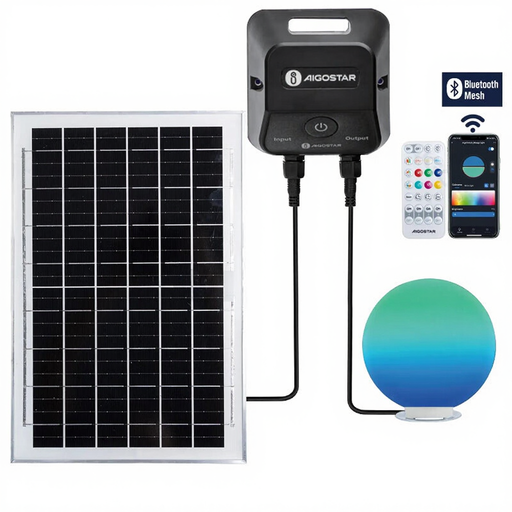
Why this product suits these needs: This solar ground light is designed for larger outdoor spaces, adjustable lighting effects and controlling multiple devices via Bluetooth Mesh.
With IP65 protection, a stated battery capacity of 8000 mAh and a luminous flux of 350 lm, it provides key details to help you choose a light for a larger area.
Choose from RGB, warm white and daylight white; the stated battery life is up to 24 hours, with a charging time of 4–6 hours.
We’ve put together a complete, regularly updated list of products that meet these strict selection criteria and the safety regulations in force in the EU.
Many models need around 4–6 hours to charge in suitable sunlight. The actual time depends on the solar panel, time of year, orientation and shade. Before using the light for the first time, charge the battery fully according to the product instructions.
Their lifespan depends on the battery, LED, casing, frost, moisture and care. Product specifications may, for example, state an LED life of 15,000 hours. This doesn’t automatically mean the battery and the light as a whole will last just as long. Clean the solar panel regularly, and only replace batteries with compatible models if the light is designed to allow this.
Solar lights draw their power from the battery charged during the day. They don’t need to be connected to the mains. So, unlike mains-powered lights, they don’t incur running costs through electricity use, although you may need to buy replacement batteries or replace the light further down the line.