
Lieferung heute & morgen

Qualitätsgarantie

Willkommens-Angebote freischalten: KOSTENLOSE Lieferung | Bis zu 80 % RABATT | Kostenlose 30-Tage-JoyPlus-Testphase
App herunterladen
Solar garden lights offer wireless outdoor lighting for paths, flower beds, lawns, driveways and patios. Installation is usually straightforward: push the light into the ground, position the solar panel and let the battery charge during the day. Even so, a few common buying mistakes mean that many solar garden lights end up barely used after a short time.
Claims like "8–12 hours" generally apply under suitable charging conditions. In shade, cloudy weather or winter, the actual run time can be shorter. A small solar panel and a low-capacity battery are fine for decorative light, but not necessarily for consistent pathway lighting throughout the night.
So pay attention to:
The IP rating describes how well a housing is protected against solid objects and water. IP44 means protection against solid objects larger than 1 mm and against splashing water. Such a light is suitable for many sheltered outdoor areas, but should not stand in water or be exposed to persistent heavy rain.
With IP54, there is also limited protection against dust. This rating does not mean the light can be submerged. For permanently exposed positions, buyers should carefully check the installation instructions and the intended area of use.
Cool white light at around 6,500 Kelvin appears clear and striking. It can be suitable for orientation along paths, but on a patio or near seating areas it often feels rather clinical. Warm white solar lights at 2,700 Kelvin create a more subtle light effect and tend to suit seating areas, flower beds and decorative arrangements.
RGB solar lights or solar lights with colour-changing options offer additional design possibilities. They are mainly suitable for decorative accents. For consistent functional lighting, however, the brightness of the white light and the positioning of the lights should take priority.
Solar lights store energy during the day in an integrated battery. The stated lighting duration only makes sense when considered alongside the charging time. For the Aigostar models featured here, for example, approximately 4–6 hours charging time and 8–12 hours of lighting are stated. These values depend on sunlight, orientation, shading and temperature.
A battery with a higher capacity can store more energy, but does not automatically lead to a longer run time if the solar panel cannot recharge the required energy. Clean the panel surface regularly with a soft, damp cloth and avoid abrasive cleaning products.
Solar ground spike lights can be placed in soft soil, lawn or loose earth without a mains connection. For hard or compacted ground, a ground spike is less suitable. The spike should not be forced into dry ground, as the holder or housing could be damaged.
Solar ground lights with a flat design are suitable for borders and paved areas, but require a suitable recess or a stable surface. So check before buying:
For subtle LED garden lights, 2,700 to 3,000 Kelvin is often a suitable choice. 6,500 Kelvin provides a noticeably cooler white. With smart solar lights, additional features such as schedules, grouping, brightness control and colour changing may be available.
Bluetooth Mesh can support the control of multiple lights. For this, compatibility, app availability and any required hub must be checked. A smart control system is not automatically necessary if you only want a single light to switch on at dusk.
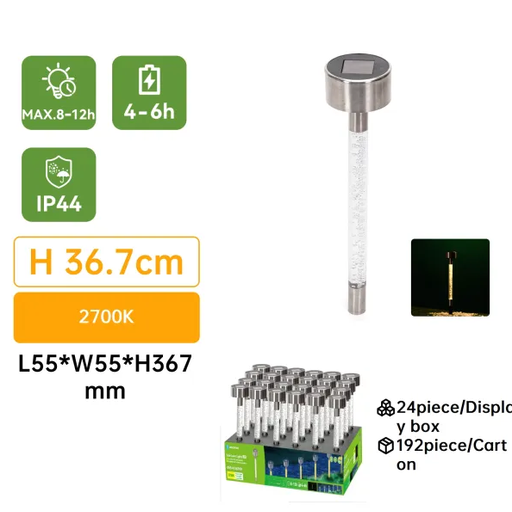
Why this product suits the profile: The 36.7 cm high ground spike light can be placed in soft earth or lawn without any fixed wiring. Warm white light at 2,700 Kelvin is ideal for decorative accents in flower beds and along paths.
The technical specifications clearly state the charging time, lighting duration and IP44. This makes it easier to assess the light for sheltered outdoor areas.
2700K light, Ni-MH battery, automatic dusk function and a stated 8–12 hours run time under suitable conditions.
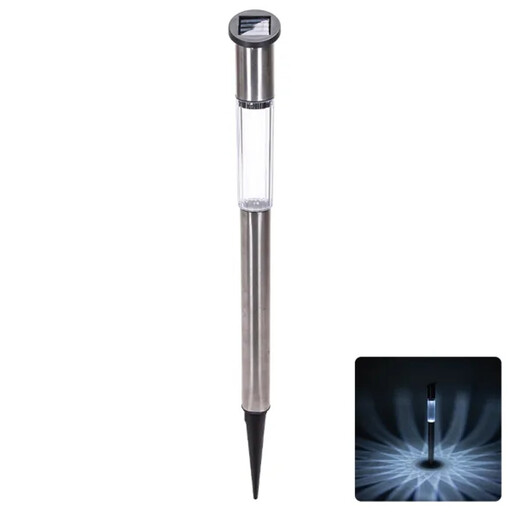
Why this product suits the profile: The cool light at 6,500 Kelvin is ideal for users who want to clearly mark paths, lawn edges or driveways.
The description highlights IP44 and clarifies that it is not suitable for submersion. This prevents it being mistakenly seen as a fully waterproof light.
Polycrystalline solar panel technology, NiMH battery, Ra≥70 and a stated lifespan of up to 15,000 hours.
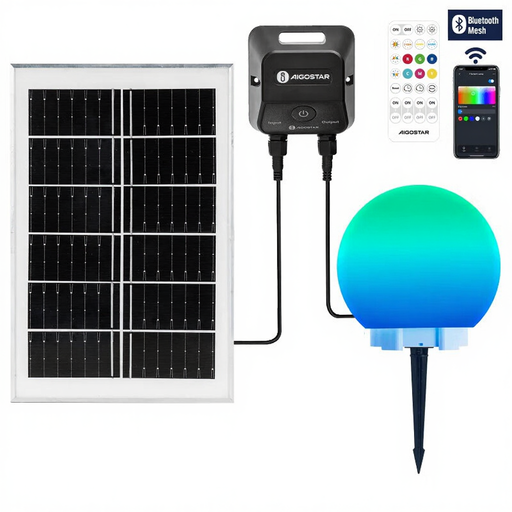
Why this product suits the profile: RGB+CCT with 2,700–6,500 Kelvin and app control offer multiple light modes for larger garden areas, paths or seasonal decorations.
IP54 or IP44 is specifically stated. In addition, the sun position, app pairing and any required hub must be considered before installation.
Bluetooth Mesh, grouping of multiple lights, schedules, brightness control and RGB+CCT light control via the AigoSmart app.
Not every high-quality outdoor light is a solar light. An EGLO garden light with IP65, 3,000 Kelvin and 470 lumens could be of interest for permanently connected outdoor lighting. However, it requires a mains connection and therefore belongs to a different product category than wireless solar garden lights. So check before buying whether mains power is available at the installation location and whether a fixed installation is permitted and can be carried out professionally.
We have put together a complete, regularly updated list of products that fully meet these strict selection criteria and the safety regulations in force in the EU.
The run time depends on sunlight, panel size, battery capacity, temperature and the brightness level selected. For several of the models featured, 8–12 hours are stated under suitable conditions. In winter or during prolonged cloud cover, the lighting duration may be shorter.
The solar panel should ideally receive several hours of direct daylight and not be shaded by trees, buildings or walls. For garden path lighting, it is advisable to keep a sufficient distance from heavily overgrown border areas. Also make sure the light is not regularly affected by watering or standing water.
During operation, they do not need a mains connection, as the battery is charged during the day via the solar panel. The ongoing costs for mains electricity are therefore low. However, you should consider battery wear, possible replacement parts and the proper disposal of the battery and electronics.