
Lieferung heute & morgen

Qualitätsgarantie

Willkommens-Angebote freischalten: KOSTENLOSE Lieferung | Bis zu 80 % RABATT | Kostenlose 30-Tage-JoyPlus-Testphase
App herunterladen
By a Joybuy Product Recommendation Officer
Solar lights offer a simple, cost-effective way to bathe your garden, balcony, or patio in an atmospheric glow—all without cables or an impact on your electricity bill. But the market is crowded, and not every product lives up to its advertising claims. Before you invest, it's crucial to understand the common pitfalls that often lead to disappointment and unnecessary expense.
This guide will help you cut through the noise. We'll focus on the critical technical specifications and show you what to look for to find durable, functional solar garden lighting that truly meets your needs.
Many buyers are drawn in by appealing product photos, but overlook critical flaws that only become apparent with everyday use. Here are the three most common problems:
To avoid these problems, let objective technical data—not marketing promises—guide your decision. Three metrics are of central importance.
The IP (Ingress Protection) rating indicates how well an electrical device is protected against the intrusion of foreign objects and water. For outdoor use, the following ratings are relevant:
The runtime depends directly on the battery's capacity (measured in milliampere-hours, mAh) and the solar panel's efficiency. A higher mAh number means more energy can be stored. At the same time, the panel must be capable of fully charging the battery during the day. Monocrystalline solar panels generally offer higher efficiency in direct sunlight than amorphous panels, although the latter can still perform in low or diffuse light. Look for a balanced ratio between battery capacity, charging time (typically 6–8 hours), and the stated runtime (typically 8–14 hours).
The lighting ambiance is largely determined by the colour temperature. Warm white solar lights (approx. 2700K) create a cosy, inviting atmosphere. Cool white light (over 5000K) appears brighter and is well-suited for functional areas. A multi-colour solar string light offers decorative versatility for parties.
For maximum flexibility, consider smart garden lighting. Models with RGBCCT (Red, Green, Blue + Correlated Colour Temperature) allow for the seamless adjustment of millions of colours, as well as tuning white tones from warm to cool. Technologies like Bluetooth Mesh enable the control and synchronisation of hundreds of lights via a single app—a modern form of cord-free patio lighting.
Based on these criteria, we have curated products for different user groups.
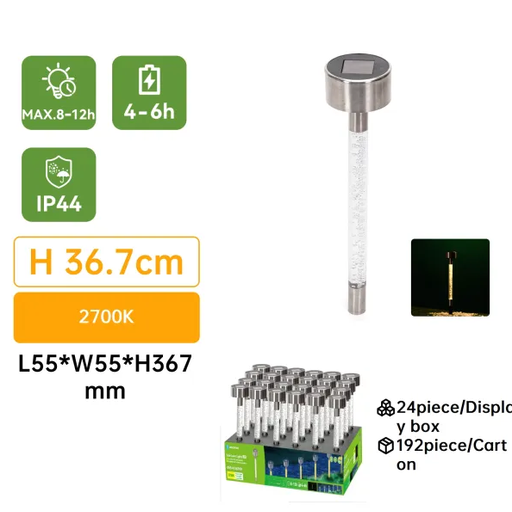
Why This Fits Their Persona: Ideal for users who want to add initial accents to their garden without significant effort or expense. Perfect for marking pathways or subtly illuminating flowerbeds.
The product states a realistic runtime of 8–12 hours under suitable charging conditions and features an IP44 certification, which is sufficient for its intended use as an accent light and avoids the pitfall of poor weather resistance.
Hassle-free installation with a ground stake; produces a pleasant warm white light at 2700K; decorative bubble design.

Why This Fits Their Persona: Perfect for creative minds who want to flexibly and colourfully showcase balconies, fences, trees, or shrubs for parties or everyday ambiance.
With an IP65 rating, this string light is explicitly designed for year-round outdoor use and can withstand heavy rain. The 8 different lighting modes with a memory function also offer much more than just a faint glow.
Set of two 8-metre string lights; flexible copper wire; 8 lighting modes for varied effects; automatic on/off function.
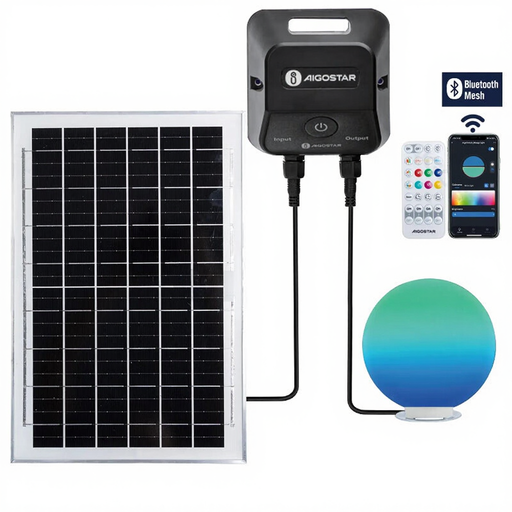
Why This Fits Their Persona: For users who want complete control over their lighting concept. Ideal for creating dynamic light scenes, scheduling, and integrating into a smart outdoor system.
It addresses all three pitfalls: A large 8000mAh battery and an efficient monocrystalline panel ensure a long runtime (up to 24h). The brightness of 350 lumens is significantly more than just a glow. The IP65 rating guarantees high weather resistance.
Bluetooth Mesh for controlling over 200 lights; full RGBCCT colour control (2700K-6500K); high brightness and long battery life.
We have compiled a complete, up-to-date list of products that fully meet these strict selection criteria and all relevant safety regulations.
The lifespan of a solar light is determined by two main components: the LEDs and the battery. The LEDs themselves are very durable, often with a rated lifespan of 15,000 to 30,000 hours. The limiting factor is typically the rechargeable battery, whose capacity can diminish after 1–3 years (approx. 500–1000 charge cycles). On some models, the battery can be replaced, which extends the product's lifespan.
Yes, but with reduced performance. Solar lights also charge in diffuse light, but much more slowly than in direct sunlight. This results in a shorter runtime at night during winter or on consistently overcast days. Models with high-efficiency monocrystalline solar panels and large batteries are better suited for these conditions.
The most important factor is the placement of the solar panel. It should be installed in a location that receives as much direct sunlight as possible throughout the day and is not shaded by trees, buildings, or overhangs. Keep the panel's surface clean of dust and debris to maintain charging efficiency. Before the first use, it is recommended to let the light charge in the sun for a full day.