
Lieferung heute & morgen

Qualitätsgarantie

Willkommens-Angebote freischalten: KOSTENLOSE Lieferung | Bis zu 80 % RABATT | Kostenlose 30-Tage-JoyPlus-Testphase
App herunterladen
Solar lights for the garden don’t need a permanent mains connection and can usually be set up without tools. However, models vary considerably in light colour, IP rating, battery capacity and build quality. If you focus only on the design or stated operating time, you could end up with a light that barely charges in a shady spot or isn’t sufficiently protected for its intended use.
Figures such as “8–12 hours” are generally based on suitable charging conditions. In autumn, during prolonged cloudy weather or beneath trees, less solar energy is available. So, wherever possible, position your solar light where its panel will receive several hours of direct daylight.
Also check whether the stated operating time depends on battery capacity, light output or an energy-saving mode. A long operating time doesn’t automatically mean bright illumination.
Many solar garden lights have an IP44 rating. The first digit, 4, indicates protection against solid objects measuring 1 mm or more; the second digit, also 4, indicates protection against water splashing from different directions. IP44 is suitable for many covered or open outdoor areas, but it doesn’t protect against prolonged immersion, high-pressure water or standing water.
So, check the location carefully. A solar light may not be suitable despite its IP44 rating if it’s in a dip, somewhere that regularly floods or directly beneath a roof edge where water pours off heavily.
RGB solar lights and warm white models create atmosphere, but they aren’t necessarily a substitute for bright security lighting. Solar path lights, spaced evenly apart, are a good choice for paths. For flower beds or lawns, solar ground lights or models with ground spikes may be sufficient. The key factors are spacing, light output, beam direction and light colour.
Warm white solar lights at around 2,700 Kelvin have a subtle appearance and often work well on patios, in seating areas and among plants. Cool white light at around 6,500 Kelvin looks crisper and can be used for paths or guidance. Depending on the model, an RGB function cycles through several colours and is best suited to decorative use.
Check the Ra colour rendering index. A value of Ra ≥70 is stated for several of the products listed here. It indicates how natural colours look under the light, but doesn’t measure brightness.
Depending on the model, the products featured list a charging time of around 4–6 hours and an operating time of 8–12 hours under suitable conditions. These are manufacturer’s figures and may be affected by the time of year, positioning, shade, dirt and battery age.
Several models have an integrated NiMH battery. Don’t open or modify the battery compartment yourself. When replacing or disposing of a battery, follow local regulations for electrical equipment and batteries.
Solar lights with ground spikes are pushed into soft soil or a lawn. The spike may be damaged if you try to push it into hard or compacted ground. When planning where to position your lights, consider their height too: models around 19 to 37 centimetres tall are better suited to marking flower beds and paths, while taller lights create a more striking decorative effect.
A stainless steel look doesn’t necessarily mean the whole housing is made of stainless steel. According to the product details, some models have a plastic main body with a stainless steel-effect finish. If the materials used are important to you, compare the description and technical specifications before buying.
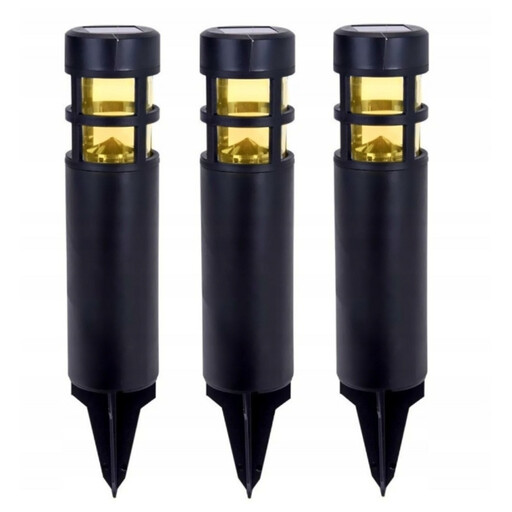
Why this product suits this profile: This set of three is a good choice for small paths, flower bed borders or a balcony when you only need a modest number of lights to begin with. The lights charge using sunlight and, according to the product description, switch on automatically at dusk.
The pack size is clearly stated, making it easier to plan how many you need rather than buying too many lights for a small area.
Three lights for easy positioning; switches on automatically at dusk, according to the description.

Why this product suits this profile: The stated light colour of 6,500 Kelvin, its height and ground spike, and the technical details on charging and operating times make it easier to plan where to use it on paths or lawns.
The description specifies the materials, IP44 rating, charging time of 4–6 hours and operating time of 8–12 hours under suitable conditions. However, IP44 should not be mistaken for protection against immersion.
Polycrystalline solar panel, NiMH battery and stated Ra colour rendering index of ≥70; plastic body with a stainless steel-effect finish.
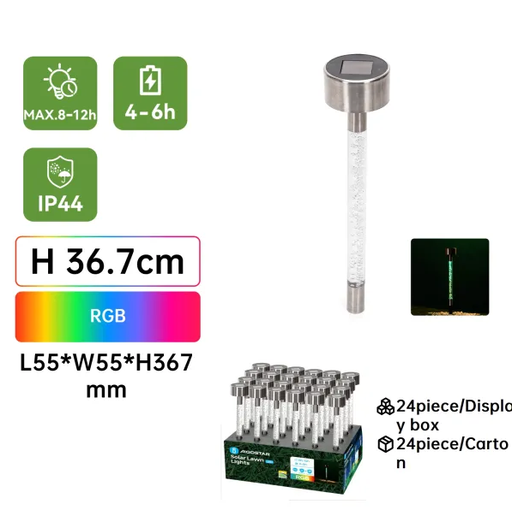
Why this product suits this profile: The RGB function and height of 36.7 centimetres make this a good choice if you want to add colour to flower beds, lawns or paths. The ground spike lets you position it flexibly in soft soil.
The product details explicitly state that it has RGB lighting and an IP44 rating, and give its charging and operating times. This makes it easier to distinguish its decorative function from neutral path lighting.
RGB light, 36.7 centimetres tall, NiMH battery and a stated operating time of 8–12 hours under suitable charging conditions.
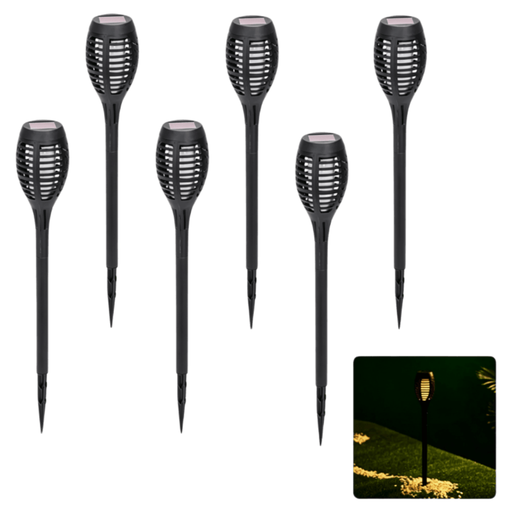
Why this product suits this profile: This set of six solar lights casts warm white light at 2,700 Kelvin along paths, lawns or flower bed borders. The larger pack size is ideal for longer stretches and a coordinated look.
The colour temperature, pack size and IP rating are all clearly stated. This makes it clear that these are primarily decorative solar garden lights, rather than a solution for brightly illuminating a large area.
Six lights, warm white light at 2,700 Kelvin, IP44 rating and a stated operating time of 8–12 hours under suitable conditions.
We’ve put together a complete, regularly updated list of products that meet these strict selection criteria and fully comply with the safety regulations in force in the EU.
Many models have a stated charging time of around 4–6 hours in suitable sunlight. Charging may take longer in overcast weather or in shady spots. Before using the light for the first time, it’s a good idea to let it charge fully in direct sunlight.
Their lifespan depends on the LED, battery, housing, weather conditions and care. Some of the products listed state an LED lifespan of up to 15,000 hours. This is a manufacturer’s technical figure for the light source and doesn’t necessarily represent the lifespan of the complete light.
They don’t need to be connected to the mains while in use. The integrated battery charges during the day via the solar panel. So, unlike mains-powered lights, they don’t have ongoing electricity costs; however, you should still factor in the purchase price, possible battery replacements and disposal.