
Lieferung heute & morgen

Qualitätsgarantie

Willkommens-Angebote freischalten: KOSTENLOSE Lieferung | Bis zu 80 % RABATT | Kostenlose 30-Tage-JoyPlus-Testphase
App herunterladen
Solar lights for the garden don’t need a mains connection and can be installed in many places without complicated fitting. However, solar garden lights vary considerably in brightness, battery, IP rating and controls. If you focus only on the design or a high wattage, you could end up buying a model that doesn’t work reliably in your garden.
With solar lights, the wattage doesn’t automatically indicate how bright the light will appear. The most important factors are the light output in lumens, the beam angle and where the light is positioned. A decorative solar spike light with a low lumen output may be suitable for a flower bed, but it won’t necessarily be bright enough to light up a driveway.
The label ‘for outdoor use’ doesn’t replace a specific IP rating. An IP44 solar light is protected against solid objects larger than 1 mm and water splashes. It may be suitable for sheltered flower beds or paths, for example, but shouldn’t be left permanently in a dip where water can collect.
An IP65 solar light is dust-tight and protected against water jets. This rating may be more suitable for areas exposed to the elements. IP67 solar lights are also designed to withstand temporary immersion under defined conditions. However, IP67 doesn’t mean the light can be left permanently in water or used as pond lighting.
Actual run time depends on sunlight, the time of year, shade, battery condition and the brightness setting. A solar panel beneath a tree or on a north-facing wall will charge much less effectively than one in an unobstructed, south-facing position. With models that have a separate panel, the light itself can be placed in the shade while the panel is positioned somewhere sunnier.
Check the battery type, capacity and stated charging time. Depending on the model, the product details provided list Ni-MH or lithium batteries, charging times of around 4 to 6 hours, and run times of 8 to 12 hours or up to 24 hours. Treat these figures as a guide to performance under suitable charging conditions.
Keep the panel clear of leaves and dust, and make sure it isn’t constantly in the shade. Regularly wiping it with a soft cloth can help maintain its charging capacity. For solar lights with a separate panel, also check the cable length and how the panel can be mounted.
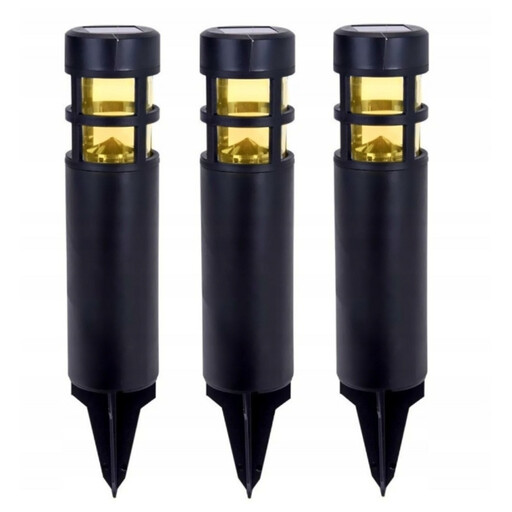
Why this product suits this profile: This set of three solar lights is designed for simple markers along paths, flower beds or lawn edges. They switch on automatically at dusk, so there’s less to manage.
The product description clearly states the number of lights and their intended use. This helps you light a small area without expecting a single light to cover too much ground.
Three lights per pack; cordless placement and automatic activation in the dark.
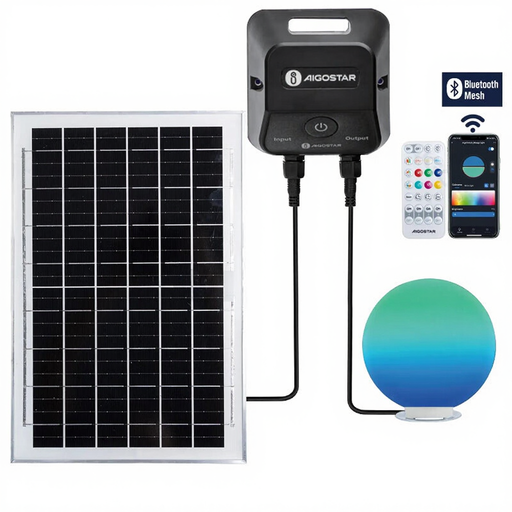
Why this product suits this profile: This light combines a stated output of 350 lumens with RGB and white light options, plus Bluetooth Mesh control for larger outdoor spaces.
The IP65 rating, separate solar panel connection and stated battery capacity of 8000 mAh give you specific details to check, rather than just a description of the design.
350 lumens; RGB plus 2700 to 6500 Kelvin; Bluetooth Mesh for connecting more than 200 devices, according to the product details.
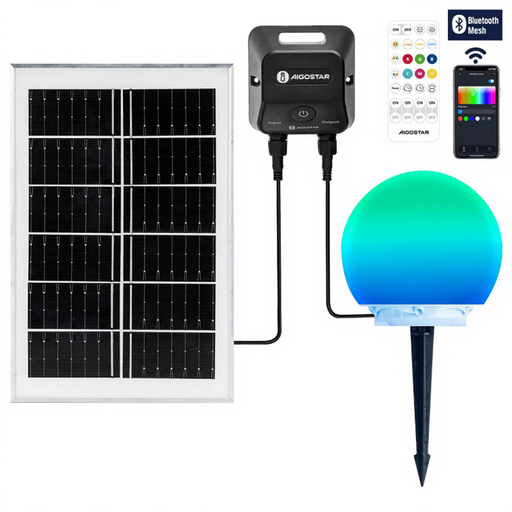
Why this product suits this profile: Its recessed design is intended for paths, patios and other ground surfaces. RGB, adjustable white light and a stated battery capacity of 4000 mAh make it suitable for anyone looking for flexible lighting options.
The IP67 rating is more relevant than IP44 for ground areas subject to heavier use. The separate panel also gives you more flexibility to position it towards the sun.
IP67; Bluetooth Mesh; stated lighting time of up to 24 hours under suitable conditions.
We’ve put together a complete, regularly updated list of products that meet these strict selection criteria and fully comply with the safety regulations in force in the EU.
Lifespan depends on the battery, electronics, materials, temperature and maintenance. Product details for some models state a lifespan of 15,000 or 30,000 hours, for example. This doesn’t necessarily indicate how long the battery will last. As the battery deteriorates, the light may start running for less time at night.
The panel should receive several hours of direct sunlight wherever possible, and shouldn’t be covered by trees, buildings or dirt. Charging performance may decrease in winter and cloudy weather. With a separate panel, you can position the light independently of the sunniest spot for installation.
Solar lights draw their power from the charged battery while in use, so they don’t need mains electricity. This means they don’t have ongoing costs like mains-powered lights, although you may need to allow for replacement batteries or replacing the light at a later date.