
Lieferung heute & morgen

Qualitätsgarantie

Willkommens-Angebote freischalten: KOSTENLOSE Lieferung | Bis zu 80 % RABATT | Kostenlose 30-Tage-JoyPlus-Testphase
App herunterladen
Solar garden lights don't need a fixed power supply and can usually be set up without any tools. However, not every light suits every outdoor area. Vague information about battery life, an unsuitable IP rating, or a solar panel that's positioned at the wrong angle often means the lighting only works intermittently after a short time.
This buying guide explains which technical specifications matter before you make a purchase, and which types of light are best suited to different situations.
Manufacturers' figures for operating time are usually based on specific charging conditions. Shade from house walls, trees or balcony railings reduces the available solar energy. The lighting duration can also be shorter in winter or during several cloudy days.
So pay attention to the combination of battery capacity, charging time and solar panel output. A light with a separate panel can often be positioned more flexibly towards the sun than a model where the panel and light source are fixed together.
The IP rating is far more meaningful than general marketing claims:
For a sheltered patio, IP44 may be sufficient. For solar ground lights placed close to lawns or paths, the local conditions are what matter. Even with a high IP rating, you should regularly check the seals, cable entry points and the solar panel.
RGB solar lights create colourful accents, but they aren't automatically suitable for guiding you along paths. For a front door or a staircase, an even, clearly visible light distribution is more important than a wide range of colours. Colour-changing effects are better suited to flower beds, parties, balconies or seasonal decorations.
The installation method determines which shape of light makes sense:
Warm white, around 2700 to 3000 Kelvin, feels subtle and works well for seating areas. Cool white, up to 6500 Kelvin, looks more functional and can highlight paths or entrance areas more clearly. With RGB+CCT lights, you can switch between colours and different shades of white.
Smart solar lights offer additional settings such as brightness control, timers or group control. Before you buy, check whether an app, a hub or a Bluetooth connection is required. For larger installations, you should also consider the connection range.
ABS and PC plastic are common in many outdoor lights. Stainless steel can offer extra stability and a different look, but it doesn't automatically protect against every weather condition. What really matters is the build quality, the IP rating and correct installation.
Clean the solar panel with a soft, slightly damp cloth. Don't use any abrasive products. For models with replaceable or integrated batteries, follow the manufacturer's safety instructions. Damaged housings or cables should not be used outdoors any longer.

Why this product fits the profile: This solar spike light can be placed in soft soil or grass without any cables and works with a polycrystalline solar cell. It's ideal for simple marking along borders and paths.
The stated values give a charging time of 4–6 hours and a lighting duration of 8–12 hours under suitable conditions. The IP44 rating also makes it clear that submersion is not intended.
6500 Kelvin light colour, stainless steel elements and automatic on/off at dusk.
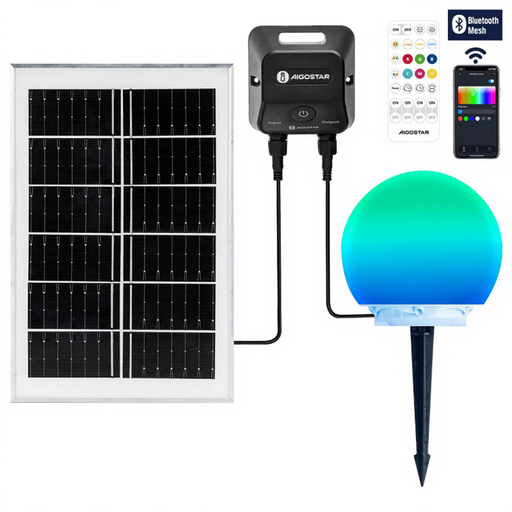
Why this product fits the profile: This recessed light combines RGB+CCT, an adjustable white light range from 2700 to 6500 Kelvin and Bluetooth Mesh control. It's a great fit for larger garden or patio concepts with coordinated lighting groups.
The IP67 rating is more specific than the term "waterproof". Nevertheless, the installation location and drainage must be suitable; the light is not described as a product for permanent submersion.
4000 mAh lithium battery, separate 5W solar panel and Bluetooth Mesh for grouping multiple lights.
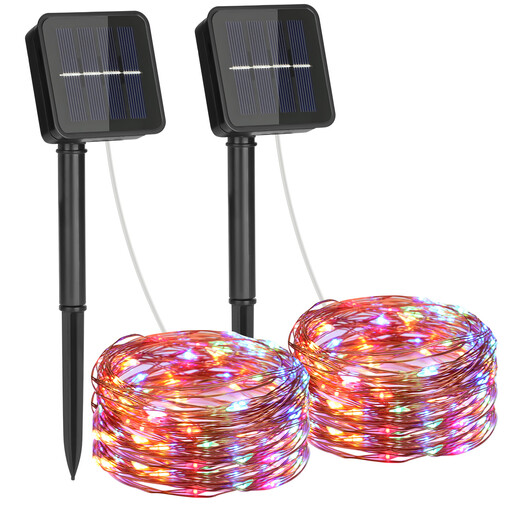
Why this product fits the profile: Two solar string lights, each 12 metres long with 120 LEDs, are ideal for balconies, pergolas, garden parties and seasonal decorations.
The product details state 8–14 hours of lighting after 6–8 hours of sunlight and explicitly note that IP65 protects against rain and splashing water, not against submersion.
Eight lighting modes, memory function and flexible copper wire for different decorative shapes.
We've put together a full, regularly updated list of products that fully meet these strict selection criteria and the safety regulations in force in the EU.
The solar panel should receive several hours of direct sunlight if possible. Avoid permanent shade from buildings, trees or parasols. With solar spike lights, the panel faces upwards; with separate panels, the orientation can be independent of the light source.
The actual lifespan depends on factors including the battery, LED operating time, temperature, humidity and maintenance. Clean the panel regularly and store portable lights during severe frost according to the manufacturer's instructions. A stated LED lifespan is not automatically the same as the battery's lifespan.
During operation, they don't need to be connected to the mains. The energy is collected during the day via the solar panel and stored in the battery. Costs can arise from replacement batteries or replacing damaged components. With battery-powered alternatives, such as decorative outdoor lighting using AA batteries, you'll have ongoing battery costs.