
Lieferung heute & morgen

Qualitätsgarantie

Willkommens-Angebote freischalten: KOSTENLOSE Lieferung | Bis zu 80 % RABATT | Kostenlose 30-Tage-JoyPlus-Testphase
App herunterladen
Solar garden lights are a practical way to illuminate paths, lawns or flowerbeds where there’s no mains power. There’s a wide choice, from simple solar stake lights to colour-changing RGB solar lights. However, attractive product images and sweeping advertising claims don’t automatically mean you’ll find the right light.
A solar light can look impressively bright, yet have enough stored energy to last only a few hours. Claims such as “8–12 hours” are based on suitable charging conditions and may vary in cloudy weather, in shaded spots or at low temperatures. So, if you need consistent lighting along a path, consider more than just the light colour: the location and battery capacity matter too.
IP44 means protection against solid objects larger than 1 mm and splashing water from different directions. However, this rating doesn’t mean you can submerge a light or leave it standing unprotected in a puddle. Place solar garden lights on a well-drained surface.
A silver finish may be plastic with a stainless steel effect. This often makes the light lighter, but it says nothing about the long-term sturdiness of the ground stake or connector. Before buying, check the material, dimensions and weight, rather than relying on the product image alone.
Solar path lights or solar stake lights are a good choice for marking out a continuous route. To highlight individual plants, borders or edges, try solar ground lights or compact solar stake lights.
Solar lights need a spot with as much direct sunlight as possible. Trees, house walls, porches and dense hedges can reduce charging efficiency. The models selected here have stated charging times of around 4–6 hours and a lighting duration of 8–12 hours in suitable conditions.
Regularly cleaning the solar panel with a soft, slightly damp cloth can help remove dirt. Abrasive cleaners and stiff brushes may damage the surface.
Check the following:

Why it suits this profile: This solar light is easy to install with its ground stake, and offers cool white light at 6500 K with a stated IP44 rating. It’s a good choice if you want to mark out paths or lawns without running cables.
The light colour, charging time, run time, temperature range and IP rating are all clearly stated. This makes it easier to compare the light objectively with other outdoor LED solar lights.
Polycrystalline solar panel, NiMH battery, 6500 K light and a stated lighting duration of 8–12 hours in suitable conditions.
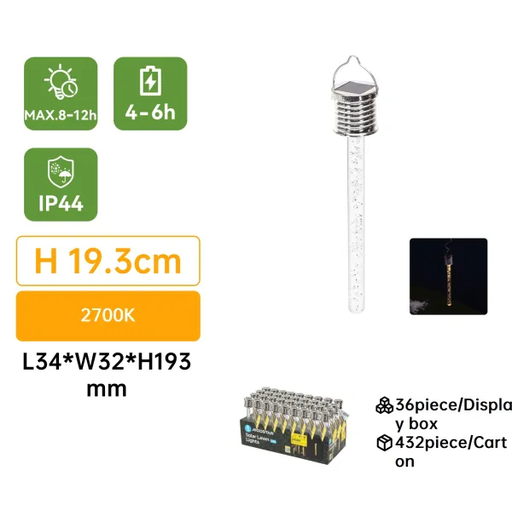
Why it suits this profile: The warm white light at 2700 K and compact Bubble Stick design are a good fit for decorative areas such as patios, flowerbeds and garden borders.
The specifications clearly state the colour temperature, IP44 rating, dimensions of 34 × 32 × 193 mm and plastic construction.
2700 K warm white light, a stated colour rendering index of Ra≥70, a 40 mAh NiMH battery and automatic lighting in suitable charging conditions.
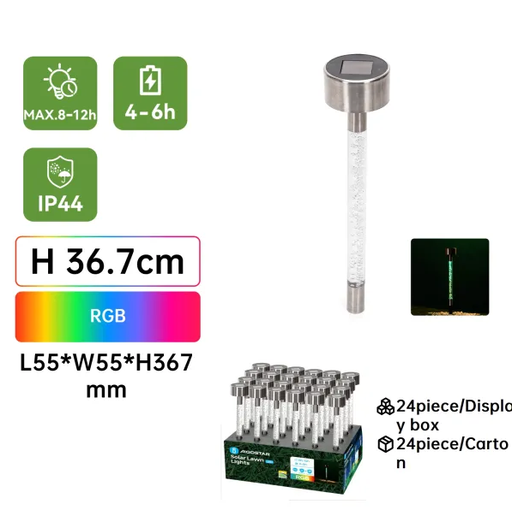
Why it suits this profile: The RGB feature adds colourful accents to lawns, paths or flowerbeds. At 36,7 cm tall, the light is visible from further away.
The product details distinguish decorative RGB lighting from technical limits such as IP44, -10 °C to 50 °C and a run time of 8–12 hours.
RGB light, 36,7 cm height, a 40 mAh NiMH battery, an amorphous solar panel and a stated charging time of 4–6 hours.
We’ve put together a complete, regularly updated list of products that meet these strict selection criteria and fully comply with the safety regulations in force in the EU.
It depends on the solar panel, direct sunlight and the time of year. The models mentioned have a stated charging time of around 4–6 hours. On cloudy days or in shaded spots, they may store less energy.
Their lifespan depends on factors including the battery, weather, cleaning and temperature. Several Aigostar lights have a stated nominal LED lifespan of up to 15.000 hours. This doesn’t necessarily mean the battery or the product as a whole will last just as long.
During normal use, solar garden lights draw their energy from daylight and don’t need to be connected to the mains. You may incur costs later if you need to replace a battery or dispose of electronic components. Batteries should not be opened or burned; follow local guidelines for disposing of electrical and electronic equipment.