
Lieferung heute & morgen

Qualitätsgarantie

Willkommens-Angebote freischalten: KOSTENLOSE Lieferung | Bis zu 80 % RABATT | Kostenlose 30-Tage-JoyPlus-Testphase
App herunterladen
Solar garden lights promise cordless outdoor lighting without complicated wiring. That makes them a practical option for paths, flower beds, lawns, patios or driveways. However, solar lights for the garden differ significantly in brightness, protection rating, battery and installation.
If you only focus on design or the stated lighting duration, you could quickly buy a product that doesn't charge sufficiently in its intended location or becomes noticeably dimmer after just a few hours. The following criteria will help you avoid typical buying mistakes and choose the right garden lighting for your outdoor space.
Claims such as "8–12 hours" generally apply under suitable charging conditions. In a British garden, shade from house walls, trees or hedges, short winter days and overcast skies can reduce the available charging energy.
The solar panel should therefore receive as many hours of direct daylight as possible. A location under a dense tree is usually unsuitable for solar ground lights, even if the product promises a long lighting duration on the packaging.
The IP rating describes protection against solid foreign objects and water. IP44 means, among other things, protection against splashing water, but not against permanent immersion or heavy water accumulation. For a freestanding light in a flower bed, IP44 may be sufficient if it isn't placed in a dip.
For more exposed areas, higher protection ratings such as IP65 are more suitable. You should still follow the installation instructions, because a protection rating doesn't replace proper installation.
RGB solar lights or warm white solar lights primarily create atmosphere and orientation. For a driveway, garage or house wall, a higher light output with targeted direction may be required.
A small garden light with a ground spike isn't automatically suitable as security lighting. So check whether the lumen value, beam angle, sensor function and mounting height match the intended use.
Colour temperature is given in Kelvin:
A value of 6500 K appears significantly cooler than 2700 K. For a uniform LED garden lighting scheme, you should combine lights with a similar colour temperature.
Pay attention to the battery type, capacity, and charging and lighting duration. For several products in our selection, around 4–6 hours of charging time and 8–12 hours of lighting are stated. These values depend on sunlight, panel orientation, temperature and the age of the battery.
A larger battery alone doesn't guarantee a longer operating time. The solar panel must be able to recharge enough energy. Additionally, Ni-MH batteries can lose capacity over time. Replacement should only be carried out if the manufacturer allows it.
Garden lights with a ground spike can be inserted into soft soil without tools. However, on hard or stony ground, the spike can be damaged. The light should not be forced into the ground.
Mains-powered outdoor floodlights have different requirements to solar lights. The LUTEC Twin LED Spotlight operates, according to the product information, with AC 120 V, 60 Hz. This doesn't automatically correspond to the British household mains supply of 230 V and 50 Hz. Before purchasing for the UK, electrical compatibility must be clearly established. A hardwired installation should always be carried out by a suitably qualified electrician.
Material information also deserves attention: die-cast aluminium, toughened glass, plastic or a stainless steel finish all have different properties in terms of weight, durability and maintenance. A stainless steel finish, for example, can be made of plastic and is not the same as solid stainless steel.
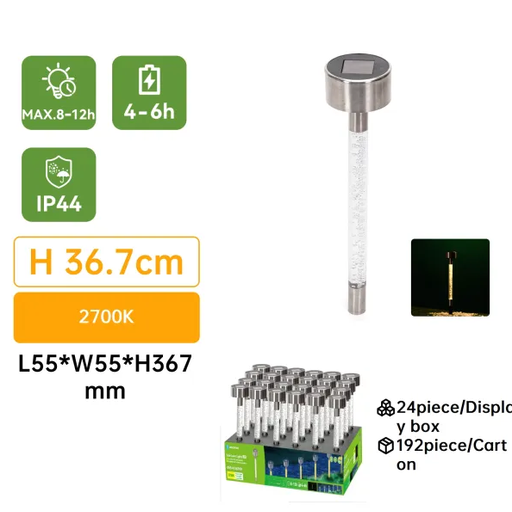
Why this product fits the profile: The RGB function and ground spike offer a straightforward introduction to decorative path lighting, flower beds and lawns without a mains connection.
The technical specifications state IP44, a charging time of 4–6 hours and 8–12 hours of lighting duration under suitable conditions. This helps you better assess expectations for the location.
RGB light, polycrystalline solar panel, 200 mAh Ni-MH battery and simple ground installation; according to the product information, an operating range of -10 °C to 50 °C.
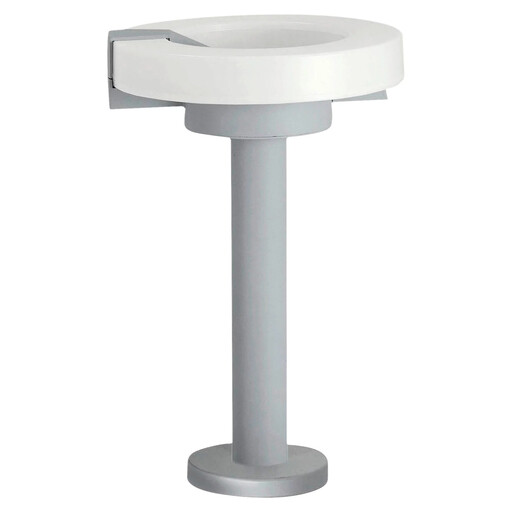
Why this product fits the profile: The post form is suitable for permanently planned outdoor lighting along paths, lawns and driveways, provided a mains connection is available.
The product information explicitly states IP65 and a non-dimmable LED. This means the protection rating and operating limits are more clearly described than with purely decorative solar lights.
IP65, 3000 K warm white light and 470 lumens according to the product description; additionally an E27 socket for bulbs up to 40 W, not included.
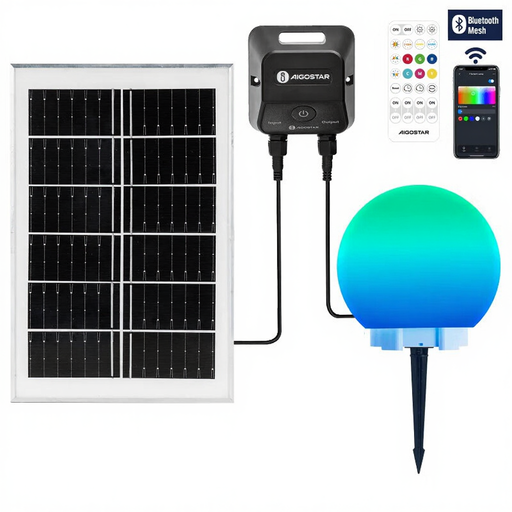
Why this product fits the profile: Bluetooth Mesh, app control and RGB+CCT are aimed at users who want to group multiple lights, set schedules or switch between warm white, cooler and coloured light.
The specifications state IP54 or IP44. Therefore, the light should not be left standing in water or submerged. The protection rating is thus not interpreted as unrestricted waterproofing.
RGB+CCT with 2700–6500 K, AigoSmart app and Bluetooth Mesh; according to the product description, group control, brightness adjustment and schedules are possible.
We've put together a complete, regularly updated list of products that fully meet these strict selection criteria and the safety regulations in force in the EU.
Before installation, you should determine the lighting needs of the area. For even path lighting, several lights spaced at similar intervals are usually more practical than a single, particularly bright lamp. Solar panels must remain free of leaves, dust and permanent shade.
Also bear in mind:
That depends on the panel, battery, light output, temperature and sunlight. For some models, 8–12 hours are stated under suitable charging conditions. In winter or on heavily overcast days, the lighting duration may be shorter.
Many models are designed for a specific temperature range. For example, several Aigostar lights are rated from -10 °C to 50 °C. You should check the respective manufacturer's instructions regarding frost, snow, ice and standing water. Lower battery performance in cold temperatures is possible.
Solar lights charge their integrated battery via the solar panel and normally don't require a direct mains connection during operation. However, the actual energy yield depends on the available sunlight and the position of the panel. For consistently bright security lighting, wired outdoor floodlights may be a more suitable solution.