
Lieferung heute & morgen

Qualitätsgarantie

Willkommens-Angebote freischalten: KOSTENLOSE Lieferung | Bis zu 80 % RABATT | Kostenlose 30-Tage-JoyPlus-Testphase
App herunterladen
Solar lights for the garden combine cable-free installation with decorative or practical lighting. But not every model is right for every outdoor space. A small battery, a poorly positioned solar panel or an insufficient IP rating can mean that a light becomes less reliable after just a few weeks.
These three buying mistakes are particularly common:
The IP rating describes protection against solid objects and water. IP44 may be sufficient for covered balconies or sheltered patios. For freestanding outdoor lights exposed to the weather, higher ratings such as IP65 are a better choice, particularly if the light will be exposed to rain and splashing water all the time.
IP65 means protection against dust and water jets from different directions. However, this does not automatically make a light suitable for standing water or full immersion. So, avoid placing the solar panel in a hollow where rainwater can collect.
The panel’s output, battery capacity and daily exposure to sunlight all affect run time. A solar light with a battery should be placed where the panel will receive as many hours of direct sunlight as possible. Trees, walls and balcony railings can significantly reduce charging performance.
When choosing a light, look out for the following details:
For a solar light for flower beds and patios, design and light colour are often key considerations. Warm white at around 2700 Kelvin creates a subtle effect and works well around seating areas or as a decorative accent. A solar string light with several modes can brighten up hedges, balcony railings or pergolas.
For paths, however, check the light output in lumens and the beam angle. A model with a wide beam angle spreads light over a larger area. RGB functions offer a range of colours, but are primarily decorative. If you want to coordinate several lights, look for Bluetooth or app control too.
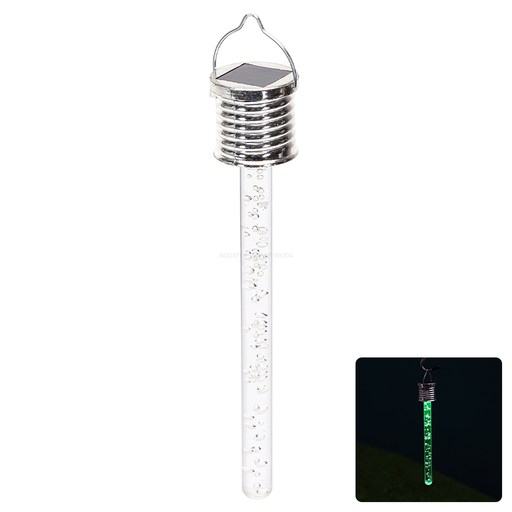
Why this product suits your needs: The compact ground spike is ideal for flower beds, lawns and small patio areas. Its RGB function adds colourful accents without the need to run cables.
The charging time of around 4 to 6 hours and stated run time of 8 to 12 hours help set realistic expectations. With an IP44 rating, this light is intended for sheltered outdoor areas, not places where water can collect.
RGB lighting, a stainless steel look, automatic on/off operation and a stated run time of 8 to 12 hours.
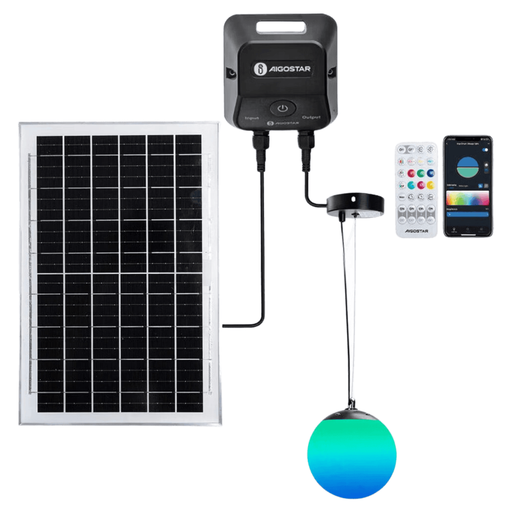
Why this product suits your needs: This solar garden pendant combines a 10 W monocrystalline solar cell with app control, making it suitable for larger patios, garden areas or covered outdoor seating areas.
The IP65 rating protects against dust and water jets, but not immersion. The stated run time of up to 24 hours depends on a full charge and the settings you choose.
350 lumens, a 120-degree beam angle, an 8 Ah LiFePO4 battery and Bluetooth Mesh control for schedules and brightness adjustment.
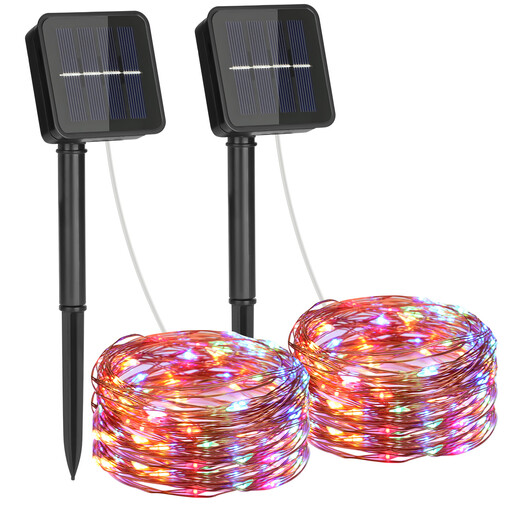
Why this product suits your needs: Two flexible string lights, each 12 metres long, are ideal for pergolas, balconies, railings, hedges and seasonal decorations.
The 8 lighting modes and memory function make it easy to use. IP65 protects against dust and rain, but the solar panel and LED units must not be submerged.
240 LEDs in the set, 8 lighting modes, a memory function and a stated run time of 8 to 14 hours with a suitable charge.
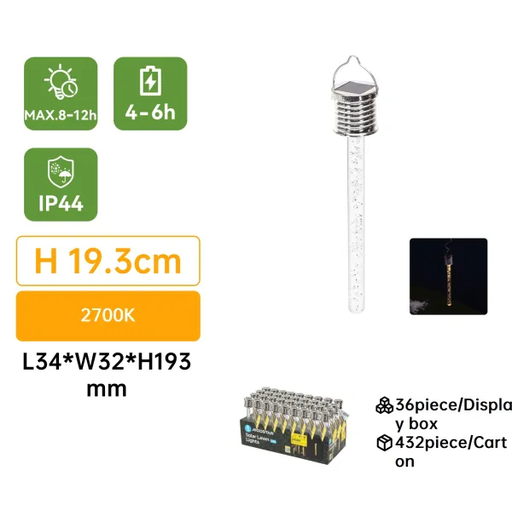
Why this product suits your needs: Its warm-white colour temperature of 2700 Kelvin is ideal for subtle decorative lighting around flower beds, paths and smaller patios.
The specifications list an IP44 rating, a charging time of 4 to 6 hours and 8 to 12 hours of battery operation. This makes it easier to plan where to use it in sheltered areas.
2700 K warm-white light, an integrated 40 mAh Ni-MH battery, compact dimensions and a low weight of 40 grams.
We’ve put together a complete, regularly updated list of products that meet these strict selection criteria and fully comply with the safety regulations in force in the EU.
Choose a spot for the panel that gets as little shade as possible. If you’re using ground spikes, make sure the soil is firm enough to stop the wind twisting the light. Position any cable between the panel and the light to avoid creating a trip hazard.
Dust on the panel reduces the amount of light it can absorb. An occasional clean with a soft, slightly damp cloth is usually enough. Don’t use harsh cleaning products or open the casing or battery yourself. If there’s a frost, strong winds or the light won’t be used for a long time, check the manufacturer’s storage instructions.
Run time depends on sunlight, battery capacity, lighting mode and brightness. Product claims such as 8 to 14 hours or up to 24 hours should be understood as applying when the light has been charged under suitable conditions. In winter or in constantly shaded spots, the run time may be shorter.
IP44 may be sufficient for sheltered areas. For freestanding lights exposed to direct rain, an IP65 solar light offers greater protection against dust and water jets. Even so, it is not designed to be submerged in water.
Not during normal operation. Solar lights charge their built-in battery from the panel during the day, so running costs don’t depend on a mains connection. Instead, charging conditions, battery performance and the expected lifespan of the components are what matter.