
Lieferung heute & morgen

Qualitätsgarantie

Willkommens-Angebote freischalten: KOSTENLOSE Lieferung | Bis zu 80 % RABATT | Kostenlose 30-Tage-JoyPlus-Testphase
App herunterladen
Solar garden lights don’t need a mains connection and can be installed in many places without complicated fitting. However, not every solar-powered garden light is right for every location. A small light for a flower bed may not provide enough guidance along a dark path, while a sophisticated Bluetooth system may be unnecessarily complex for a single patio.
So, before you buy, look beyond design and price. Key factors include light output, IP rating, battery capacity, charging conditions and the intended installation location.
Many solar garden lights switch on automatically when it gets dark. However, how long they stay lit depends on sunlight, the time of year, shade and the condition of the battery. Claims such as “up to 8–12 hours” should therefore be treated as a guide based on suitable charging conditions.
In winter, or after several cloudy days, the lights may stay on for considerably less time. Avoid placing solar path lights under dense foliage or on the north side of a building.
IP44 means protection against solid objects larger than 1 millimetre and against splashing water. This rating is suitable for many decorative outdoor areas, but it doesn’t protect a light from being submerged or left standing in water.
IP65 means protection against dust and water jets. According to product information, even an IP65 solar light must not be submerged. This rating may be a better choice for exposed areas, paths and patios, provided the other technical specifications are also suitable for the location.
RGB solar lights add colourful accents to lawns, flower beds or patios. For clearly lighting steps, driveways or uneven paths, brightness, beam angle and positioning matter more than colour-changing features.
Also check whether a light is designed to provide decorative illumination only or is specifically intended to light a larger area.
The lumen (lm) rating describes the light output. A 350 lm solar light is in a different category from a small decorative LED with a much lower light output. The beam angle indicates how widely the light is spread. An angle of 120° can cover a larger area, while a narrower beam is better for highlighting a particular spot or a short section of path.
For solar ground lights and solar stake lights, the distance between each light also matters. If they’re spaced too far apart, dark patches can appear. For path lighting, evenly spaced lights are usually more practical than a few particularly bright points.
Check which type of battery is fitted and whether its capacity is specified. Lithium iron phosphate (LiFePO4) and NiMH batteries differ in their construction and technical characteristics. For everyday use, the runtime, charging time and permitted temperature range stated by the supplier are the key details.
Ideally, the solar panel should receive direct, unobstructed sunlight. Clean its surface regularly with a soft, damp cloth. If the solar light has a separate panel, make sure the connecting cable is routed safely so it doesn’t become a trip hazard.

Why this product suits this profile: This compact solar path light has two LEDs and a ground stake. It’s a good choice if you’re looking for simple, cable-free lighting for paths or flower beds.
Its simple design avoids unnecessary extra features. The light is designed to be placed directly in the ground and switches on automatically when it gets dark.
Two LEDs, an integrated solar panel, one battery and a ground stake; the product description gives the weight as 402 g.
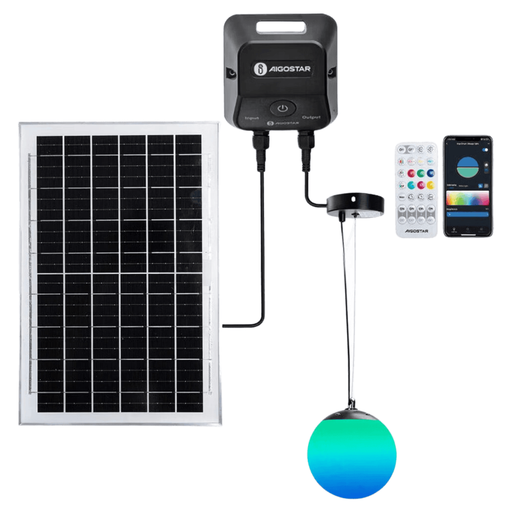
Why this product suits this profile: This light is for anyone who wants to coordinate several outdoor lights and manage brightness, schedules and switching on and off via Bluetooth Mesh.
The IP65 rating and stated temperature range of -10 °C to 50 °C provide clear guidance for outdoor use. However, the panel must not be submerged.
350 lm, a 120° beam angle, a 10 W monocrystalline solar panel, an 8 Ah LiFePO4 battery and Bluetooth Mesh connectivity for more than 200 devices, according to the product description.
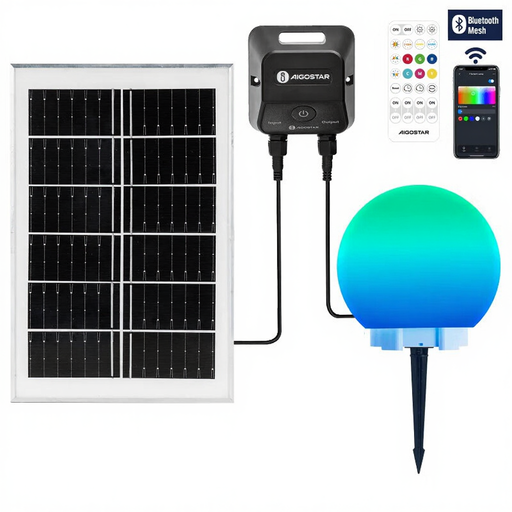
Why this product suits this profile: This smart solar light is designed for larger garden areas, group installations or anyone who wants to switch between warm, cool and coloured light.
App control adds schedules and grouping to automatic solar charging. Check the stated IP54/IP44 rating carefully to make sure it’s suitable for the installation location.
RGB+CCT with 2700–6500 K, Bluetooth Mesh, app control and the option to adjust brightness and schedules, according to the product description.
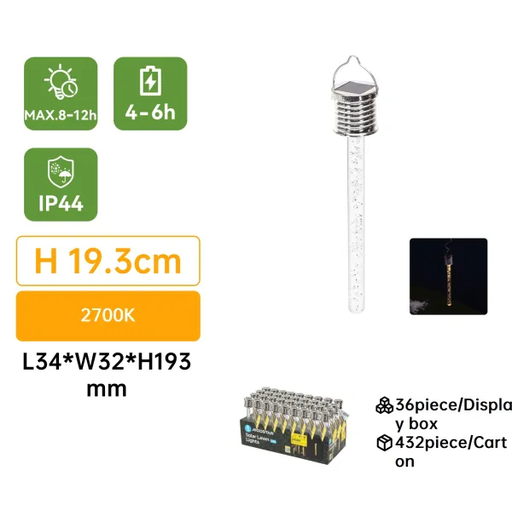
Why this product suits this profile: With a colour temperature of 2700 K, this compact light is ideal for flower beds, lawns and patios when you want a decorative solar garden light with a warm white glow.
The product information gives specific charging time, runtime and IP rating figures: around 4–6 hours to charge, 8–12 hours of operation in suitable conditions and IP44.
2700 K warm white light, a 40 mAh NiMH battery, ground stake design and stated dimensions of 34 × 32 × 193 mm.
We’ve put together a complete, regularly updated list of products that meet these strict selection criteria and the safety regulations in force in the EU.
Their lifespan depends on the LED, battery, materials, charging conditions and weather. Some product descriptions, for example, state an LED lifespan of up to 15,000 hours. This doesn’t necessarily mean the battery will last just as long. Clean the solar panel regularly and replace any damaged lights.
IP44 may be sufficient for flower beds, lawns and sheltered patio areas. For more exposed locations, areas with frequent rain or dustier environments, an IP65 solar light may be a better choice. Neither rating is suitable for submersion. Also check the installation instructions and position the light so that water can’t collect around it.
While they’re on, solar-powered garden lights draw their energy from the battery charged during the day. A mains connection is usually not needed. However, the actual amount of time they stay lit is affected by sunlight, battery capacity and temperature. Smart solar lights may require a few extra setup steps for the app, Bluetooth Mesh and schedules.