
Lieferung heute & morgen

Qualitätsgarantie

Willkommens-Angebote freischalten: KOSTENLOSE Lieferung | Bis zu 80 % RABATT | Kostenlose 30-Tage-JoyPlus-Testphase
App herunterladen
Solar garden lights promise cable-free installation and automatic illumination. In practice, however, how well they work depends heavily on their location, ingress protection rating and battery capacity. If you focus only on design or a high wattage, you could end up with a light that barely charges in the shade, isn’t adequately protected from rain or doesn’t provide enough light for its intended purpose.
For decorative lights in flowerbeds or along paths, subtle lighting is usually enough to help you find your way. Driveways, façades and security areas, on the other hand, need outdoor solar spotlights with a higher light output. So check the lumens, beam angle and mounting height. Wattage alone doesn’t tell you how bright a product will actually be.
An outdoor light should come with more than just a marketing claim that it’s waterproof. The IP rating consists of two digits: the first indicates, among other things, protection against dust, while the second indicates protection against water. IP44, for example, protects against splashing water, but isn’t suitable for submersion. IP65, IP66 or IP67 offer greater protection, depending on the product, but you still need to install the light according to the instructions.
Manufacturers’ runtime claims generally assume plenty of sunlight and a fully charged battery. Trees, exterior walls, short winter days and dirty solar panels all reduce the available energy. A solar light in a permanently shaded front garden may therefore be less reliable than the same model on an open south- or west-facing side of your property.
Warm white, between around 2700 and 3000 Kelvin, creates a subtle atmosphere around paths and seating areas. Neutral or cool white can make it easier to see around driveways, garages and work areas. RGB solar lights are best suited to decorative accents and won’t necessarily provide even ambient lighting.
Check whether the solar panel is integrated or can be positioned separately. A separate panel can be useful if you want to install the spotlight on a shady wall and position the panel somewhere sunnier. Treat charging and runtime figures as guidelines rather than guarantees. Keep the panel clear of leaves and dust, and out of places that are permanently shaded.
Solar lights with ground stakes can be positioned flexibly in soft ground. For hard surfaces or permanent installation on a façade, you’ll need wall brackets and suitable fixings. Not all LED outdoor lighting runs on solar power: mains-powered LED garden spotlights need a safe, weatherproof connection. Fixed 230-volt lights should be installed by a qualified electrician.
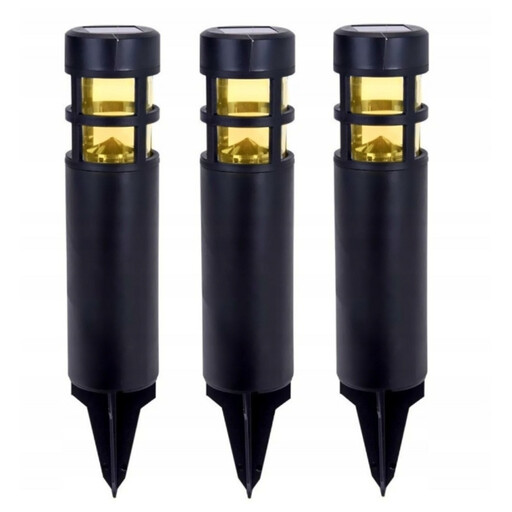
Why this product suits you: According to the product details, this set contains three solar lights for paths, flowerbeds and lawn edges. They switch on automatically at dusk, making it easy to add basic lighting without cables.
The set makes it easier to space the lights evenly. They still need a spot that gets direct sunlight, and you should check the protection rating and lighting time before buying.
Three lights in one set; automatic activation at dusk; designed for cable-free outdoor placement.
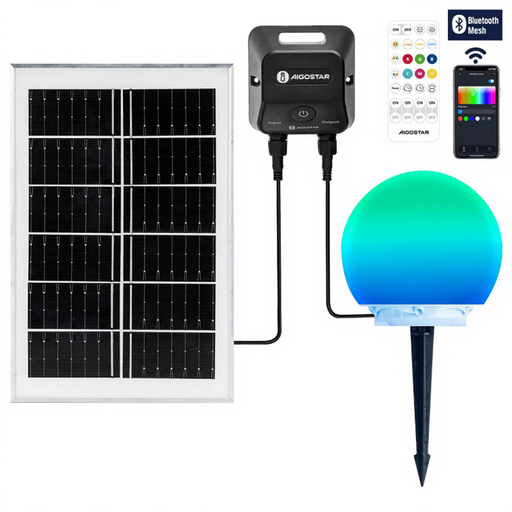
Why this product suits you: According to the product description, this model combines solar power, Bluetooth Mesh and RGBCCT lighting from 2700 to 6500 Kelvin. It’s designed for users who want to group several lights in an app and adjust the colour temperature or colours.
The separate panel can be positioned to catch the sun more easily. However, the stated IP67 rating shouldn’t be taken as approval for every installation situation.
Bluetooth Mesh control; RGB+CCT with adjustable colour temperature; 4000-mAh lithium battery and separate 5-W solar panel, according to the product description.
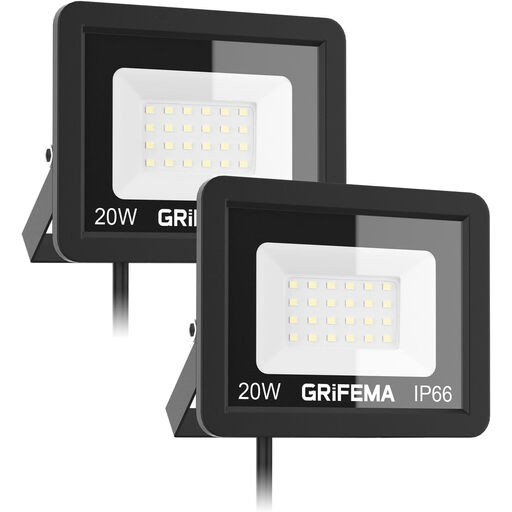
Why this product suits you: This mains-powered twin pack is designed for gardens, garages, courtyards and work areas where higher light output matters more than cable-free installation.
The clear specification of 2200 lumens for two lights and an IP66 rating makes it easier to assess. You’ll still need a weatherproof power connection and secure fixings.
Two LED spotlights; 2200 lumens combined, according to the product details; adjustable 180-degree bracket; IP66 rating.
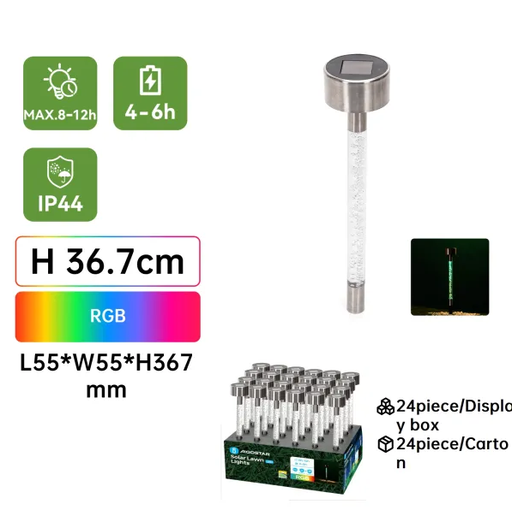
Why this product suits you: Its decorative bubble shape and RGB lighting are ideal for flowerbeds, lawns and paths if you want colour-changing effects as part of your garden design.
The product details specify IP44, a charging time of around 4 to 6 hours and a runtime of 8 to 12 hours in suitable conditions. This gives you a more realistic idea of its decorative use.
RGB lighting; ground-stake installation; 36.7 cm tall; integrated NiMH battery, according to the product details.
We’ve put together a complete, regularly updated list of products that meet these strict selection criteria and fully comply with the safety regulations in force in the EU.
Lifespan depends on the LED module, battery, weather, charging cycles and maintenance. A stated LED lifespan doesn’t mean the whole product will last just as long. Batteries can lose capacity after repeated charging and may need replacing; check whether they’re replaceable or available as spare parts for your model.
Solar lights don’t need mains electricity while in use. However, you’ll need to factor in the purchase price and, potentially, the cost of replacement batteries. For mains-powered LED garden spotlights, energy use depends on their power rating, daily operating time and your electricity tariff. A motion sensor can reduce how long these lights stay on.
Yes, solar panels can still collect energy from diffuse light. However, they’ll charge less effectively than in direct sunlight. In autumn and winter, or in a shaded spot, the lights may therefore stay on for considerably less time.