
Lieferung heute & morgen

Qualitätsgarantie

Willkommens-Angebote freischalten: KOSTENLOSE Lieferung | Bis zu 80 % RABATT | Kostenlose 30-Tage-JoyPlus-Testphase
App herunterladen
Solar garden lights promise an effortless and budget-friendly way to add atmospheric lighting to your outdoor space. With no wiring required and no extra electricity costs, they transform balconies, patios, and gardens into luminous oases. However, the market is flooded with products whose promises quickly prove to be empty. As your Joybuy Product Recommendation Officer, I'm here to help you identify the common pitfalls and make an informed choice.
Many buyers report the same issues: the lights fail after the first heavy downpour, the runtime is barely long enough for a pleasant evening, or the material becomes brittle after just one summer. These disappointments can be avoided if you know which technical details truly matter.
Before you make a decision, you should be aware of the most common flaws often hidden behind attractive product images.
To avoid a bad purchase, focus on three objective criteria. These will help you realistically assess the performance and longevity of a solar garden light.
The IP (Ingress Protection) rating is a two-digit code that defines a device's protection against foreign objects and water.
For reliable solar garden lighting that remains outdoors year-round, a rating of IP65 is a solid benchmark.
A long runtime requires a balance between the battery and the panel. A battery with 1200 mAh capacity provides a good foundation, but it also needs a sufficiently large solar panel to be fully charged on an average sunny day. Modern polycrystalline or monocrystalline solar panels offer higher efficiency here. An integrated dusk-to-dawn sensor is also standard, ensuring the lights turn on automatically at nightfall and off at dawn to save energy.
The light colour significantly influences the atmosphere. Warm white (approx. 2700–3300 Kelvin) creates a cosy and inviting ambience, ideal for seating areas and balcony lighting. Cool white light appears more modern and is well-suited for illuminating pathways. Colourful LEDs, often found in an outdoor solar string light, are perfect for parties and festive garden decor. Many models also offer various lighting modes such as flashing, dimming, or smooth transitions.
Here are some product suggestions tailored to specific needs and use cases.

Why This Fits Their Persona: Ideal for users looking for classic yet atmospheric lighting for garden parties, patios, or balconies. The G50 bulb design produces a warm white light reminiscent of traditional incandescent bulbs.
With an IP65 rating, this string light is protected against heavy rain. According to the manufacturer, the 1200mAh battery combined with the polycrystalline panel provides a runtime of up to 12 hours, thus avoiding the problem of short illumination times.
The 10-metre string with 160 LEDs offers extensive coverage. Eight different lighting modes allow for flexible atmosphere adjustments.
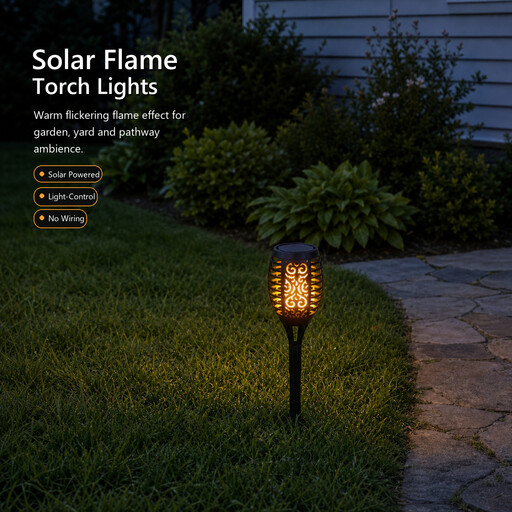
Why This Fits Their Persona: Perfect for garden owners seeking functional yet aesthetic lighting for paths, flowerbeds, or pond edges. The flickering light effect of these outdoor solar torches mimics a real flame, creating a special ambience.
These torches are rated IP65 waterproof, making them suitable for unprotected use in the ground. The automatic dusk-to-dawn sensor ensures reliable operation without manual intervention.
The set includes four torches, allowing for the illumination of a longer path or a larger area. The 51 cm height ensures good visibility above low-growing plants.
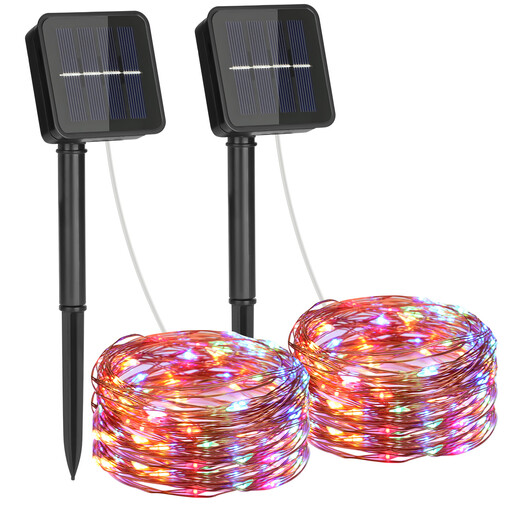
Why This Fits Their Persona: For creative users who want versatile and colourful lighting for holidays, birthdays, or simply to brighten up the garden. The flexible copper wire can be easily wrapped around railings, plants, or other objects.
The IP65 certification ensures durability outdoors. According to the manufacturer, an improved solar panel provides a charging time of 6-8 hours and a runtime of 8-14 hours, promising reliable performance even on less sunny days.
The set includes two string lights, each 12 metres long with 120 LEDs. The memory function saves the last selected lighting mode, simplifying daily use.
We have compiled a complete, real-time list of products that fully satisfy these strict selection criteria and UK safety regulations.
Yes, but with reduced performance. The shorter days and lower intensity of sunlight in winter mean the battery won't fully charge. The runtime per night is therefore significantly shorter than in summer. Look for models with efficient solar panels and position them to receive as much direct sunlight as possible.
The lifespan depends on the quality of the components. The LEDs themselves usually last for many years (often over 20,000 hours). The limiting factor is typically the battery, which loses capacity after 1 to 3 years depending on its type and usage. On many higher-quality models, the battery (often a standard AA or AAA size) can be easily replaced. The quality of the plastic housing and the solar panel also plays a major role in longevity.
Installation is incredibly simple. The most important point is the placement of the solar panel: it must be positioned in a location where it receives at least 6-8 hours of direct, unobstructed sunlight during the day. Avoid spots in the shade of trees, walls, or roof overhangs. Before first use, the light should typically be left to charge in the sun for a full day while switched on.