
Lieferung heute & morgen

Qualitätsgarantie

Willkommens-Angebote freischalten: KOSTENLOSE Lieferung | Bis zu 80 % RABATT | Kostenlose 30-Tage-JoyPlus-Testphase
App herunterladen
Solar garden lights are a practical solution for paths, flower beds, lawns, balconies and patios. They generally don’t require any fixed wiring, and with the right models, they turn on automatically when it gets dark. However, not every decorative light will give you a satisfying outdoor lighting setup.
Typical buying mistakes come down to three recurring pitfalls:
If you check these points before buying, you can choose solar lights for your garden more precisely, based on where you’ll place them and the lighting effect you want.
The IP rating describes how well a product is protected against solid objects and water. Many solar ground lights and garden spike lights come with IP44. This rating is suitable for splashing water, but it shouldn’t be mistaken for full waterproofing.
For a covered balcony or a sheltered patio, IP44 can be sufficient. If the light is placed on an open lawn, it should be positioned so that water cannot collect around the housing, battery or connection points. Models with a higher rating, such as IP65, are often more practical for more demanding outdoor areas. The manufacturer’s specific information remains the key reference.
During the day, the solar cell converts light into electrical energy. The stored energy powers the LED after nightfall. So, check the following:
A solar path light should ideally receive several hours of direct daylight. Purely decorative lights with low power consumption are better suited for accent lighting than for bright security illumination.
LED garden lights can shine warm white, neutral white, cool white or multi-coloured. Warm white light around 2700 to 3000 Kelvin feels subtle and often suits seating areas. Cool white light around 6500 Kelvin appears much more clinical and can be more suitable for paths or functional areas.
With RGB solar lights, you should also check whether colours change automatically, can be selected manually, or if there is an app control. Dimmable garden lights allow you to adapt to different situations. A smart outdoor lighting system with Bluetooth Mesh or an app is particularly interesting if you want to control several lights together. However, this may require setup, smartphone compatibility and possibly a hub.
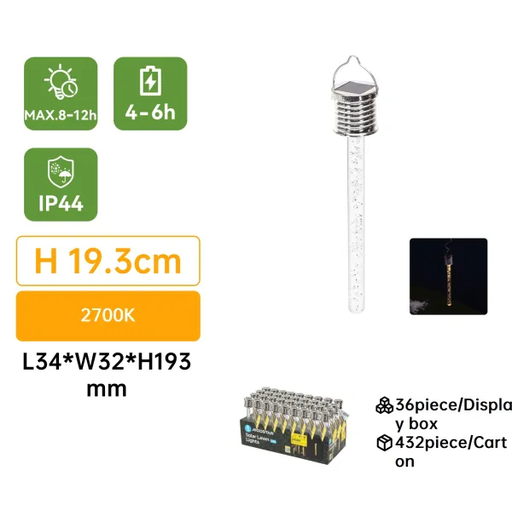
Why this product suits the profile: This compact solar light is ideal for small flower beds, balconies and sheltered patio areas when you want warm white decorative lighting without a fixed power cable.
The specifications state a charging time of around 4–6 hours, an operating time of 8–12 hours and an IP44 rating. This makes it easier to match the location and your expectations.
2700 Kelvin warm white light, integrated Ni-MH battery and a lightweight design at 40 g. The light is 193 mm tall.
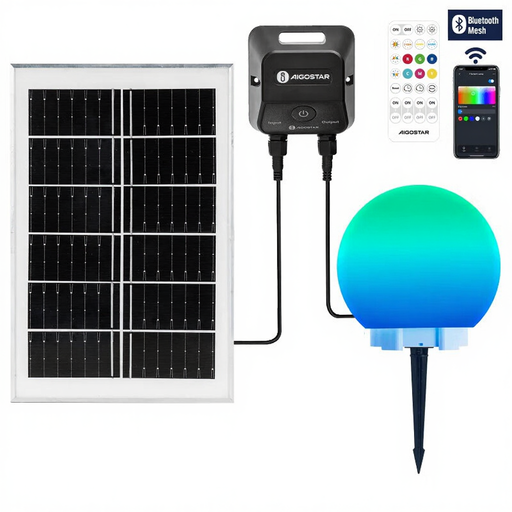
Why this product suits the profile: For larger outdoor areas with multiple light points, this light offers RGB and CCT settings, plus control via the AigoSmart app.
The description explicitly states IP54 or IP44 and warns against submerging the light. Additionally, the solar panel must be positioned in a sufficiently bright location.
RGB+CCT from 2700 to 6500 Kelvin, Bluetooth Mesh function and groupable control via app or optional voice control through a hub.
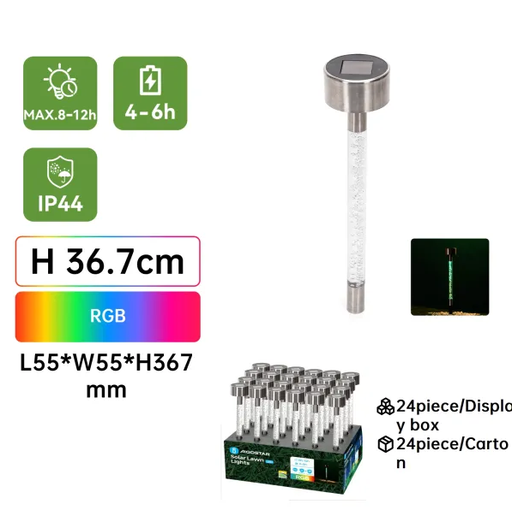
Why this product suits the profile: This 36.7 cm tall garden spike light is designed for colourful accents in flower beds, along pathways or on lawns.
The product data states IP44, a charging time of 4–6 hours and an operating time of 8–12 hours. This makes it clear that the light is intended for accent lighting, not for bright pathway illumination.
RGB light, automatic on/off switching and an integrated Ni-MH battery with 200 mAh. The light weighs approximately 79.6 g according to the specifications.
Place solar ground lights and solar path lights into loose soil or turf without forcing the housing into hard ground. The panel should face upwards and, if possible, not be obscured by plants or buildings. Before first use, a full charge according to the manufacturer’s instructions is recommended.
Clean the solar cell regularly with a soft, slightly damp cloth. Do not use abrasive cleaning products. In frost, exceptionally heavy rain or during extended periods of non-use, dry storage may be advisable, provided the manufacturer allows it. Batteries and electronic components should be disposed of in the designated collection systems after replacement or at the end of their service life.
We have put together a complete, regularly updated list of products that fully meet these strict selection criteria and the safety regulations in force in the EU.
The run time depends on the size of the solar cell, the battery, the charge level, the light mode and the weather. Manufacturer claims of 8 to 12 hours generally refer to suitable charging conditions. In winter or during prolonged cloud cover, the lighting duration may be shorter.
An ideal location receives several hours of direct brightness each day. Avoid permanent shading from trees, walls or overhangs. For pathways, position the lights so they don’t become a trip hazard and don’t cause glare.
Solar garden lights charge their battery using daylight and don’t require a mains connection during normal operation. Running costs mainly arise from possible replacement batteries or replacing a light. With battery-operated, non-solar outdoor lights, on the other hand, you need to factor in batteries or charging via USB or a mains adapter.